DeWalt FlexVolt Review: Is Dual-Voltage Still the Smartest Idea in Cordless?
Key takeaways
- One battery that switches between 20V and 60V sounded like marketing. Years later it is still the cleverest thing DeWalt has done.
What's inside
As an Amazon Associate I earn from qualifying purchases. This post may contain affiliate links at no extra cost to you.
When DeWalt launched FlexVolt, the pitch sounded like a gimmick: a battery that changes its own voltage depending on the tool you slide it into. Years on, it has quietly become one of the strongest arguments for buying into the DeWalt platform at all.
We judge a battery platform on things you can weigh at the bench: what the pack costs you in the hand, how long it feeds a hungry tool before it sags, how long the charger ties it up, and how many separate pack families you have to keep alive to run a whole kit. FlexVolt wins the last of those outright and loses the first, which is why the useful verdict is never “buy it” or “skip it” but “buy it with the tool that needs it.” Here is what it does, where it earns its price, and where it is simply heavy.
As an Amazon Associate we earn from qualifying purchases at no extra cost to you. Product prices and availability are accurate as of the date shown and are subject to change.




How it works, briefly
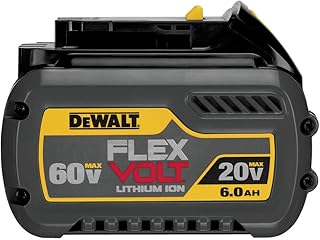
A FlexVolt pack contains fifteen cells arranged so they can be wired as three groups of five (20V) or one long string (60V). A mechanical switch in the tool’s mount decides which. Slide it into a standard 20V MAX drill: it behaves as a large 20V pack. Slide it into a 60V circular saw: it becomes a 60V pack.
The switching is mechanical rather than electronic, and that is a quiet strength. There is no handshake to fail, no adapter to lose, no way for the pack to sit in the wrong mode for the tool holding it. It also means the energy inside never changes — rewiring the cells into one long string only trades current for voltage. That is why the pack carries two amp-hour ratings, the 20V figure being the larger, and why neither number tells you anything the other does not. Same fuel, different plumbing.
The third case: FlexVolt Advantage
Some 20V MAX tools carry a FlexVolt Advantage label. They still run at 20V, but they recognise a FlexVolt pack and draw harder from it than they would from a standard one, because the bigger cell stack can supply that current without sagging. If you own tools with the badge, the pack you clip on changes how the tool behaves.
The practical result is that one battery type serves your whole kit, including the big cutting tools. Nobody else offers this — Makita’s XGT is a separate platform, Milwaukee’s high-output packs stay on M18. The rivals are not being careless, they are making a different bet: that light packs and one simple platform beat one pack that does everything. DeWalt’s bet is that you would rather carry extra weight on a drill than keep two chargers and two shelves of batteries alive.
Where FlexVolt earns its keep, tool by tool
The dividing line is duty cycle and posture, not power. Weight is a cost you pay on every trigger pull; runtime is a benefit you only collect when the cut is long. Tools that sit on a stand make the weight disappear. Tools you hold at arm’s length make you pay it all day.
| Tool type | FlexVolt worth it? | Why |
|---|---|---|
| Table saw | Yes | Genuine cordless capability |
| Miter saw | Yes | Removes the cord from a mobile tool |
| Circular saw (rear handle) | Yes | Sustained cutting power |
| Recip saw | Yes, for demolition | Long cuts without sag |
| Drill / driver | No | Heavy for no gain |
| Impact driver | No | Standard packs are better balanced |
Read that as a pattern rather than a list. Everything in the yes column pulls hard for sustained stretches and carries its own weight on a base or a stand. Everything in the no column works in bursts and lives in one hand, often above your shoulders, where a heavy pack changes your wrist angle long before it changes your runtime.
What we like
- ✔ One battery family across the whole kit, including big tools
- ✔ Cordless miter and table saws that genuinely work all day
- ✔ Backward compatible — runs every 20V MAX tool you own
- ✔ High capacity in 20V mode, useful for long drilling sessions
What we do not
- ✘ Heavy — noticeably so on a drill or overhead work
- ✘ Expensive per pack
- ✘ Charge times are longer than standard packs
- ✘ Easy to over-buy: many users never own a 60V tool
How to weigh the trade-offs
Weight against posture
Sort your tools by how you hold them. Anything used overhead, one-handed or at full extension stays on standard packs regardless of the runtime on offer, because fatigue ruins more cuts than a battery change ever will. Anything that rests on a surface while it works can take the heaviest pack you can afford — the tool carries the load, not your forearm.
Runtime against charger throughput
Big packs and basic chargers are a bad pairing. A high-capacity pack holds a lot of energy and putting it back takes proportionally longer, so one pack plus the slowest charger in the range means a saw that works for a while and then stops for longer than you expect. If the budget is tight, a second pack beats a bigger pack.
What separates a good buy from a bad one, band by band
At the cheapest end you buy bare tools and lean on packs you already own. That is the best value in the system, and it only works one way: if you already have FlexVolt packs, a bare 60V tool is close to free power. If you do not, it is a paperweight.
In the middle band you buy a kit, and the part to inspect is not the tool but what surrounds it. Count the packs, check the pack capacity instead of accepting whatever is in the box, and check whether the charger is a fast or multi-port unit. A good saw shipped with one modest pack and a slow charger is how good saws earn bad reputations.
At the top the battery stops deciding anything. Two or more packs and a fast charger take runtime off the table, and the money should go into the mechanics that set cut quality: base flatness and stiffness, fence and detent accuracy, guard action, blade-to-base squareness, dust collection you will actually connect. A 60V saw with a flexy shoe is still a bad saw.
The three purchases that make sense
Nearly every sensible FlexVolt decision comes down to one of these.
DeWalt FlexVolt batteries
Only worth buying alongside a 60V tool. As a general-purpose 20V pack it is heavier and pricier than you need.
DeWalt FlexVolt circular saws
This is the tool that justifies the system. Rear-handle cordless saws that cut like corded ones.
DeWalt FlexVolt miter saws
Cordless trim work in houses without power is genuinely transformative for finish carpenters.
Common mistakes
- Buying a FlexVolt pack purely for runtime on a drill or impact driver, then paying the weight penalty on every trigger pull for a benefit you rarely reach.
- Buying a single pack alongside a table saw or miter saw, so the charger sets your working pace instead of the tool.
- Buying into the platform before owning a 60V tool, on the assumption you will want one later.
- Assuming compatibility runs both ways. A bare-tool bargain is not a bargain if you have no FlexVolt pack to feed it.
- Judging a saw by its voltage rather than its shoe, fence and guard.
Who should buy in
If you own or want a cordless table saw, miter saw or rear-handle circular saw, FlexVolt is the reason to be on DeWalt. If your heaviest tool is a hammer drill, buy standard 20V MAX 5Ah packs and put the difference toward tools.
Finish carpenters, remodellers and anyone working in buildings without power see the clearest return, because the platform removes the cord and the generator from the part of the job that always needed them. A hobby woodworker in a wired shop sees the least: a corded miter saw on a fixed bench does the same work for less money and no charging logistics. Between those two, count the tools you own that pull hard for minutes at a time. If the answer is none, skip it.
Verdict
FlexVolt is not a gimmick and it is not for everyone. It solves a real problem — powering large tools without maintaining a second battery platform — and it solves it better than any rival approach. Its failure mode is predictable and self-inflicted: buying the batteries first and hoping the tools will justify them later. Buy it with the tool that needs it, not before.
FAQ
Do FlexVolt batteries work in old 20V tools? Yes, every 20V MAX tool.
Can standard 20V packs run 60V tools? No. That direction does not work.
Is 60V actually 60 volts? Peak. Nominal is 54V, the same marketing convention as 20V MAX being nominally 18V.
Do I need a special charger? No — DeWalt’s standard 20V MAX chargers will take a FlexVolt pack. But a large pack on a basic charger is a long wait, which makes a fast or multi-port charger the first accessory worth buying.
Check FlexVolt prices →