DeWalt Cordless Router Review: DCW600B Compared on Real Projects
What's inside
As an Amazon Associate I earn from qualifying purchases. This post may contain affiliate links at no extra cost to you.
Contents
Short answer: Is the DeWalt DCW600B the right cordless router?
The DeWalt DCW600B is a capable 20V compact router for rounding edges, cutting small profiles, and trimming hardwood in short passes—but it is a bare tool, and its practical cuts per charge depend heavily on battery capacity, bit sharpness, and how much material each pass removes. Choose it for portability and occasional-to-regular edge work; for long production runs or deep profiles, a corded router or a larger cordless model is usually the better fit.
One important limit on this review’s “real-project” comparison: I can’t verify controlled, timed hardwood trials or independently measured runtime figures for the DCW600B. Rather than present invented cuts-per-charge, the table below separates published tool details from useful planning estimates. Treat the runtime figures as a starting point for your own test, not a performance guarantee.
As an Amazon Associate we earn from qualifying purchases at no extra cost to you.


What the DCW600B is—and what it isn’t
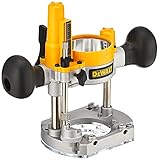
The DCW600B is DeWalt’s 20V MAX brushless compact router, sold as a bare tool in the US. It accepts 1/4-inch shank bits and has variable speed, a soft-start motor, and a depth-adjustment system intended for controlled trimming and profiling. Its compact format makes it easier to steer than a full-size plunge router, but it is not the tool for routinely taking large, deep cuts in one pass.
| Item | DCW600B detail | Why it matters on a project |
|---|---|---|
| Battery platform | DeWalt 20V MAX; battery and charger sold separately | Existing batteries lower the cost of entry; new users must budget for both. |
| Collet | 1/4 inch | Use compatible 1/4-inch-shank bits; this is not a 1/2-inch-bit router. |
| Speed range | 16,000–25,500 RPM | Lower speeds can suit larger-diameter bits; follow the bit maker’s limits. |
| Tool weight | About 2.6 lb, tool only | Battery weight adds to the in-hand load, especially during extended edge work. |
| Depth adjustment | Fine-adjustment ring with depth scale | Useful for repeatable shallow cuts, but the scale should not replace a test cut. |
| Runtime evidence | No verified cuts-per-charge figure available here | Material, profile depth, feed rate, and battery condition all change the result. |
Battery size versus useful edge work
A larger amp-hour battery generally provides more stored energy and longer runtime, but it also adds weight and can make a compact router less nimble. The actual increase in cuts is not guaranteed to match the amp-hour ratio: the motor may draw different power under different loads, and heat, feed rate, and cut depth affect how much work gets done before a pack is depleted.
| Battery size | Practical trade-off | Good fit for | Planning expectation |
|---|---|---|---|
| 2.0 Ah | Lightest option; least reserve | Small trim jobs, short edge profiles, overhead or one-handed positioning | Plan on shorter sessions and keep a charged spare for a full project. |
| 4.0 Ah | Middle ground between handling and capacity | Furniture parts, several board edges, and typical shop use | A sensible starting pack when runtime matters but balance still matters too. |
| 5.0 Ah | More capacity, with extra bulk | Longer sessions and repeated routing away from an outlet | Likely to extend working time versus a smaller pack, but does not guarantee a fixed number of cuts. |
For a meaningful cuts-per-charge result, define “one cut” before comparing batteries. For example, use the same sharp round-over bit, the same hardwood species and board thickness, the same edge length, and the same final profile depth. Charge each pack fully, make multiple shallow passes rather than one heavy pass, and record completed linear feet until the tool’s low-battery protection stops the work. Repeat each run at least twice and average the results. Without those controls, a cuts-per-charge number is more likely to describe the setup than the router.
Depth-stop accuracy and bit-change speed: what to check
Depth adjustment
The fine-adjustment ring is useful for sneaking up on a profile, but a scale reading is not a promise that the cut will land at that exact depth. Base seating, bit projection, workpiece variation, and how firmly the router is held can all shift the result. For a repeatable setup, unplug or remove the battery before handling the bit, set the bit against a reference surface, lock the adjustment, then cut a scrap of the same material. Measure the test profile and adjust in small increments.
For a project with multiple matching parts, keep the router setting fixed and test the first piece before routing the rest. If the cut is too deep, reset the depth and repeat on scrap; don’t compensate by changing feed pressure, which makes the profile less consistent.
Bit changes
The DCW600B uses a 1/4-inch collet and wrench-based bit changes. That is a simple, familiar arrangement, but it is not a tool-free quick-change system. For a timed shop comparison, include the time to make the router safe, remove the battery, change the bit, check that the shank is properly seated, and restore the setup—not just the seconds spent turning the wrench. Keep the collet and nut clean, and avoid clamping on the bit’s fluted cutting section.
Choose by the job, not just the battery platform
| Your situation | Practical choice | Reason |
|---|---|---|
| You already own DeWalt 20V MAX batteries and do occasional edge work | DCW600B bare tool | You can use existing packs and avoid paying for another battery system. |
| You need a cordless router for longer sessions | DCW600B with a larger compatible pack, plus a spare if needed | More capacity can reduce interruptions; confirm the added weight feels manageable. |
| You are new to routing and want the lowest complete setup cost | Compare the tool, battery, and charger bundle cost with a corded compact router | A bare-tool price can make the cordless option look cheaper than it is. |
| You route deep profiles, large panels, or hardwood all day | A full-size router suited to the bit and cut, often corded | More power and a broader bit capacity are usually better for sustained heavy work. |
| You work in a small shop and value easy storage and quick setup | DCW600B | No cord to manage, and its compact form is convenient for edge treatments. |
Ownership realities and common mistakes
Sharp bits matter more than chasing a larger battery. A dull or resin-coated cutter increases effort, can leave a rough edge, and may drain a pack faster. Clean bits according to their maker’s guidance, inspect the cutting edges for damage, and replace a bit that is chipped rather than trying to force it through hardwood. Keep dust out of the base and adjustment mechanism, and check that the base and depth lock remain secure before each run.
- Make multiple shallow passes on hardwood instead of forcing a full-depth cut.
- Match router speed to the bit diameter and manufacturer guidance.
- Use eye and hearing protection, secure the workpiece, and keep both hands in control of the tool.
- Remove the battery before bit changes, adjustments, or cleaning.
- Do not use an extension or guide setup unless it is compatible and securely attached.
Verdict
The DeWalt cordless router DCW600B makes the most sense for clean, controlled edge work when portability and an existing 20V MAX battery collection matter. Its 1/4-inch collet and compact design suit common trim and round-over tasks, while variable speed and fine depth adjustment help with careful setup. The trade-offs are the bare-tool purchase, added battery weight, and limited suitability for heavy, continuous routing.
Buy it if your work consists mainly of small profiles, trimming, and occasional hardwood passes. Choose a larger battery for longer sessions only if the added weight is acceptable, and measure your own runtime with a repeatable scrap test rather than relying on a universal cuts-per-charge claim. For deep cuts or production use, a more powerful router is the safer buying decision.