How to Choose Jointer Width for Cabinet Door Stock
What's inside
As an Amazon Associate I earn from qualifying purchases. This post may contain affiliate links at no extra cost to you.
Choosing a jointer width for cabinet door stock comes down to the widest face you need to flatten—not the overall size of the door. For many frame-and-panel doors, a 6-inch jointer can handle rails and stiles comfortably. Wider parts, glued-up panels, and jobs where you want more support may justify an 8-inch machine. But a wider cutterhead does not make a board flat automatically, and buying more capacity than your stock needs can mean paying for a larger, heavier machine without improving the result.
Contents
Start with the widest face you need to joint
Jointer capacity refers to the maximum width of a board that can pass over the cutterhead in one setup. Measure the actual stock you plan to flatten, including any extra width you leave for later ripping. A 3½-inch stile blank is easy work for a 6-inch jointer; a 7¼-inch panel blank exceeds its capacity.
For frame-and-panel doors, rails and stiles are commonly narrow enough for a 6-inch jointer. The panel is a separate question. If you flatten individual boards before gluing them into a panel, a 6-inch machine may be sufficient even when the finished panel is much wider. If you want to joint the face of the whole glued-up panel, its full width matters—and many panels will be too wide for either a 6- or 8-inch jointer.
Keep a little margin between your stock width and the machine’s rated capacity. A board exactly as wide as the cutterhead leaves no room for a crooked edge or a small steering error. This does not mean every part must be narrower than the jointer, but it is a good reason to avoid choosing a machine that only just covers your widest routine work.
What 6, 8, and wider jointers handle
| Jointer width | Typical fit for door work | Main trade-off |
|---|---|---|
| 6 inches | Rails, stiles, narrow panel pieces, and most small-shop door stock | Less room for wide blanks; limited capacity for flattening assembled panels |
| 8 inches | Wider stile or rail blanks, wider panel boards, and occasional glued-up sections | Higher cost, greater weight, and more space needed |
| 12 inches or wider | Wide stock and production work, if the material fits the machine and setup | Usually unnecessary for ordinary frame-and-panel parts; demanding to move and accommodate |
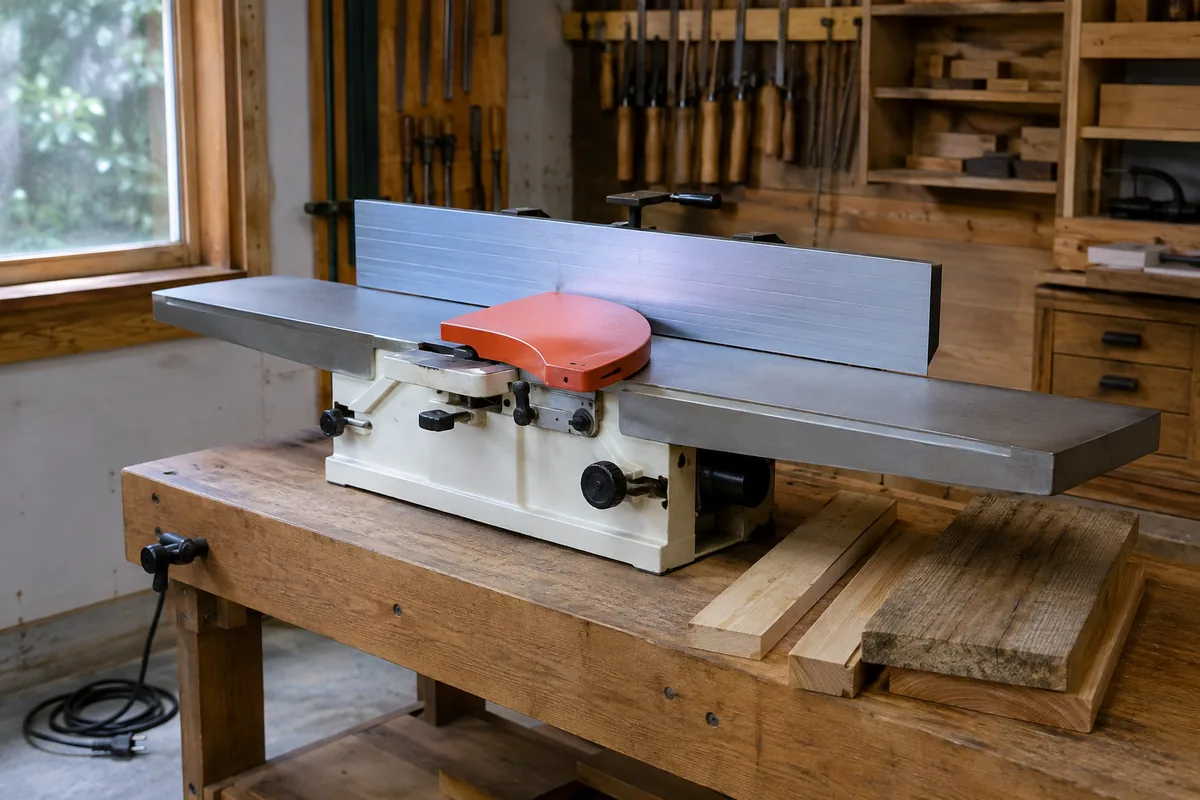
For a small shop making a few cabinet doors at a time, a 6-inch benchtop jointer can be a reasonable budget choice for narrow parts. Check that its tables are long and stable enough for your stock, and plan a safe way to mount and support it. A benchtop machine’s compact size can make long door rails harder to control than on a heavier floor model.
An 8-inch floor-model jointer gives more width and usually more table length and mass. That can help when jointing wider or longer stock repeatedly. It is not automatically the better buy: if nearly all your parts are 3 to 5 inches wide, a sound 6-inch machine may do the work just as well.
Do not confuse door width with jointing width
A 30-inch cabinet door does not require a 30-inch jointer. A frame-and-panel door may have stiles around 2 to 3½ inches wide, rails around 2 to 5 inches wide, and a panel assembled from several narrower boards. Joint the edges of those boards before glue-up, then use a planer to bring the panel faces to consistent thickness. That is often safer and more practical than trying to flatten the complete panel on a jointer.
If a panel is wider than your jointer, do not try to pass it over the cutterhead at an angle or flatten only a narrow strip and assume the rest is coplanar. That can create a twisted face, a step, or a board that rocks on the machine. For wide panel faces, alternatives include a planer with suitable capacity, a router-and-sled flattening setup, or careful hand-planing. Choose based on panel size and how often you do the work.
Width is only one part of the decision
Table length and rigidity matter because cabinet parts can be several feet long. Short tables can let a long rail dip at the ends, producing a hollow or bowed edge. A heavier machine with aligned tables is generally easier to control than a light unit with a wide cutterhead but inadequate support. Before buying, check the infeed and outfeed table lengths, fence height and stiffness, and how the machine adjusts depth of cut.
A jointer is for making one face flat and one adjacent edge square to it. A thickness planer then makes the opposite face parallel to the jointed face. The jointer does not make both faces parallel in one pass. For door stock, that distinction matters: running a cupped board through a planer without first establishing a flat reference face can simply press the cup flat temporarily, then let it spring back.
For most cabinet door stock, take light cuts—often around 1/32 inch or less on a finishing pass—and inspect the result rather than trying to remove a deep defect at once. A dull or chipped knife can leave ridges and tear-out, especially in figured hardwood. Keep hands clear of the cutterhead, use push blocks, and never joint stock that is too short or narrow for the machine’s safe operating guidance.
A practical buying rule
List the widest individual piece you expect to joint, not the finished door size. If your widest routine blank is under 6 inches and work is occasional, a 6-inch jointer is often enough. If you regularly prepare stock between 6 and 8 inches wide, an 8-inch machine reduces the need to rip pieces narrower first. If the main concern is flattening whole door panels, verify the panel dimensions and consider another method rather than assuming a wider jointer solves the problem.
When comparing machines, prioritize stable tables, a dependable fence, usable table length, and parts support alongside width. A carefully set-up 6-inch jointer is better than a poorly aligned 8-inch one. Pay for extra capacity when your stock and workflow will use it; otherwise, the money and floor space are usually better spent on a good planer, sharp knives, or proper outfeed support.