Best Professional Hair Steamers for Salon Use
What's inside
As an Amazon Associate I earn from qualifying purchases. This post may contain affiliate links at no extra cost to you.
The best professional hair steamers for salon use are adjustable hooded units with even full-head coverage, a stable base, a 1.5–2.5 L water tank, and controls that let you reduce heat and steam for client comfort.
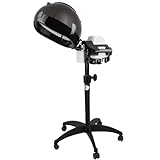
For most salons, a wheeled salon hood steamer is a better choice than a handheld steamer: it keeps both hands free, positions consistently over the client, and supports repeated appointments. A compact tabletop model makes more sense for a small suite, while a wall-mounted or premium integrated unit suits a busy salon with permanent stations.
As an Amazon Associate we earn from qualifying purchases at no extra cost to you.



Contents
Best professional hair steamers by salon situation
| Salon situation | Best steamer type | Target specifications | Why it fits |
|---|---|---|---|
| One stylist or home-based suite | Compact tabletop hood | 1.0–1.5 L tank; 800–1,200 W; under 15 kg | Lower price and smaller footprint, with enough capacity for occasional services |
| Busy independent salon | Rolling floor-standing hood | 1.5–2.5 L tank; 1,000–1,500 W; 60–90 minute timer | Good balance of mobility, refill intervals, and hands-free operation |
| Multiple daily steaming services | Heavy-duty wheeled unit | 2.0–3.0 L tank; metal stand; four or five casters | More stable during repositioning and less interruption between clients |
| Permanent luxury treatment station | Wall-mounted or integrated hood | Adjustable arm; broad hood; plumbed or high-capacity reservoir | Excellent footprint efficiency, but installation and maintenance cost more |
| Mobile stylist or occasional use | Handheld facial-and-hair steamer | 0.3–0.8 L tank; 300–800 W; short operating cycle | Portable, but usually slower and less even for dense or long hair |
What to compare before buying
1. Steam output and control
Steam output matters more than wattage alone. Wattage indicates electrical input; it does not guarantee that steam reaches the hair evenly. Look for a unit with a stated warm-up time, adjustable steam or heat settings, and a timer that can be set independently of the power switch.
A useful professional range is roughly 15–30 minutes of adjustable treatment time, with a lower setting for fine, dry, color-treated, or heat-sensitive hair and a stronger setting for dense hair. The steam should leave the hood comfortably warm rather than producing concentrated hot spots. A dial or multi-step control is preferable to a single on/off switch because clients differ in tolerance and hair density.
Do not choose solely by the largest wattage number. A well-shaped hood with moderate power can distribute steam more comfortably than a powerful unit with a narrow outlet.
2. Hood coverage and adjustability
The hood should cover the crown, sides, nape, and the length of the hair without forcing the client to sit unnaturally. Measure the opening before purchase if the salon serves clients with large rollers, thick protective styles, extensions, or long hair.
Useful adjustment features include:
- A height range of about 95–135 cm from the floor to the hood, depending on whether the client is seated in a styling chair or under a lower workstation.
- A tilting or pivoting hood that can be centered over different head shapes and chair positions.
- An opening of approximately 30–40 cm across for comfortable coverage without excessive steam escaping.
- A removable or washable hood liner, if supplied, to simplify cleaning and reduce product buildup.
Hood depth is especially important for long hair. A shallow hood may steam the scalp while leaving the ends outside the main vapor area. Conversely, a very deep hood can feel enclosed and may trap more heat around the face. Choose even coverage over maximum size.
3. Water capacity and refill burden
A larger reservoir reduces interruptions, but it also increases weight and makes stale water more likely if the salon does not use the machine daily. As a practical estimate, a 1.5 L tank may support around four to eight 15-minute services, while a 2.5 L tank may support approximately seven to twelve. Actual use varies with steam intensity, room temperature, and the machine’s design.
For example, if a unit consumes 180 mL per 15-minute service, a 1.5 L tank provides:
1,500 mL ÷ 180 mL = 8.3 theoretical services.
In practice, leave a reserve below the minimum fill line, so plan on about seven services rather than eight. This is a more useful capacity comparison than assuming every advertised liter is available for treatment.
A wide fill opening, visible water level, automatic low-water shutoff, and a drain plug are valuable in daily work. Avoid filling beyond the marked line; expanding water and steam pressure can create leaks or trigger safety cutoffs.
4. Stability, mobility, and electrical safety
A salon steamer is repeatedly rolled around chairs, so stability affects both workflow and client confidence. Prefer a broad five-star base, a low center of gravity, and casters that roll without wobbling. Locking wheels are useful when positioning the hood, but they should not be so stiff that the entire unit jerks when moved.
Metal stands generally tolerate daily repositioning better than thin plastic supports, although a reinforced plastic hood can still be perfectly serviceable. Check the assembled weight: a lightweight unit may be convenient to lift but easier to knock out of position. A professional rolling model commonly weighs about 10–20 kg; heavier units are not automatically better, but a very light stand deserves closer inspection.
Keep the cord away from wet floor areas and use the electrical protection required by local salon regulations. The steamer should sit on a level surface with clearance around vents and controls.
Head-to-head: which format is right?
Rolling hood steamer versus tabletop steamer
The rolling hood wins for a salon that performs several treatments per day. It is easier to position, usually has a larger reservoir, and does not occupy a workstation. Its disadvantages are storage space, assembly, and the need to keep casters clean.
A tabletop hood is economical and easier to store. It can work well for a single stylist, but the table must be strong and stable, and the hood height may not suit every chair. A small reservoir also means more refills during a busy schedule.
Hooded steamer versus handheld steamer
A handheld unit is useful for targeted steaming, travel, or a stylist who needs flexibility around braids and treatments. It generally provides less uniform whole-head coverage and requires the stylist to hold or reposition it. For repeated salon appointments, a hooded unit is usually more consistent and less tiring.
Basic salon model versus premium installed unit
Entry-level rolling models commonly fall in the general market range of about $100–$250, mid-range professional units around $250–$600, and premium installed systems from roughly $600 upward before installation. Prices vary substantially by region and distributor.
Spend more when the salon needs daily durability, a stronger stand, quieter operation, better controls, or serviceable replacement parts. Spend less when usage is occasional and the unit can be stored safely between appointments. A premium unit is not good value if its reservoir is difficult to drain or its replacement parts are unavailable.
Ownership details that listings often omit
Mineral scale is usually the first maintenance problem, particularly where tap water is hard. Scale can restrict the heating element, reduce steam output, and cause inconsistent warm-up. Follow the manufacturer’s descaling instructions; do not assume that concentrated vinegar or commercial chemicals are safe for every reservoir, seal, or heating element.
- Empty unused water at the end of the day unless the manufacturer specifically permits storage.
- Wipe the hood, handle, controls, and chair-facing surfaces between clients using products compatible with the materials.
- Inspect the cord, plug, casters, and height-locking mechanism weekly.
- Never operate below the minimum water line or leave the unit unattended while heating.
- Do not add oils, conditioner, color, or treatment products to the water tank.
- Keep the hood slightly above the client’s head rather than pressing it against hair or the scalp.
The components most likely to wear are seals, caster wheels, height-adjustment knobs, switches, and heating elements affected by scale. Before buying, confirm whether these parts can be ordered separately and whether the distributor provides a warranty or repair route.
A practical setup routine for client comfort
- Fill with the recommended water type to the marked level and check that the unit is on a level surface.
- Preheat before bringing the client under the hood when the model allows it. This shortens the first appointment’s waiting time.
- Center the hood over the head, leaving comfortable clearance around the face and ears.
- Start on the lower steam or heat setting, then adjust after the client confirms that the temperature feels comfortable.
- Set the timer and check the client after several minutes rather than relying only on the control panel.
- After the service, switch off, allow the unit to cool, drain it when required, and wipe visible condensation.
Clients who feel overheated, dizzy, uncomfortable, or unusually sensitive to heat should be removed from the steamer and assessed appropriately. Hair steaming is a cosmetic salon service, not a treatment for a medical condition; clients with relevant health concerns should ask a qualified healthcare professional before using heated steam.
Final buying recommendation
For the widest range of salon workflows, choose a rolling professional hood steamer with adjustable heat and steam, full-head coverage, a 1.5–2.5 L removable tank, a 60–90 minute timer, low-water protection, and a broad locking base. Choose a compact tabletop model only when space and appointment volume are limited. The best professional hair steamers are the ones that deliver even coverage while allowing the stylist to control temperature, refill frequency, and positioning without interrupting the service.