Best Jointers with Parallelogram Tables for Fast Adjustments
What's inside
As an Amazon Associate I earn from qualifying purchases. This post may contain affiliate links at no extra cost to you.
Contents
What a parallelogram table changes
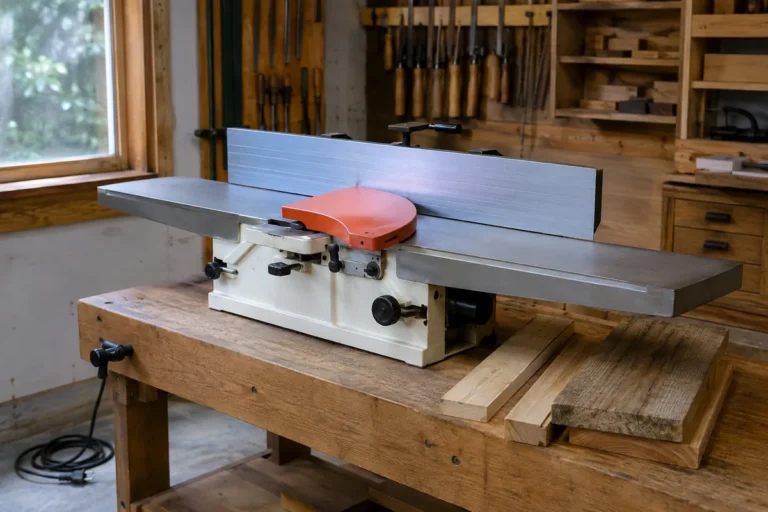
A jointer’s outfeed table should stay level with the knives as you adjust cutting depth. On a parallelogram jointer, the tables move through linked arms that keep them parallel to the cutterhead. That lets you raise or lower a table without the same fore-and-aft shift found in many conventional dovetail-bed designs. The practical payoff is quicker setup and less fuss when changing depth or correcting table alignment.
It does not make a jointer self-setting. You still need to check the outfeed table against the knife edges, set the fence square, and confirm that the infeed table’s depth scale is accurate. A poorly adjusted parallelogram machine can still produce tapered boards, snipe, or an unsafe cut. The mechanism makes adjustment easier; it does not replace it.
As an Amazon Associate we earn from qualifying purchases at no extra cost to you.

Who benefits most
Parallelogram tables are useful if you change cut depth often, work with stock of varying thickness, or want to bring a table back into alignment without wrestling with several adjustment points. They are also attractive in a shared shop where different users may change settings. For occasional edge-jointing at one shallow setting, a conventional parallelogram-free jointer may do the job just as well for less money.
Do not choose by mechanism alone. A longer bed supports long boards better; a wider cutter capacity handles wider stock; and a reliable fence and dust port matter every time you use the machine. For most home shops, a 6-inch jointer is enough for furniture parts and cabinet stock. A 8-inch machine gives more room for wider boards, but costs more, takes up more floor space, and may need a larger electrical circuit.
Compare by shop need
| Option | Best fit | Main trade-off |
|---|---|---|
| 6-inch parallelogram jointer | Small or mid-size shop; frequent setup changes | Limited to boards that fit the cutter width |
| 8-inch parallelogram jointer | Wider furniture parts and more capacity | Higher purchase price and greater space and power needs |
| Conventional 6-inch jointer | Budget-conscious user with stable settings | Table adjustments may take more care to keep aligned |
| Long-bed jointer | Long boards that need stable support | Footprint and cost can be substantial |
These are categories, not guarantees: table length, motor, cutterhead, fence, and adjustment hardware vary by machine. Compare the actual specifications and service support before buying a 6-inch parallelogram jointer or stepping up to a wider model.
What to check before buying
Table length and support: A short table makes long boards harder to control, even if the cutterhead is wide. Check the total bed length and whether the machine can accept infeed and outfeed extensions. Roller stands help, but they must be set to the table height; a stand that is even slightly high can lift the workpiece and spoil the cut.
Fence: Look for a fence that locks securely and can be set accurately at 90 degrees. Check its usable length and whether it tilts for bevel work. A long fence supports the board, but it needs to remain square along its length. If the fence rocks under hand pressure, adjustment convenience elsewhere will not rescue the result.
Cutterhead and knives: Straight knives are often cheaper to replace, while a helical or segmented carbide head can reduce tear-out on figured wood and allows individual inserts to be rotated or replaced. It is not automatically a better value: replacement inserts cost money, and you should check availability before buying. If you want that feature, compare a wider parallelogram jointer with a helical head against a straight-knife model, including the cost of consumables.
Power and dust collection: Confirm voltage, amperage, and whether the motor is suitable for your shop circuit. A jointer that trips a shared circuit is a poor fit regardless of its table design. Plan for dust collection: chips can pile up under the cutterhead or clog a small port, reducing extraction and making cleanup harder.
Set the tables and avoid common errors
Before first use, unplug the machine and check the outfeed table against the knife cutting circle using a straightedge or a setup gauge. The table should meet the knife edge at its highest point. If it is too low, the board’s trailing end can drop into the cutter and develop a step or snipe. If it is too high, the wood may catch on the outfeed edge.
Set a modest infeed depth first. Around 1/32 inch is a sensible starting point for ordinary stock; 1/16 inch removes material faster but can increase tear-out and make a warped board harder to control. Take several light passes rather than forcing a deep cut. Keep pressure over the infeed table before the cut and shift it to the outfeed table as the board advances. Never joint stock shorter than the machine’s specified minimum or narrower than you can control safely.
Use a straightedge to check that table faces are coplanar, and verify the fence with a reliable square. If a board comes out tapered, check table alignment and your feeding pressure before blaming the parallelogram mechanism. If one end is thinner, uneven support or a low outfeed table is more likely than a need to make a large adjustment.
When to pay more—and when not to
Pay extra for parallelogram adjustment if you expect to change settings often or value repeatable table movement. A longer bed or wider capacity may be a better use of the budget if you routinely handle long or wide stock. If your work is mostly short boards, your settings rarely change, and you are willing to check alignment carefully, a conventional jointer is a reasonable buy. The best machine is the one that fits your stock, shop power, floor space, and maintenance habits—not simply the one with the most elaborate adjustment system.