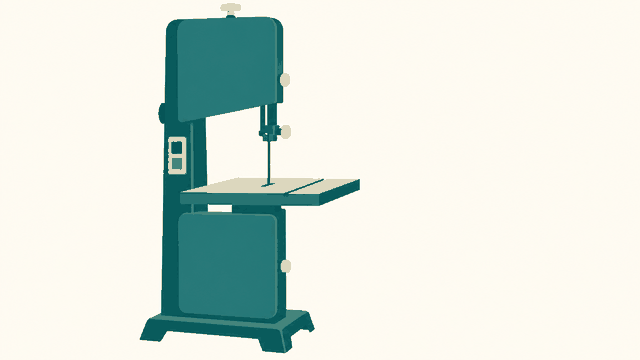
Floor-Standing Band Saw vs Benchtop Band Saw for Furniture Shops
What's inside
As an Amazon Associate I earn from qualifying purchases. This post may contain affiliate links at no extra cost to you.
For a furniture shop, the choice between a floor-standing band saw and a benchtop band saw comes down to capacity, stability, and how often the machine will be used. A benchtop saw can handle many small-shop jobs for less money and less floor space. A floor-standing saw becomes worthwhile when you regularly resaw boards, cut thick stock, or need a machine that stays steady through long work sessions.
As an Amazon Associate we earn from qualifying purchases at no extra cost to you.


Contents
The Main Difference: Capacity and Stability
A floor-standing band saw typically offers 12 to 18 inches of resaw height and a larger throat capacity. Many benchtop machines provide roughly 6 to 10 inches of resaw height. That difference matters when cutting book-matched panels, thin slabs, wide legs, or thick components from rough lumber.
Wheel diameter is another useful indicator. Benchtop saws commonly use wheels in the 9- to 14-inch range. Floor-standing machines often use 14- to 18-inch wheels. Larger wheels generally produce a smoother blade path and can accept wider, longer blades. They also give you a larger table and a more substantial frame, which reduces vibration.
Neither category automatically cuts better. A well-tuned benchtop saw with a sharp blade can outperform a poorly aligned floor-standing saw. However, the larger machine gives you more adjustment range and is less likely to flex when the workpiece is pushed against the blade.
Capacity for Furniture Work
| Factor | Benchtop band saw | Floor-standing band saw |
|---|---|---|
| Typical resaw height | 6 to 10 inches | 12 to 18 inches |
| Typical throat capacity | 9 to 12 inches | 12 to 18 inches |
| Footprint | Small; sits on a bench or stand | Large; occupies dedicated floor space |
| Typical motor range | About 1/2 to 1 horsepower | About 1 to 3 horsepower |
| Best suited to | Small parts, curves, and occasional resawing | Wide resawing, thick stock, and repeated production cuts |
| Common limitation | Blade drift, vibration, and limited height | Cost, space, and heavier setup |
For furniture parts, measure the largest cut you actually make rather than buying for an imagined project. If your typical stock is 4/4 or 6/4 hardwood and you mainly cut cabriole legs, brackets, templates, and curved rails, a benchtop model may be enough. If you routinely split 8-inch boards into veneers or resaw panels 10 inches wide, its height limit will become frustrating quickly.
When a Benchtop Band Saw Is Enough
A benchtop band saw is the sensible choice for a small furniture shop that has limited floor space or uses the machine intermittently. It is usually cheaper to buy, easier to move, and simpler to fit into a garage shop already crowded with a table saw, planer, and jointer.
It works well for cutting curves, roughing out chair parts, trimming small glued panels, cutting tenons, and making templates. With a narrow blade, it can follow tighter curves than a large saw equipped with a wide resaw blade. A 1/4-inch blade is useful for moderate curves, while a 1/8-inch blade handles tighter radii if the saw can tension it correctly.
The cheaper option is fine when your largest stock stays below about 6 inches and you do not need to produce matching veneers every week. Spend part of the savings on a good blade, a sturdy stand, and dust collection. A flimsy bench can make an otherwise capable saw look defective.
For this use, compare benchtop woodworking band saws by actual resaw height, table size, blade guide quality, and replacement-blade availability—not just motor horsepower.
When a Floor-Standing Saw Wins
Choose a floor-standing saw when resawing is a regular operation rather than an occasional experiment. The taller frame provides more blade clearance, while the heavier base and larger table make it easier to control a wide board. This is especially valuable when cutting 8/4 hardwood, where a small motor may slow noticeably or stall if you feed too aggressively.
A larger saw is also better for batch work. If you cut twelve identical legs or resaw a stack of boards for cabinet panels, reduced vibration and easier setup save time on every piece. Many full-size machines also offer better blade tensioning, wider tables, more effective thrust bearings, and stronger fences.
That does not mean every floor-standing saw is ready for production. Some inexpensive machines have weak fences, inaccurate scales, poor dust ports, or guides that are difficult to set. A heavy cabinet can hide mediocre blade tracking. Read the specifications for maximum blade width, table tilt, throat depth, and resaw capacity before assuming the machine is an upgrade.
For a shop that resaws frequently, look at floor-standing woodworking band saws with at least 12 inches of resaw capacity and a rigid fence system.
Blades Matter More Than the Motor
A band saw’s rated horsepower does not compensate for a dull or unsuitable blade. For resawing, use a wide blade—often 3/4 inch or 1 inch on a full-size saw—with a low tooth count and an appropriate hook angle. A three-tooth-per-inch or four-tooth-per-inch blade clears sawdust better than a fine scrolling blade.
Benchtop saws may claim they accept wide blades but lack the wheel width or tensioning strength to use them effectively. This is a common failure mode: the blade wanders, the cut bows in the middle, and the operator responds by forcing the board. That increases heat, dulls the blade, and can pull the workpiece off the table.
Use a narrow blade for curves and install a dedicated resaw blade for straight, wide cuts. Do not expect one blade to do both jobs well. Check the blade tension, tracking, guide clearance, and fence alignment before diagnosing the motor.
Dust Collection and Safety
Band saws produce fine dust, particularly when resawing dry hardwood. A 2-1/2-inch dust port is common on smaller machines; larger saws may use a 4-inch port. Connect the saw to a real dust collector when possible. A shop vacuum can help with a benchtop machine but may struggle to capture dust from a full-size cabinet.
Keep the upper blade guide only slightly above the workpiece—about 1/8 inch when practical. This reduces exposed blade length and improves control. Never reach around the blade to retrieve offcuts. If a cut binds, stop the machine and wait for the blade to stop before backing out the stock.
A Practical Buying Decision
Buy a benchtop saw if you cut mostly curves and small parts, have limited space, and resaw less than about 6 inches. Buy a floor-standing saw if you need more than 8 to 10 inches of resaw height, work with thick hardwood regularly, or want a stable platform for repeated furniture production.
If your budget is tight, a used heavy-duty floor-standing saw can be better value than a new lightweight machine, provided the wheels, tires, guides, bearings, and blade tension mechanism are serviceable. Replacement parts and electrical condition matter. A bargain saw that needs tires, bearings, and a new motor can cost more than a ready-to-use benchtop machine.
Before buying, measure your shop aisle, doorways, dust-collection layout, and available electrical circuit. The best band saw is the one that has enough capacity for your real work and can remain properly tuned, supported, and accessible.