Best Table Saws for Small Shops with Limited Floor Space
What's inside
As an Amazon Associate I earn from qualifying purchases. This post may contain affiliate links at no extra cost to you.
A small shop does not need a full-size cabinet saw, but it does need a saw that fits the work and the room. The key measurements are not just the machine’s footprint: include space for the longest boards you expect to rip, room to stand safely, and clearance for the fence and outfeed. A compact saw can still be awkward if a sheet of plywood has nowhere to go.
As an Amazon Associate we earn from qualifying purchases at no extra cost to you.

Contents
Choose by the work you do
For furniture parts, trim, and occasional solid-wood ripping, a jobsite or compact table saw is often enough. These saws take up less space, can be moved when the shop needs to change, and usually cost less than stationary cabinet-style machines. The trade-off is more noise, a lighter stand, and often less capacity or refinement.
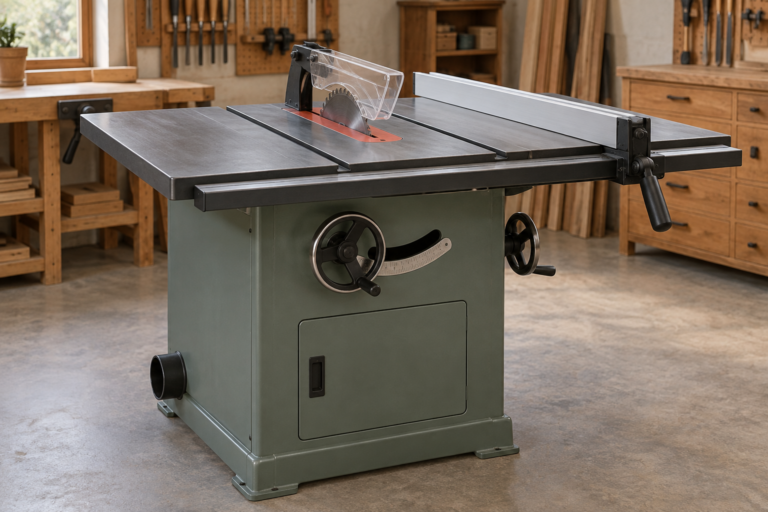
If you routinely rip thick hardwood, work with a dado stack, or want a heavier machine that stays put, consider a contractor-style or compact cabinet saw. A stronger motor and heavier table can make demanding cuts less troublesome, but the saw may need a dedicated circuit and more room for assembly, dust collection, and stock handling. Check the manufacturer’s electrical requirements before buying; a 240-volt model is not a drop-in replacement for a standard 120-volt outlet.
Browse compact table saws if portability and a smaller footprint matter most. For regular hardwood work, compare contractor-style table saws as well.
Compare the common options
| Saw type | Best fit | Main trade-off | Space to plan for |
|---|---|---|---|
| Jobsite | Small shops, occasional work, movable setup | Lighter stand and more vibration | Folded storage plus infeed and outfeed space |
| Compact stationary | Frequent use without a full cabinet saw | Less mass and sometimes limited fence capacity | Fixed footprint, dust hose, and stock clearance |
| Contractor-style | Regular furniture and hardwood work | Heavier, costlier, may require 240 volts | Permanent working zone and electrical access |
Measure the whole working area
Measure the saw’s base, then mark the blade and fence line on the floor. Add room on both sides for the boards you actually cut. A 6-foot board needs support before and after the blade; a 4-by-8-foot sheet needs a safe way to control its full length and width. In a tight shop, a folding outfeed table or a mobile base can help, but neither makes solo sheet handling safe by itself.
Use the saw’s listed rip capacity—the distance from blade to fence—as a practical limit, not a promise that every wide panel will be easy to cut. If you regularly break down plywood, a track saw or circular saw and guide may be a better first cut, followed by the table saw for smaller pieces. This reduces the space and effort needed to control a full sheet.
Features worth paying for
Prioritize a fence that locks parallel to the blade and stays put when pushed, a riving knife, a blade guard, and accessible, repeatable adjustments. A flimsy fence that shifts can ruin a cut and increase binding risk. Before purchase, look for clear instructions on fence alignment and blade changes, and confirm that replacement blades and common accessories are available.
Dust collection matters in a small room because fine dust builds up quickly. A shroud with a 2½-inch or 4-inch port can connect to different shop vacs or collectors, but the port size alone does not tell you how well the saw captures dust. Expect some dust to escape, especially with a jobsite saw. A shop vac with a suitable filter is better than no extraction; a larger collector may improve capture, but it costs floor space.
Check whether the saw accepts a dado set if you need one. Capacity varies, and some compact models do not support dado blades at all. Do not assume a saw’s arbor, throat plate, or manual permits a particular stack width. For ordinary joinery, a regular blade with a jig, router, or multiple passes may be a reasonable alternative.
Avoid common small-shop problems
A common failure is buying by footprint alone, then discovering there is no safe outfeed support. Another is expecting a light saw to cut thick hardwood at the same pace as a heavy cabinet saw. If the motor bogs down, forcing the feed can burn the wood, stall the blade, or pull the stock out of line. Use a sharp blade suited to the cut, feed steadily, and make multiple passes when the saw or material calls for it.
Also plan for the floor and power. An uneven floor can make a mobile saw wobble; level the stand and lock its casters before cutting. Avoid extension cords unless the manual permits them, and use the correct gauge and length. If the breaker trips repeatedly or the motor sounds strained, stop and check the circuit rather than continuing to reset it.
Make the buying decision
For a shop where every square foot matters and work is occasional, a jobsite saw is a sensible, less expensive choice if you can provide solid support and accept some compromises in noise and stability. If the saw will be used several days a week, a heavier compact stationary model may be worth the extra cost and permanent space. Compare compact stationary table saws against your actual work, not just their advertised features.
Before ordering, verify the assembled dimensions, voltage, rip capacity, dado compatibility, and dust-port arrangement in the current manual. Then tape out the footprint and test your longest expected cut path. If the board cannot be supported and controlled without blocking a doorway or crossing another machine’s work zone, choose a different layout or a different way to break down stock.