How to Level a Stationary Jointer on an Uneven Workshop Floor
What's inside
As an Amazon Associate I earn from qualifying purchases. This post may contain affiliate links at no extra cost to you.
Contents
Why level a stationary jointer?
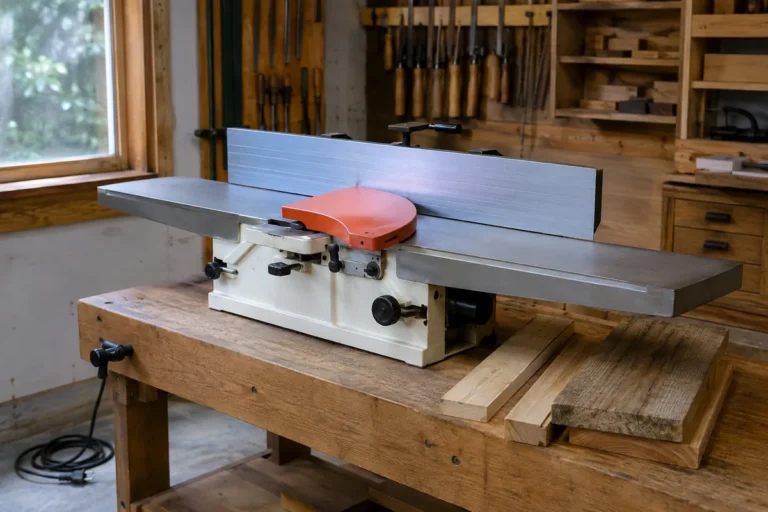
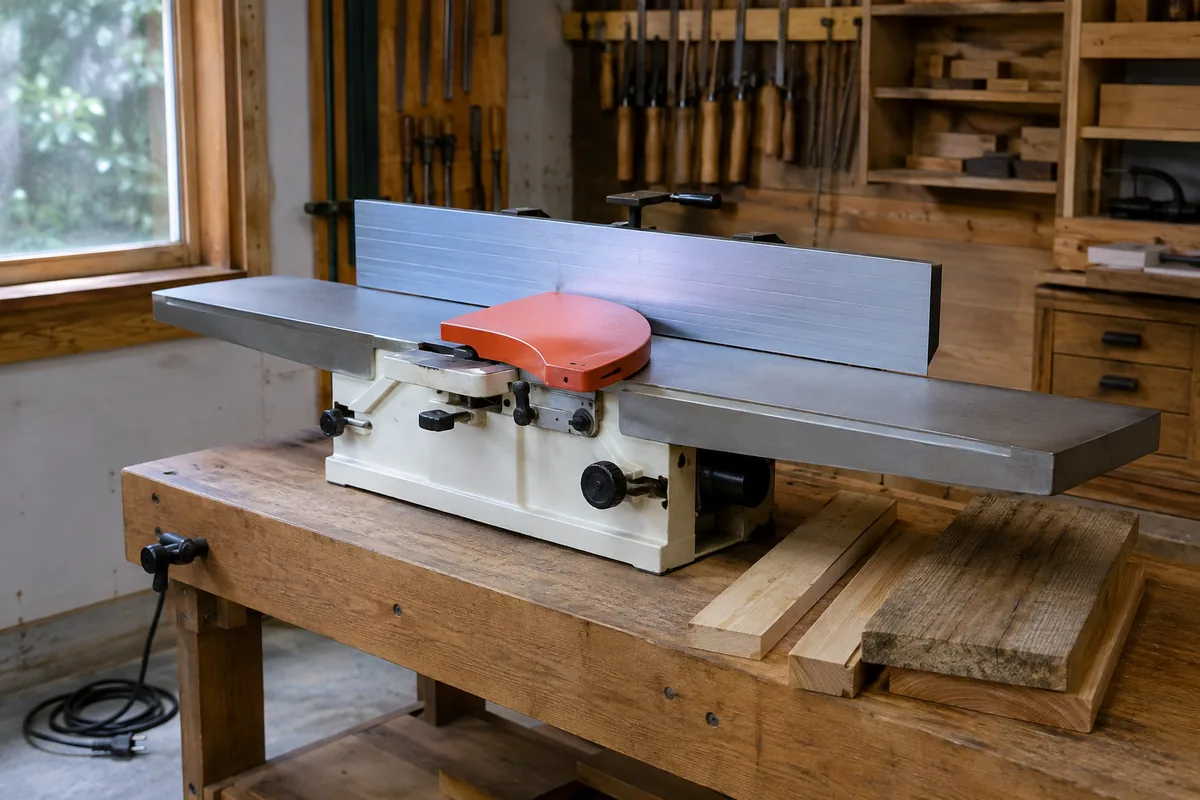
A jointer does not need to sit perfectly level to cut a straight edge. It does need a stable base that does not rock, twist, or shift when you feed a board across the tables. On an uneven floor, a stand can be supported at three points while a fourth foot hangs free. Tightening that foot against the floor can twist the stand, which may move the infeed or outfeed tables out of alignment.
Start by distinguishing floor level from machine alignment. A jointer can be slightly out of level and still work well if its tables are coplanar and the cutterhead is set correctly. The goal here is a firm, untwisted base—not making the machine’s tables read level relative to the room.
Check the machine and floor
Unplug the jointer before working around the cutterhead or adjusting the stand. Remove dust and chips from under the feet, then check that the stand’s fasteners are snug. A loose joint in the stand can look like a floor problem.
Rock the machine gently at opposite corners. If it moves, identify which foot or feet are not bearing on the floor. A thin feeler gauge, paper strip, or business card can help locate a small gap. For larger gaps, measure the height difference with a straightedge and ruler. Check the floor where each foot lands; a crack, raised seam, or sloped patch may make a single shim unstable.
Before changing support, check the jointer’s table alignment with a reliable straightedge. On a typical benchtop or cabinet jointer, a straightedge spanning the tables should not show a new twist after you adjust the feet. If the tables are already misaligned, record the condition first so you do not blame the floor for an existing setup issue.
Choose a support method
Use the simplest support that gives all feet solid contact. Thin, hard shims are inexpensive and work well for a small, fixed height difference. Adjustable leveling feet are more convenient when you expect to move the machine or the floor varies over a wider area. A machine base or mobile base with leveling pads can combine mobility and stability, but adds cost and can raise the jointer enough to affect working height.
| Support option | Best for | Trade-off |
|---|---|---|
| Hard plastic or metal shims | Small gaps on a machine that stays put | Cheap and simple, but may need trimming or stacking |
| Adjustable leveling feet | Frequent adjustment or a larger height difference | Convenient, but must be fitted securely and checked for loosening |
| Leveling mobile base | Moving the jointer occasionally, then locking it in place | Costs more and may add height, flex, or another source of movement |
For a small gap, start with hard plastic machine shims. They resist crushing better than cardboard, folded paper, or soft wood scraps. Metal shims are also suitable, though they can slip on smooth floors if the foot does not hold them in place.
Level the base without twisting it
Place the jointer where you intend to use it, with enough clearance to feed your longest usual workpiece. If the machine is heavy, get help moving it; do not try to lift a cabinet jointer by its tables or fence. Loosen any anchors or foot locknuts that prevent adjustment.
Support the machine at three points first. Three points define a stable plane, so this helps remove rocking without forcing all four corners into a twisted position. If one corner is low, add a shim under that foot in thin increments. Keep the shims fully under the foot, not partly exposed where they can catch a shoe or workpiece. For a large gap, use a broad, solid shim or an adjustable foot rather than a tall stack of narrow pieces.
Once the machine sits firmly on three points, bring the fourth foot into contact with the floor. Add only enough support to stop the foot from hanging free; do not jack that corner upward. Recheck for rocking after each adjustment. If the machine has threaded feet, adjust them a little at a time and tighten their locknuts when finished. A suitable set of heavy-duty adjustable leveling feet is useful when the floor gap is too large for a safe shim stack, but confirm the thread size and load rating before buying.
Verify stability and alignment
Push firmly on the stand from the front, rear, and sides. It should not rock or walk. If it does, check for a loose fastener, a shim that has slipped, or a floor surface that is too irregular for the current support. Do not cure rocking by overtightening an anchor bolt; that can pull the stand down unevenly and twist it.
Check table alignment again with the same straightedge and positions you used before adjusting the base. Compare the infeed and outfeed tables near both sides and along the center. If the readings changed noticeably, back off the latest adjustment and support the machine more evenly. Follow the jointer manual’s alignment procedure if it gives a tolerance or a specific measurement method; do not assume a general-purpose level reading is the right test.
Make a test cut on a straight, flat board. Support long stock so its weight does not tip the machine or lever against the fence. Inspect the jointed edge with a straightedge and check whether the board rocks on a flat reference surface. A jointer that is stable but still produces a bowed or twisted edge may need cutterhead, table, or fence adjustment rather than more shimming.
When a mobile base makes sense
A mobile base is worth considering if you routinely clear floor space or need to move the jointer for maintenance. Choose one rated for the machine’s weight, including any stand or accessories, and check its minimum and maximum height. Some bases lift the machine several inches, which can make feeding awkward or change how the outfeed support lines up with nearby equipment.
For a machine that rarely moves and has only a small floor gap, shims are usually the better buy. If mobility is part of the job, look for a woodworking machine mobile base with leveling feet. After moving the jointer, lower and lock the leveling pads so the casters are not carrying the cutting load. Recheck for rocking and table alignment before returning to work.