Best Drill Presses for Boring Large Holes in Thick Stock
What's inside
As an Amazon Associate I earn from qualifying purchases. This post may contain affiliate links at no extra cost to you.
Contents
What matters when boring large holes
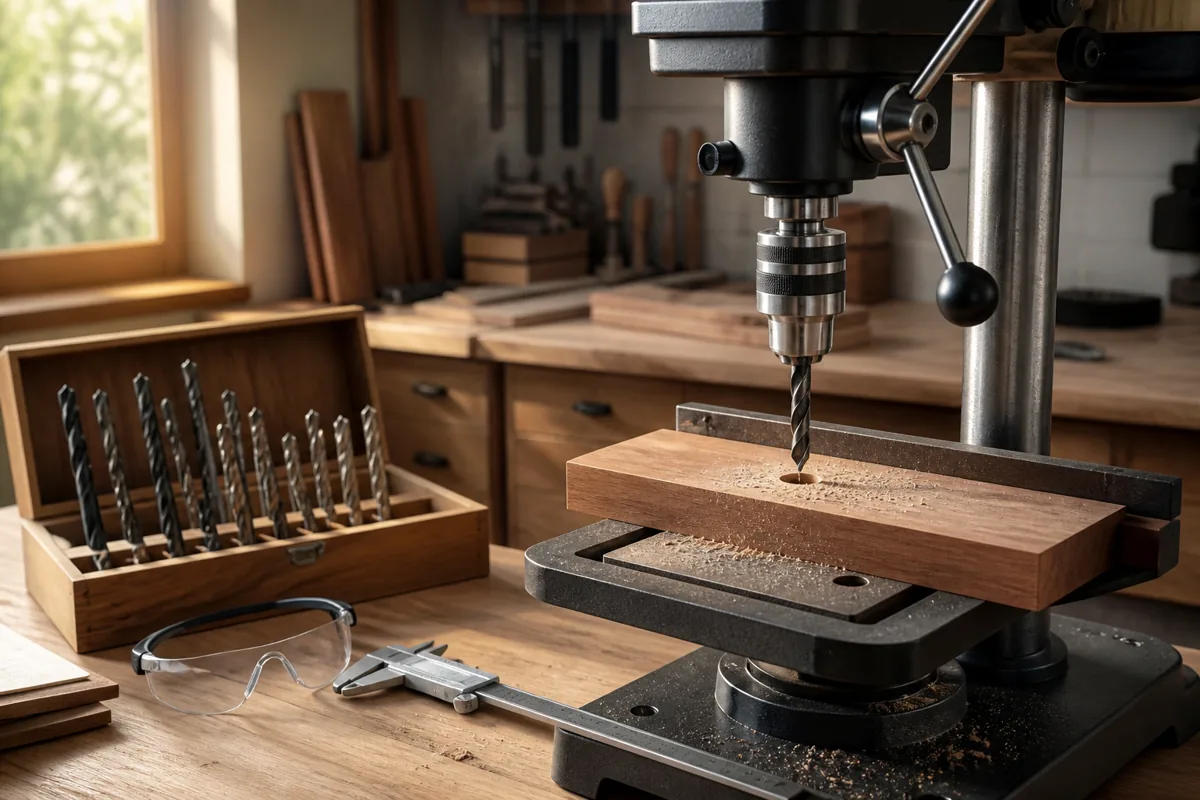
A drill press can bore a large hole in thick stock, but the job is limited by more than the motor’s horsepower. The press needs enough throat depth to reach the work, enough clearance between spindle and table for the stock and bit, and a spindle speed low enough to control heat and torque. A long bit also needs to stay aligned as it enters and exits the material.
For woodworking, a 1/2-inch chuck is common and accepts many Forstner bits and hole saw arbors. Check the chuck’s actual capacity and the bit manufacturer’s recommended speed; do not assume a press’s top speed is suitable for a large cutter. A 2-inch Forstner bit in hardwood may call for only a few hundred RPM, while a small twist bit can run much faster. If the press’s lowest speed is too high, it is the wrong machine for that bit and material.
As an Amazon Associate we earn from qualifying purchases at no extra cost to you.


Floor models, bench models, and radial presses
A floor drill press usually gives you more spindle travel, table size, and capacity under the spindle than a compact bench unit. Those advantages matter when boring deep holes or working with thick blanks. The trade-off is cost and shop space. A bench press can be a sound buy for occasional holes in stock that fits comfortably below the chuck.
Throat capacity is the distance from the column to the spindle center, and it determines how far from an edge you can drill. A 12-inch press, for example, generally reaches about 6 inches from the edge. The table and base also need to support the work without rocking. For wide panels or long pieces, plan on auxiliary support; a large table alone does not prevent the work from tipping.
A radial-arm drill press lets the head move out from the column, which helps reach across broad stock. It adds adjustment points and can be less rigid when extended. If most of your work fits under a standard press, a conventional floor model is usually the simpler, more stable choice.
Which type fits the job?
| Press type | Best fit | Trade-off |
|---|---|---|
| Bench | Occasional holes in smaller work; limited floor space | Less clearance and often less spindle travel |
| Floor | Frequent work, thick stock, larger bits, longer pieces | Costs more and takes up floor space |
| Radial | Holes well away from the edge of wide stock | Extended head can flex; setup takes care |
What to buy for large holes
For regular work with large Forstner bits, look for a floor press with a low speed around 250–500 RPM, adequate spindle travel, and a table that tilts and locks securely. The exact speed range varies by cutter, wood species, and bit maker, so treat the manual’s chart as the starting point. A belt-driven press is often a good value: changing speeds takes a few minutes, but the mechanism is straightforward. Variable-speed controls save time, though they do not make an underpowered or poorly supported press rigid.
For occasional holes in moderate-size stock, a bench press can be enough if its lowest speed is appropriate and its clearance suits the work. Compare the actual distance from table to chuck with your stock thickness plus the length of the bit. A press that cannot lower the bit far enough may need a spacer block or table adjustment, but those fixes reduce stability or working room. Browse floor drill presses with low-speed ranges and compare the published throat, travel, and table dimensions before choosing.
Do not choose on motor horsepower alone. Two presses with similar motor ratings can behave differently because of gearing, belt arrangement, spindle bearings, and column stiffness. A press that bogs down on a large cutter can burn the wood and overload the bit. If you regularly bore very large holes in dense hardwood, a sturdier press and conservative feed pressure are more useful than a high top speed.
Setup prevents most failures
Clamp the work to the table or a sacrificial board; never hold a large blank by hand. A Forstner bit can catch as it breaks through and spin the work violently. Use a backing board to reduce tear-out, and for a deep hole, withdraw the bit periodically to clear chips. Packed chips create heat, slow cutting, and can scorch the hole wall.
For stock thicker than the bit’s cutting depth, bore from both faces when the hole must go all the way through. Mark the center from a common reference, drill partway from one side, then flip the stock and finish from the other. This reduces breakout, but the two holes can meet with a small step if the alignment is off. A brad-point bit or a carefully made center mark helps keep the second setup on target.
Large hole saws are usually faster and cheaper for rough openings, but they leave a rougher edge and can bind when their gullets fill with chips. For clean, flat-bottomed holes, a Forstner bit is generally the better choice. Forstner bits also generate substantial heat in deep holes, so use a suitable slow speed and clear chips instead of forcing the feed. If you need a press mainly for these cuts, compare drill presses suited to large Forstner bits with the cutter sizes you actually use.
When spending more is worthwhile
Pay more for capacity and rigidity when your stock routinely exceeds a bench press’s clearance, when you need deep spindle travel, or when the press will see frequent large-bit use. A larger table, solid column, and reliable low-speed gearing make setup easier and reduce vibration. Spend less if you only drill smaller holes in thin stock and can work within a compact press’s limits. In that case, careful clamping and the right bit matter more than buying a large machine.
Before ordering, measure your thickest workpiece, the bit’s length, and the distance needed from the edge to the hole center. Confirm the press can reach the cut with the table in a useful position, and check that the bit’s required speed is within the machine’s range. Those measurements prevent a common disappointment: a press that looks substantial but cannot fit the job.