Best Drill Presses with Adjustable Tables for Angled Joinery
What's inside
As an Amazon Associate I earn from qualifying purchases. This post may contain affiliate links at no extra cost to you.
Contents
What an adjustable table is for
For angled joinery, a drill press needs more than a table that moves up and down. You need a table that tilts, locks securely, and returns to square without a fight. That matters when drilling angled mortises, dowel holes, or bolt holes in a part that is awkward to hold by hand.
Most drill-press tables tilt to one side, commonly up to 45 degrees. A scale helps with rough setup, but it is not a precision reference. For accurate joinery, set the angle with a bevel gauge or digital angle gauge, then clamp the workpiece. Check that the table stays put under pressure; a table that creeps during drilling can ruin a hole and pull the work toward the bit.
As an Amazon Associate we earn from qualifying purchases at no extra cost to you.


What to buy
A benchtop drill press with a tilting table is often enough for furniture parts and occasional angled holes. It costs less, takes less floor space, and can be bolted to a sturdy bench. Its limits are throat depth, column height, and table size. Check the distance from the column to the spindle: a 10-inch press, for example, has roughly 5 inches of throat capacity. That can be tight for wide panels.
A floor-standing press generally gives you more working height, a larger table, and often more throat depth. Those benefits are useful for tall workpieces, but the extra capacity does not automatically mean better accuracy. Look for a rigid column, a positive table lock, and manageable runout. A large table that flexes or slips is less useful than a smaller one that stays aligned.
For a compact setup, compare benchtop drill presses with tilting tables. If you regularly drill large or tall stock, compare floor-standing drill presses with adjustable tables.
Features that matter for angled joinery
Table locking: The table should clamp firmly to the column and resist rotation. Some tables tilt around a single pivot and lock with a bolt; others use a toothed or indexed mechanism. Either can work if it holds. Before buying, check whether the locking handle is accessible when the work is clamped in place.
Table size and slots: A table around 8 by 8 inches suits small parts, while a larger surface gives more support for cabinet rails and wider boards. T-slots make it easier to secure a fence or hold-downs. A plain table can still be useful, but you may need a drill-press vise or a sacrificial board with clamps.
Speed range: Wood bits need different speeds by diameter. A 1/8-inch bit can run much faster than a 1-inch Forstner bit; slowing down helps prevent scorching and grabbing. A press with a broad belt-and-pulley range is adequate, though changing speeds can be tedious. Variable-speed controls are convenient, not essential.
Depth stop and quill travel: A depth stop makes repeatable blind holes easier. Check quill travel against the depth you need, especially for long angled holes. If the bit cannot reach far enough in one plunge, repositioning risks a stepped or misaligned hole.
Press types compared
| Type | Best fit | Trade-off |
|---|---|---|
| Benchtop, tilting table | Small parts, occasional angled drilling, limited shop space | Less throat and table capacity; needs a solid bench |
| Floor-standing, tilting table | Tall stock, larger work, frequent use | Higher cost and more floor space; not automatically more precise |
| Fixed table with tilting vise or jig | Mostly square drilling with occasional angled work | Workholding setup takes time and may limit part size |
Setting up an angled hole
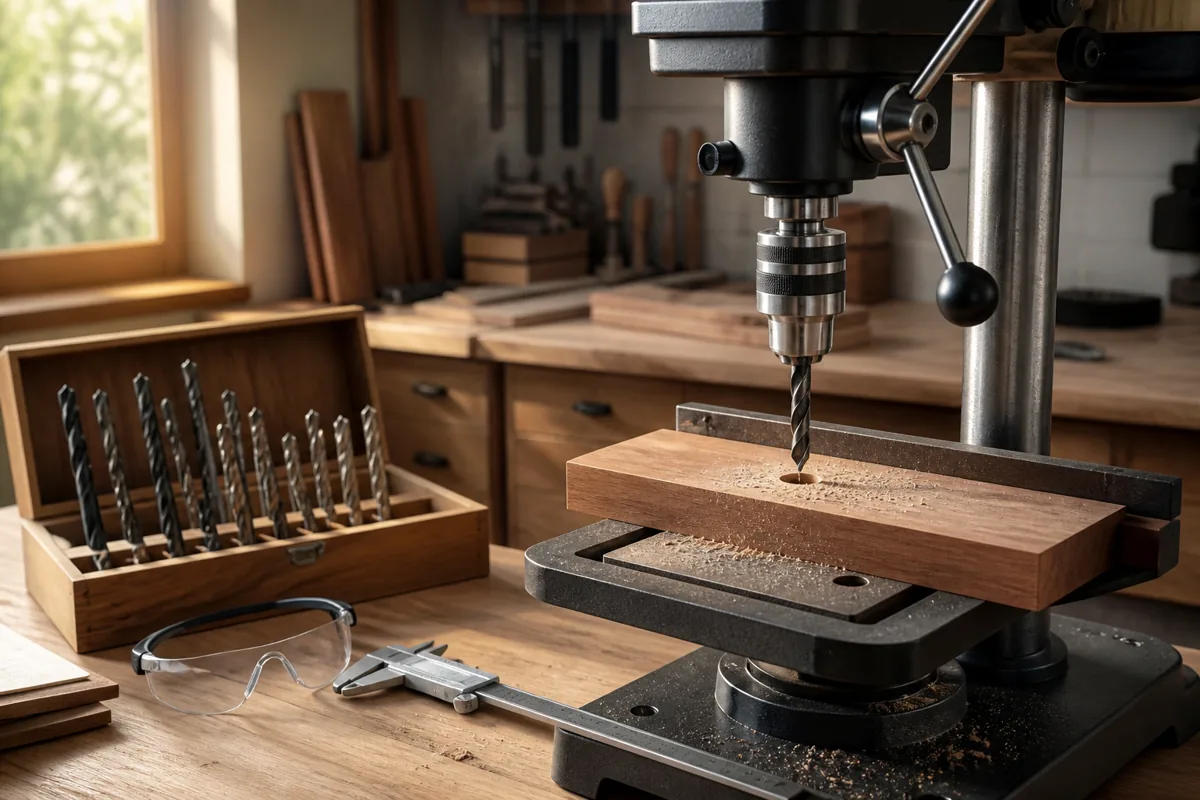
Start by unplugging the press. Tilt the table to the target angle, then verify it with an angle gauge against the spindle or a straight test rod in the chuck. Do not assume the pointer is accurate. Tighten the table lock and recheck the reading; tightening can shift the angle slightly.
Clamp a flat sacrificial board to the table, then secure the workpiece to the board with a vise, toggle clamp, or hold-downs. Never rely on hand pressure alone. A bit can catch, especially a large Forstner bit, and spin the workpiece like a propeller. Keep clamps clear of the bit path and make sure the angled part cannot slide downhill.
Mark the hole, use a center punch or awl where appropriate, and begin at a conservative speed. Feed steadily rather than forcing the bit. For deep holes, withdraw periodically to clear chips. On a through-hole, back the work with scrap to reduce breakout. If the bit wanders, stop: check the workpiece clamp, angle, and bit sharpness instead of leaning harder on the feed handle.
When a jig is the better choice
If the table only tilts one way, or its scale and lock are crude, a fixed table with an angled cradle may be more dependable. A plywood wedge or purpose-made jig can hold the work at a repeatable angle while the table stays square. This is especially useful for drilling several matching parts. The trade-off is that each jig takes setup space and must be built accurately.
A drill-press angle vise can handle small metal fittings or compact wooden pieces, but jaws may not support a broad board evenly. For wide stock, a clamped cradle is usually steadier. If your work is limited to occasional small holes, a basic press and a careful jig can be a better purchase than paying extra for a large tilting table.
A practical buying check
Before choosing, measure the largest workpiece and the distance from the column to the spindle. Confirm the table tilts far enough for your joinery, locks firmly, and has enough area for clamps. Check quill travel, speed range, and whether the press can be bolted down securely. If possible, test the table for play and inspect spindle runout; excessive wobble shows up as oversized or ragged holes.
For repeatable angled joinery, stable workholding and a verified angle matter more than a long feature list. Buy the least expensive press that fits your stock and holds its table securely; spend the difference on sharp bits and clamps if those are what your current setup lacks.