Best Planers for Reclaimed Lumber Preparation
What's inside
As an Amazon Associate I earn from qualifying purchases. This post may contain affiliate links at no extra cost to you.
Reclaimed lumber can make excellent furniture and built-ins, but it is harder on a planer than clean new stock. Hidden nails, grit, paint, and loose knots can damage knives or cutterhead inserts in a single pass. The right machine depends less on the board’s story than on its width, thickness, condition, and how much stock you need to process.
As an Amazon Associate we earn from qualifying purchases at no extra cost to you.

Contents
Inspect before planing
Remove metal before the board reaches the machine. Pull visible nails and screws, then check the full surface with a metal detector; a buried brad can nick a knife or chip an insert. Scrape off dirt, roofing grit, and loose paint. If the lumber has an unknown coating, identify it before making dust: older paint may contain lead, and a planer is not a safe way to remove it.
Planer knives can tolerate ordinary wood, not embedded sand or metal. A damaged straight knife may leave a repeating ridge across the board, while a chipped carbide insert often creates a small, localized defect. Either way, plan on stopping to inspect and replace or rotate cutting edges. Do not count on a planer to flatten a twisted board, either: it makes the two faces parallel, which can preserve a twist. Flatten one face first with a jointer, a sled, or another reliable method.
Which planer fits the job?
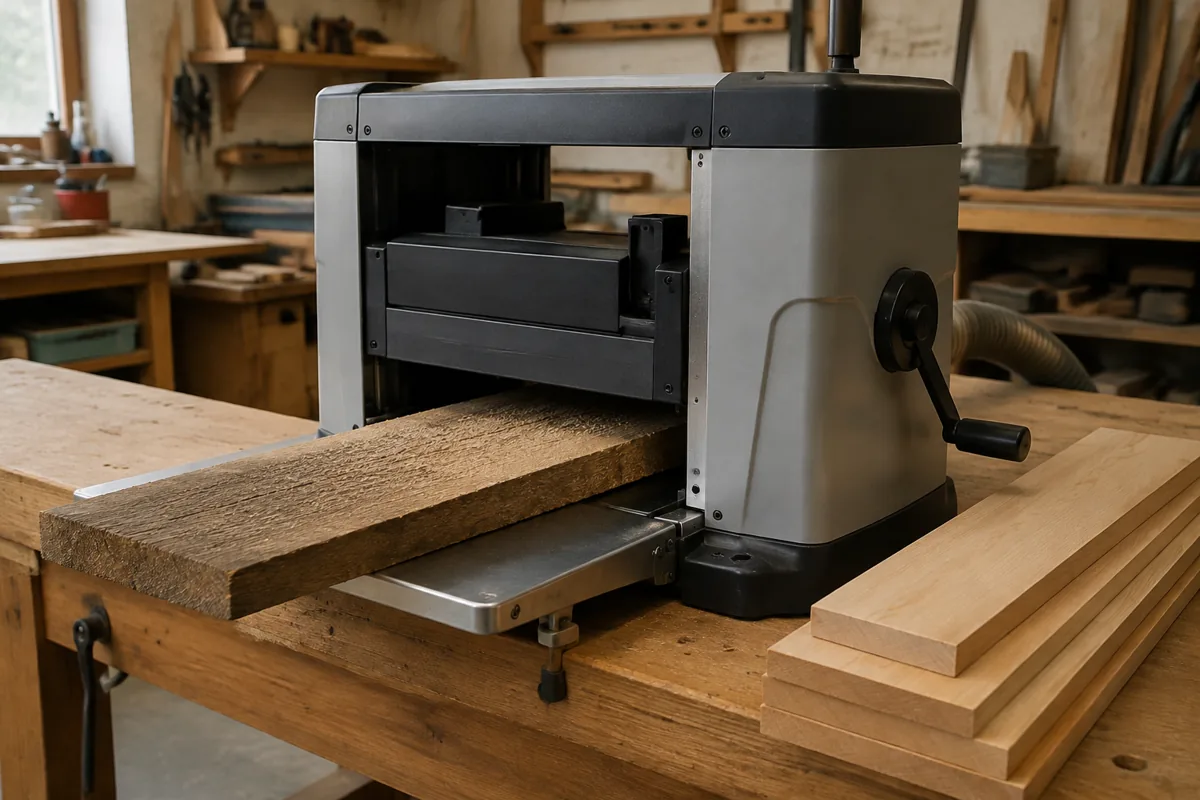
For most home shops processing occasional reclaimed boards, a benchtop thickness planer is the practical starting point. Typical portable machines handle stock about 12 to 13 inches wide and roughly 6 inches thick, though capacity varies. They are far less expensive and easier to move than stationary floor models. Their limitations are short beds, more snipe at the ends of boards, and less mass to damp vibration.
A floor-standing planer makes sense when you routinely process wide, heavy stock or need longer beds and more consistent support. It costs substantially more, takes up space, and still does not make dirty lumber safe for the cutterhead. A helical-style cutterhead uses many small carbide inserts rather than long knives. If one insert gets nicked, you can usually rotate or replace that insert instead of sharpening or replacing a full knife set. That convenience comes at a higher initial price.
| Planer type | Best fit | Advantages | Trade-offs |
|---|---|---|---|
| Benchtop, straight knives | Occasional projects and modest board widths | Lowest entry cost; portable; knives can be sharpened | Knives are vulnerable to grit; noisy; short boards may snipe |
| Benchtop, helical-style head | Frequent reclaimed-stock preparation in a small shop | Small cutter damage is easier to manage; often leaves a clean finish | Higher purchase price; inserts still wear and require care |
| Floor-standing planer | Regular production, heavy stock, or larger capacity needs | More support and mass; often greater width and capacity | High cost, space and electrical requirements; not immune to contamination |
What to buy for reclaimed lumber
If your boards are clean after inspection and you plane only a few projects a year, a straight-knife benchtop unit is often enough. Search for a benchtop thickness planer with straight knives and compare maximum width, replacement-knife availability, feed rate, and dust-port size. A lower-priced machine can be a sound choice when you are willing to inspect stock carefully and accept occasional knife changes.
If reclaimed lumber is a regular part of your work, consider a benchtop planer with a helical-style cutterhead. It is a convenience, not a license to run questionable boards. Inserts can still chip on nails or hard grit, and replacement inserts add ongoing cost. Look up the price and availability of the exact replacement inserts before buying; a low-cost machine with difficult-to-source parts can become an expensive interruption.
Choose a floor-standing machine only when its capacity or support solves a real problem. Search for a floor-standing thickness planer if you routinely work beyond benchtop capacity or need to process substantial volumes. Check the machine’s maximum stock width and height, required circuit, cutterhead options, and space for infeed and outfeed support. A larger planer will not correct poor stock preparation.
Reduce damage and improve the finish
Take light cuts on uncertain stock. A conservative starting point is around 1/32 inch per pass; clean, stable hardwood may tolerate more, but difficult grain or a struggling motor calls for less. Follow the manufacturer’s maximum-cut guidance, since limits vary by width and species. Feed boards with the grain where possible, and support long boards level at both ends. A pair of roller stands set too high or too low can make a board lift, dip, or snipe.
Snipe is a deeper cut near one or both ends, commonly caused by the board tipping as it enters or leaves the rollers. Use longer boards when practical, keep steady upward support through the cut, and trim the damaged ends afterward if the project allows. A planer with an adjustable bed or effective anti-snipe settings can help, but technique and support still matter.
Connect dust collection before planing. A planer produces chips quickly, and a small shop vacuum may clog or fail to keep up. A suitable collector and clear hose reduce buildup, but reclaimed wood can include contaminants you do not want in shop air. Wear eye and hearing protection, and use respiratory protection appropriate to the dust and coating. Stop immediately if you hear a sudden change in cutting sound or see a new repeating mark; continuing can worsen cutter damage and spoil more stock.
Make the buying decision
Buy for the clean, inspected lumber you actually process—not the worst board you can imagine feeding through a machine. A basic benchtop planer is adequate for occasional, narrow stock when careful metal checks are routine. A helical-style benchtop machine is easier to maintain after small localized cutter damage, while a floor-standing model is justified by capacity and workload. For every option, budget for blades or inserts, dust collection, support stands, and the time needed to prepare lumber. That preparation is what protects the planer.