Best Planers with Reduced Vibration for Thin Stock
What's inside
As an Amazon Associate I earn from qualifying purchases. This post may contain affiliate links at no extra cost to you.
A thickness planer can turn rough boards into uniform stock, but thin pieces are harder to feed steadily than ordinary lumber. A board that chatters, lifts, or stalls can come out scalloped or end up kicked back. Vibration matters, but so do roller pressure, cutterhead design, minimum thickness, and support around the machine. For thin stock, buy the planer that controls the work—not simply the one marketed as quieter.
Contents
What reduced vibration means for thin stock
A planer’s motor and cutterhead create vibration, while uneven knives or loose parts add more. On a thin board, even small changes in feed pressure can let the workpiece flutter against the cutterhead. The result may be washboard marks, inconsistent thickness, or a piece that stops feeding. Reduced vibration helps produce a smoother surface and makes the machine less tiring to use, but it cannot compensate for dull knives, poor support, or unsafe workholding.
For thin material, pay particular attention to the cutterhead. A helical or segmented carbide head often runs more smoothly and leaves fewer pronounced knife marks than a conventional two-knife head, though it costs more and its inserts still need maintenance. A straight-knife head can be a reasonable budget choice if its knives are sharp, correctly set, and balanced. In either case, inspect the head and knives for damage and follow the manufacturer’s instructions; never open or adjust the machine while it is connected to power.
Features worth comparing
| Feature | Why it matters for thin stock | Trade-off |
|---|---|---|
| Cutterhead type | Helical or segmented heads can reduce cutting shock and leave a more consistent finish. | Higher purchase price; replacement inserts add cost. |
| Feed rollers | Consistent pressure helps prevent chatter and slipping. | Rollers can mark soft wood or struggle with very short pieces. |
| Table size and extensions | Support before and after the cutter helps keep long, thin boards level. | Extensions take space and may need adjustment to sit flush. |
| Thickness stop or scale | Helps repeat settings when making a batch of parts. | A scale is not a substitute for measuring the finished stock. |
| Minimum workpiece thickness | Sets the lower limit for stock the machine is designed to plane. | Varies by machine; never assume a planer can safely handle a very thin piece. |
Which planer to buy
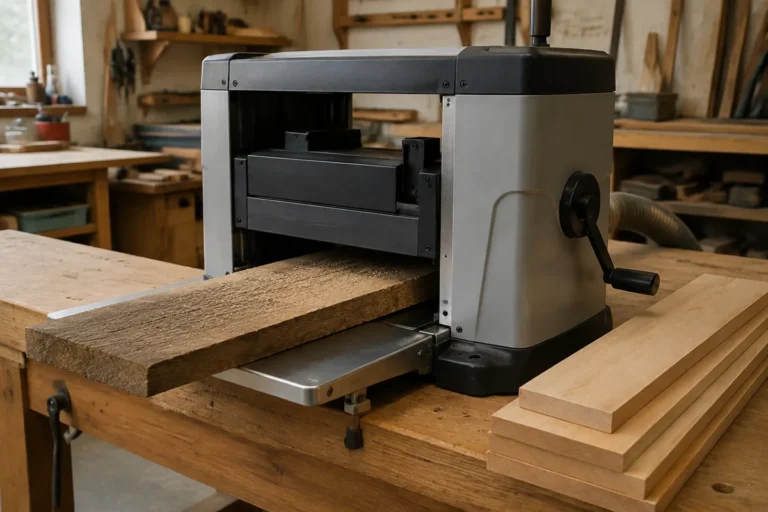
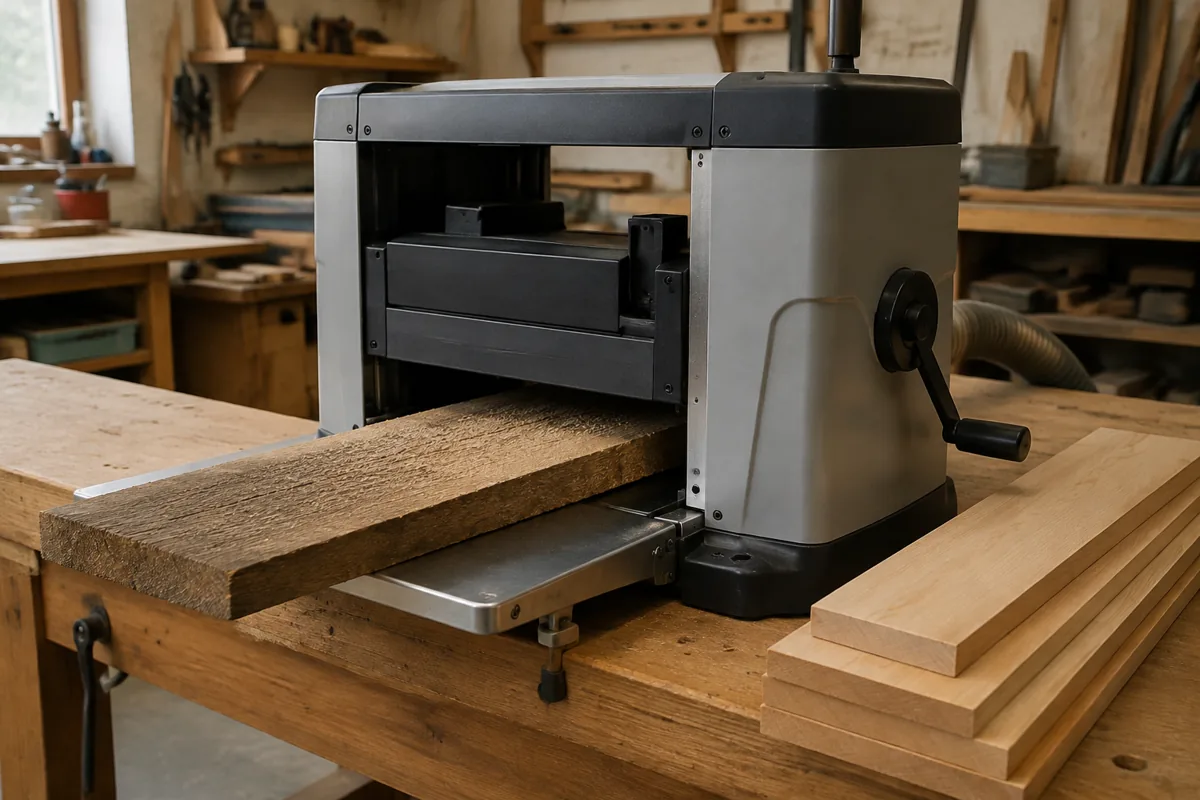
For a home shop that regularly planes thin boards, look first at a benchtop planer with a stable base, rigid infeed and outfeed support, and a stated minimum workpiece thickness that suits your work. A model with a cutterhead designed to reduce cutting shock is worth considering if surface quality and noise matter. Compare the actual thickness limits and support arrangements in the manual, rather than relying on general claims about “thin stock.”
Browse benchtop thickness planers with helical cutterheads if you want a smoother-running option and expect to use the machine often. The extra cost is harder to justify for occasional work, especially if you can get a clean result by sharpening or replacing straight knives and feeding the stock carefully.
A conventional two-knife benchtop planer is fine for budget-conscious shops, rough lumber, and projects where a little sanding is acceptable. Before choosing one, check that the machine has enough table support for your longest stock and a clear, usable depth scale. If thin pieces are a regular job, compare straight-knife benchtop planers against the cost of replacement knives and the finish you expect to achieve.
A floor-standing planer is usually unnecessary for small quantities of thin stock. Its added mass can help reduce movement, but it takes more space and costs more; it does not remove the need to support the work or respect the machine’s minimum thickness. Buy one for capacity and sustained production, not simply because it is heavier.
A safer way to plane thin stock
Read the machine’s manual for minimum thickness, minimum length, and any carrier-board instructions. Do not feed a piece below the stated limits. Very short or narrow parts may be grabbed unevenly, and a loose strip can become a dangerous projectile. If the stock is too thin for the planer’s specifications, use another method, such as sanding or a hand plane.
For stock that meets the limits, start with a flat, stable piece and support it level at both ends. Keep the board firmly against the table as it enters and exits, using the machine’s prescribed hand positions and keeping hands clear of the cutterhead opening. Set shallow cuts: about 1/32 inch (0.8 mm) or less is a sensible starting point for thin material, but use a lighter cut if the wood is hard, narrow, or prone to splitting. Take several passes and measure the result rather than trying to reach final thickness in one heavy cut.
If the manual permits a carrier board, use a flat, rigid sacrificial board to support thin stock; do not improvise a setup that could be pulled into the machine. Confirm the workpiece is secured or positioned as the manual requires, and avoid placing multiple loose pieces side by side. A carrier can improve support, but it does not make a piece below the planer’s minimum safe thickness automatically acceptable.
Common problems and fixes
Washboard ridges often point to dull or misadjusted knives, vibration, or inconsistent feeding. Check the cutting edges and machine setup before taking another pass. If a board stalls, stop the machine and follow the manual’s clearing procedure; do not push material toward the cutterhead by hand while it is running. Snipe—deeper cuts near the ends—usually improves with better infeed and outfeed support and by keeping the board level through the cut.
Thin stock that bows or twists may not be suitable for planing as-is. A planer makes faces parallel; it does not reliably flatten a warped board. Flatten one face first with an appropriate method, then plane the opposite face, and check thickness at several points. Reduced vibration can improve finish and control, but sound stock preparation and shallow, supported passes are what make thin boards predictable.