Best Planers for Small-Batch Furniture Production
What's inside
As an Amazon Associate I earn from qualifying purchases. This post may contain affiliate links at no extra cost to you.
For small-batch furniture work, a planer’s useful capacity matters more than its maximum feed rate. You need enough width for your stock, stable thickness settings, and a finish that does not turn every board into a sanding project. A portable lunchbox planer can be the right buy for a one-person shop; a stationary helical-head machine makes sense when you process hardwood regularly and can spare the floor space.
As an Amazon Associate we earn from qualifying purchases at no extra cost to you.

Contents
Start with your stock
Measure the parts you actually make. A 13-inch planer handles most furniture boards, while a 15-inch machine gives more room for wider panels and reduces the need to rip a board into strips just to thickness it. Neither size will plane a glued-up tabletop wider than its cutterhead. For panels, plane the parts before glue-up or use a different flattening method afterward.
Check the maximum thickness capacity, too. Many portable machines accept stock around 6 inches thick, which is ample for ordinary furniture components but may rule out heavy legs or thick slabs. Capacity on the spec sheet does not guarantee clean cuts: long boards need support at both ends, and short pieces may be unsafe to feed unless the manual permits them.
Portable or stationary?
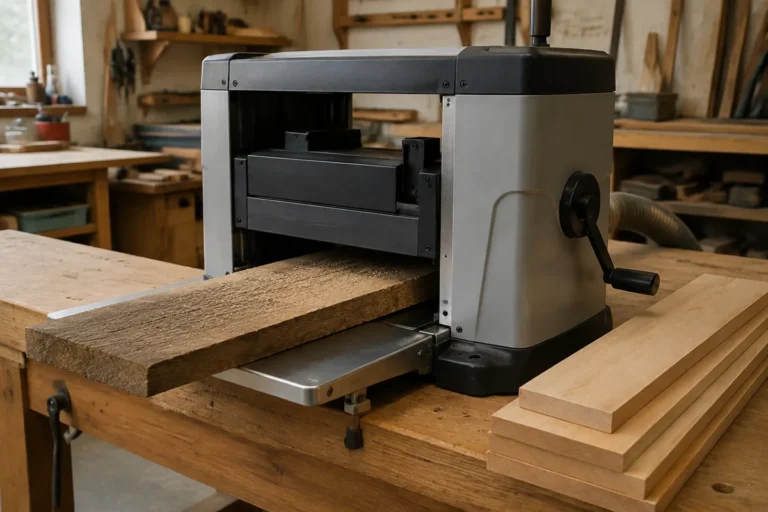
A portable two-knife planer is relatively affordable, compact, and easy to move. It suits intermittent work, softwood, and moderate hardwood batches. Its main compromises are noise, possible snipe at board ends, and more frequent knife changes or indexing. Snipe—an extra-deep cut near the leading or trailing end—wastes stock unless you allow extra length and trim it off.
A heavier stationary planer is steadier and usually better suited to repeated production. Three-knife cutterheads can leave a finer finish than basic two-knife designs, while a helical or segmented-carbide head is quieter and can be less troublesome on figured or difficult grain. Carbide inserts rotate to expose a fresh edge; replacing a damaged insert is usually easier than changing a full-length knife, though the machine costs more and the head still needs proper setup.
For a first machine or occasional batches, compare 13-inch benchtop thickness planers. If you plane hardwood every week, look at 15-inch stationary planers with helical heads and compare their footprint, electrical requirements, and dust-port size before choosing.
Planer types compared
| Type | Best fit | Main trade-off | Before buying |
|---|---|---|---|
| Portable, two-knife | Occasional furniture parts; limited shop space | More noise, knife maintenance, and possible snipe | Confirm width capacity and available outfeed support |
| Stationary, straight knives | Frequent batches on a practical budget | Knife setup and sharpening can take time | Check power needs, machine weight, and knife availability |
| Stationary, helical or segmented head | Regular hardwood work and figured grain | Higher purchase cost; inserts still need rotation or replacement | Check insert cost, dust extraction, and service access |
Features worth paying for
A reliable thickness scale and a repeatable depth stop save time when you need several parts at the same thickness. A digital readout is convenient, not essential; verify it against a caliper or a known setup before trusting it. Look for a cutterhead lock or a solid height-adjustment mechanism if the machine tends to drift under load.
Dust collection is not optional in regular production. Planers produce a large volume of chips quickly, and a small shop vacuum often cannot keep up. Match the port to your extractor and check the required airflow in the manual. A blocked chute can cause chips to recut into the surface, leaving a rough finish, or can stop a board from feeding smoothly.
Feed rollers need clean, dry surfaces to grip stock. Resin buildup, dust, or wood that is too short can cause slipping or uneven feed. Avoid planing wet or frozen lumber: it can leave a poor finish, pack the machine with damp chips, and create problems as the stock dries. Follow the manual’s minimum workpiece length and never feed loose pieces that cannot be controlled safely.
Getting accurate parts without wasting stock
Thickness planers make two faces parallel; they do not reliably flatten a twisted or cupped board. Flatten one face first with a jointer, router sled, or another suitable method, then plane the opposite face. Without that step, the rollers can press a warped board flat during the cut, only for it to spring back afterward.
Take light cuts on difficult hardwood. A cut around 1/32 inch is a sensible starting point for many machines; deeper cuts may be fine in softwood or on a powerful stationary planer, but depend on width, species, and the manufacturer’s limits. If the motor labors, the board chatters, or the surface tears, reduce the cut. Feed with the grain when possible. Reversing direction on interlocked or figured grain can cause tear-out, and a helical head reduces that risk but does not eliminate it.
To control snipe, support the board level at entry and exit, keep pressure steady without lifting the stock, and plane several boards of similar thickness as a batch. Leave a little extra length for trimming if the ends are visible parts. Check thickness at multiple points with calipers; a board that varies across its length may indicate poor support, dull knives, or a setup problem.
Make the buying decision
Choose a portable planer if it will be used in short sessions, your parts fit within its width, and you can tolerate noise and occasional cleanup from snipe. The cheaper option is fine when batches are small and you already have a way to flatten one face and handle the chips. A stationary machine is worth the added space and cost when consistent hardwood production, wider parts, or reduced setup hassle will be part of routine work.
Before ordering, confirm the machine’s actual width and thickness capacity, power supply, stand or mounting requirements, dust connection, and availability of knives or inserts. Those practical details matter more than a high feed-rate number if your goal is a stack of furniture parts that are flat, consistent, and ready for joinery.