Best Stationary Band Saws with Cast-Iron Wheels
What's inside
As an Amazon Associate I earn from qualifying purchases. This post may contain affiliate links at no extra cost to you.
Contents
What cast-iron wheels do—and don’t—tell you
Cast-iron wheels are a useful feature on a stationary band saw, but they are not a guarantee of accuracy or smooth cutting. Their mass helps a saw carry momentum through a cut, and the wheels can be durable. Just as important are wheel diameter, frame stiffness, blade guides, table support, and how easily the saw can be adjusted.
Check the specification sheet before buying: some manufacturers list cast-iron wheels clearly, while others describe only the wheel size or construction. Don’t assume a saw has cast iron because it is heavy. Also check whether the tire—the replaceable surface the blade rides on—is rubber or urethane. The tire, not the bare wheel, contacts the blade.
As an Amazon Associate we earn from qualifying purchases at no extra cost to you.


Choose a size for the work you actually do
For most home shops, the practical decision is between a compact saw with roughly 9- to 10-inch wheels and a mid-size saw with roughly 14-inch wheels. Wheel diameter affects the blade length a saw accepts and can influence how comfortably it handles wider blades. It does not, by itself, determine cutting capacity. Verify the advertised resaw height—the maximum stock height under the upper guides—and the distance between blade and frame, commonly called throat capacity.
A smaller saw can handle curves, small parts, and occasional resawing of modest boards. Its shorter blades and lighter frame are less forgiving when you ask for a tall, straight resaw cut. A 14-inch-class machine generally offers more capacity and room to tune the blade, but takes more floor space and may need a dedicated 220–240V circuit, depending on its motor. Confirm the electrical requirements and circuit capacity before purchase; a plug adapter will not make an undersized circuit safe.
If you mainly cut curves in ¾-inch stock, paying extra for a large resaw capacity may buy little. If you routinely split wide boards into thinner panels, prioritize the stated resaw height, motor power, fence, and blade support—not just the cast-iron wheels.
Comparing common stationary saw sizes
| Type | Typical use | Main advantage | Trade-off |
|---|---|---|---|
| Compact, about 9–10 inches | Curves, small parts, light hobby work | Lower cost and smaller footprint | Limited capacity and less suited to frequent resawing |
| Mid-size, about 14 inches | General furniture work and moderate resawing | More blade and stock capacity | Costs more; some versions require 220–240V |
| Large-frame, about 17 inches and up | Wide or frequent resawing | Greater capacity and often a heavier frame | High purchase cost, large footprint, and greater power demands |
These are broad categories, not guarantees: models in the same wheel-size class can differ substantially in usable capacity, motor, and guide design.
Features worth checking in person or on the spec sheet
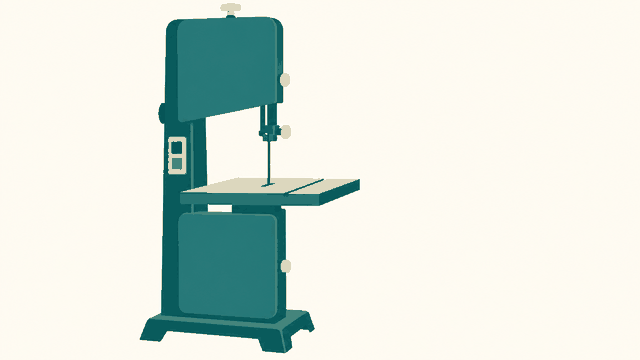
Guides and thrust bearings: Guides should adjust without awkward tools and support the blade close to the work. Poorly set guides can let a blade twist or wander, especially during resawing. Guides are not meant to clamp the blade continuously; set them according to the manufacturer’s instructions and recheck after changing blades.
Table and fence: A stable, square table matters more than a polished finish. Look for a table that tilts positively and locks securely. For resawing, a tall fence or a resaw attachment is useful, but it cannot compensate for a dull or poorly tensioned blade. A drift-adjustable fence is valuable because many blades do not track perfectly parallel to their back edge.
Blade range and tension: Check the blade widths the saw accepts and whether the tension indicator covers them. A tension scale is a starting point, not a substitute for a straight test cut. If the blade bows under feed pressure, drifts, or needs excessive force to cut, stop and check blade sharpness, tension, tracking, and guide setup rather than pushing harder.
Stand, dust collection, and access: A heavy saw still needs a level, stable base. Check that doors open far enough to change blades and that the lower wheel area is reachable for cleaning. Band saws produce fine dust around the lower wheel and guides; a dust port helps, but its size and location affect how well a shop vacuum or collector captures it.
Which saw is a sensible buy?
For light work and a tight budget, a compact stationary saw is reasonable if its capacity fits your projects. Compare compact stationary band saws with cast-iron wheels, but verify wheel material, cutting height, and electrical requirements on the manufacturer’s page before ordering. A lower-priced machine is not a bargain if it cannot accept the blade width you need.
For a general-purpose shop, a 14-inch-class saw is often the more flexible choice. Look at 14-inch stationary band saws with cast-iron wheels and compare actual resaw height, motor rating, guide adjustment, and included fence. The wheel material alone is not a sound reason to choose one saw over another.
Consider a larger saw if tall, straight resawing is a regular job rather than an occasional ambition. Browse larger stationary band saws with cast-iron wheels, then check the machine’s footprint, supply voltage, and blade options. For an occasional cut, paying for a large frame—and the space and electrical work it may require—can be hard to justify.
Setup matters as much as the wheels
After installation, level the saw, inspect the tires, and set blade tracking and tension according to the manual. Unplug the machine before opening the wheel covers or making adjustments that could put your hands near the blade. Fit a sharp blade suited to the cut: a narrow blade turns tighter curves, while a wider blade is generally easier to keep straight on a resaw cut. Tooth count matters too; too many teeth packed into thick stock can clog and burn.
Make a test cut in scrap of similar thickness. If the cut wanders, don’t immediately lean harder on the work. Check blade condition and tension, confirm the guides are close to the stock, and adjust the fence for the blade’s natural drift if needed. Clean sawdust from the wheels and cabinet periodically. Neglected dust can pack around the lower wheel, interfere with tracking, and hide tire damage.
Choose the smallest saw that comfortably fits your regular work, with enough margin for your largest stock. Cast-iron wheels are a worthwhile specification when the rest of the machine is well designed, but capacity, setup, and a suitable blade will decide whether it cuts well.