Best Stationary Table Saws for Dust-Controlled Basement Shops
What's inside
As an Amazon Associate I earn from qualifying purchases. This post may contain affiliate links at no extra cost to you.
A basement table saw has to do more than cut accurately. It needs to contain dust in a room with limited airflow, fit through stairs and doorways, and run without making the rest of the house miserable. For most basement shops, a cabinet saw is not automatically the best choice: its weight, electrical needs, and dust volume can outweigh the extra capacity.
As an Amazon Associate we earn from qualifying purchases at no extra cost to you.

Contents
What matters in a basement shop
Look first at the dust outlet and the space around the saw. A 4-inch port connected to a collector is a better starting point than a small bag, but it does not capture everything. The blade throws dust above the table and through the throat opening; a well-sealed cabinet and an over-blade guard with extraction help. A shop vacuum may work for a portable saw, but many struggle with fine dust during long ripping sessions. A collector rated around 600–1,000 CFM at the machine is a more suitable target for a stationary saw, provided the ductwork does not choke the airflow.
Measure the route into the basement, not just the finished floor space. Cast-iron tables and cabinet bases are awkward on stairs, and a saw that fits through a doorway may still leave too little room to handle a full sheet. Full 4-by-8-foot plywood is difficult to manage safely on any compact table saw; use a track saw or break down sheets before they reach the saw.
Choosing the right saw type
| Type | Best fit | Dust and space trade-offs |
|---|---|---|
| Portable jobsite saw | Small shops, occasional use, tight access | Small footprint and often a vacuum-sized port; more dust escapes around the blade and stand. |
| Contractor-style saw | Regular hobby work without cabinet-saw weight | More table and power than most jobsite saws; open stands can leak dust and need careful collection. |
| Hybrid saw | Frequent shop use with limited space or power | Enclosed base improves collection, but the saw is heavy and usually needs a 4-inch collector connection. |
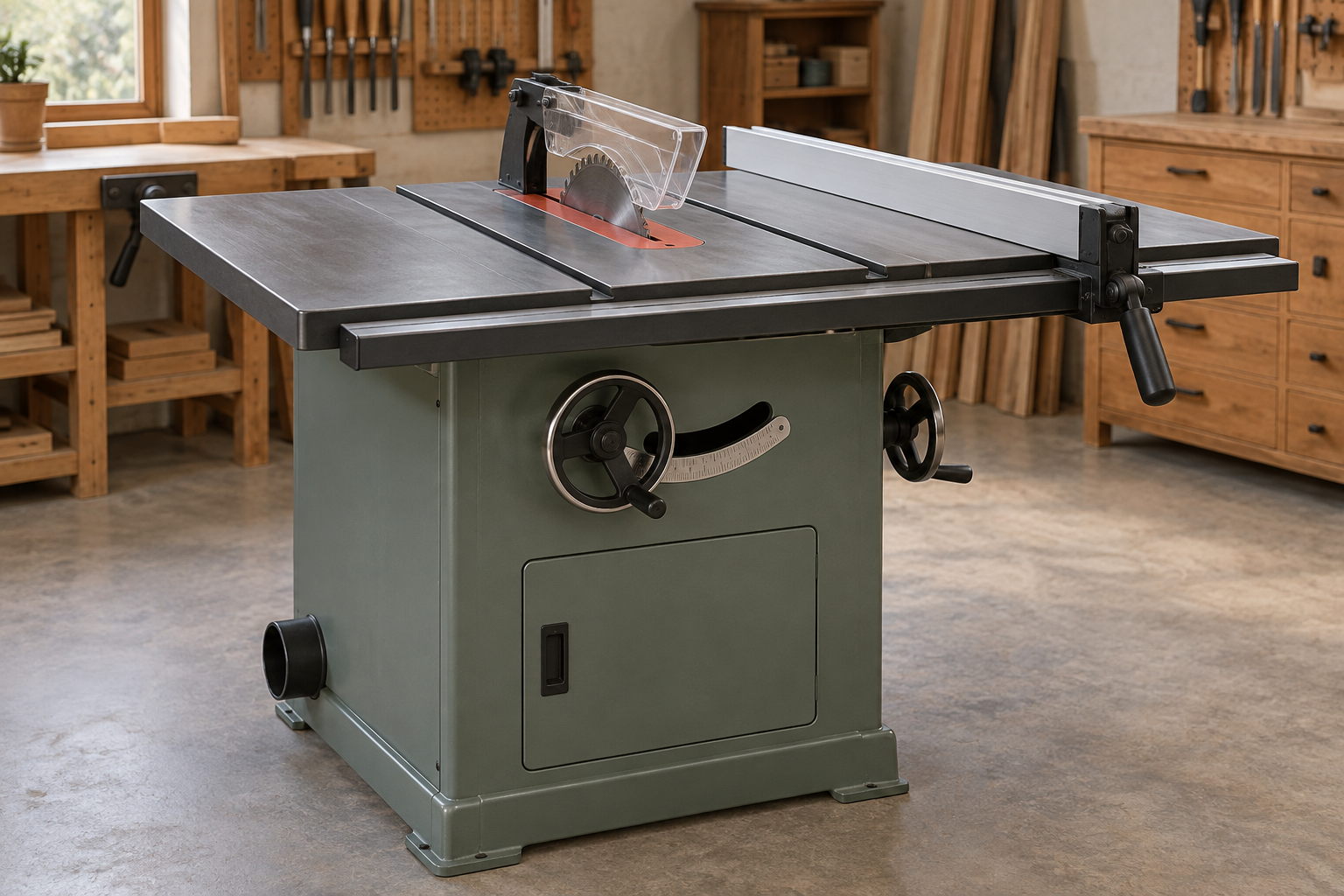
| Cabinet saw | High-volume cutting and a permanent, well-equipped shop | Strong collection potential and capacity, but heavy, costly, and commonly requires a dedicated 240-volt circuit. |
Best fit for most basement shops: a hybrid saw
A hybrid saw is the sensible middle ground when the saw will stay in one place and see regular use. The enclosed base gives dust a clearer path to the collector than an open stand, while the smaller footprint and lower weight are easier to accommodate than a full cabinet saw. Look for a solid fence, a flat cast-iron table, a standard 4-inch dust port, and a riving knife that stays in place for non-through cuts.
Before buying, check voltage and circuit requirements in the manual. Many hybrid saws run on 120 volts, but some use 240 volts or offer a conversion; do not assume a convenient outlet is adequate. A weak or shared circuit can trip under load, particularly with a large blade cutting thick hardwood. If you are adding a circuit, have an electrician confirm the panel and wiring are suitable.
For this category, compare hybrid table saws with 4-inch dust ports. Verify table dimensions, fence travel, and the actual port size in the manufacturer’s specifications; listings sometimes combine details from different configurations.
When a jobsite saw is enough
A jobsite saw is a reasonable buy if you cut a few projects a month, need to carry the saw through a narrow stairwell, or already use a track saw for sheet goods. It costs less and can be moved out of the way. A good stand, an accurate fence, and a blade appropriate to the material matter more than buying a larger saw you cannot position safely.
The compromise is dust control. A vacuum attached to the saw’s outlet catches some chips, but fine dust can escape around the blade and beneath the table. Add a well-fitted blade guard, keep the lower housing as closed as the design allows, and test collection with the material you actually cut. If dust still coats nearby shelves after a short test, the saw-and-vacuum combination is not controlling it well enough for routine basement use. Compare jobsite table saws with dust collection if portability is the priority.
Set up dust collection before production work
Use the largest practical hose run, keep it short, and avoid several tight bends. A reducer or long length of small hose can cut airflow enough that chips pile up inside the cabinet. Seal unnecessary openings with removable foam or tape, but do not block motor ventilation or moving parts. If the saw has a lower cabinet outlet and an over-blade port, connect both with a suitable splitter only if the collector can maintain useful airflow at both branches.
Check the setup by making a few cuts in scrap, then inspect the cabinet, floor, and surrounding surfaces. Accumulated chips can jam elevation or tilt mechanisms; fine dust settling across the room is a warning that collection is inadequate, not a normal cleanup condition. Wear a properly fitted respirator during cutting and cleanup, and vacuum with a machine rated for fine dust rather than sweeping it into the air. Dust collection reduces exposure but does not make airborne wood dust harmless.
A practical buying checklist
Prioritize a reliable fence, a riving knife, a blade guard that is easy to reinstall, and parts that are available for the saw. Confirm the footprint with the fence rails extended, not just the cast-iron top. Allow room for infeed and outfeed support, plus a clear path to the switch. If the shop cannot fit those clearances, a smaller saw paired with a track saw is safer than forcing long stock through a cramped layout.
Finally, budget for the collection system and setup. A cheaper saw can be fine when it is used occasionally and connected to a suitable vacuum. For frequent ripping in a closed basement, an enclosed hybrid saw and a properly sized collector are usually a better investment than spending the entire budget on a cabinet saw and leaving its dust port underpowered.