12-Inch vs 15-Inch Planer for Processing Wide Furniture Parts
What's inside
As an Amazon Associate I earn from qualifying purchases. This post may contain affiliate links at no extra cost to you.
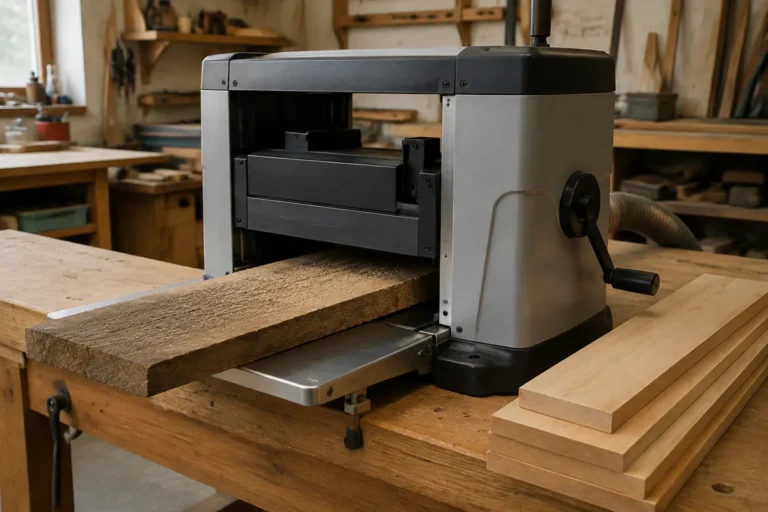
A planer’s listed width is its maximum capacity, not a promise that every wide board will come out flat and uniform. For furniture parts, the choice between a 12-inch and 15-inch machine comes down to the width of your parts, how often you’ll plane them, and whether the planer can handle the stock safely. A 12-inch machine can be the sensible buy for occasional work; a 15-inch planer saves setup and glue-up work when wide panels or tabletops are routine.
As an Amazon Associate we earn from qualifying purchases at no extra cost to you.


Contents
What width capacity means
A 12-inch planer can accept stock up to about 12 inches wide; a 15-inch planer accepts stock up to about 15 inches. In practice, leave some margin rather than feeding material right at the limit. Boards may have rough, uneven edges, and a slight steering error can bring an edge close to the cutterhead housing or rollers. Check the manufacturer’s stated capacity, minimum and maximum thickness, and feed rate before buying.
Neither machine flattens a cupped or twisted board simply by running it through. The planer makes the face parallel to the face riding on the bed. If that reference face is bowed or twisted, the board can emerge smooth but still retain the defect. Flatten one face first with a jointer, a planer sled, or another reliable method. Then plane the opposite face and bring the stock to thickness.
Width and furniture parts
A 12-inch planer handles many drawer fronts, rails, stiles, shelves, and narrow tabletop strips. It also works well if you are comfortable ripping a wide panel into narrower pieces, planing them individually, and edge-gluing them afterward. That approach can be accurate, but it adds jointing, clamping, and glue-up time. It can also change the appearance of the finished panel, since the grain and color of neighboring boards may not match.
A 15-inch machine is more useful when your project regularly calls for parts wider than 12 inches: broad cabinet sides, solid-wood shelves, bench seats, or wide boards intended to remain in one piece. It also gives a little more room for rough lumber that must be squared and trimmed. The extra capacity is only useful if the machine has enough cutterhead power, bed support, and feed consistency for the species and thickness you plan to run.
12-inch vs. 15-inch comparison
| Factor | 12-inch planer | 15-inch planer |
|---|---|---|
| Useful work | Most narrow furniture parts and strips for glued panels | Wider shelves, cabinet parts, seats, and larger boards |
| Shop footprint | Generally easier to fit in a small shop | Typically larger and heavier; allow room for infeed and outfeed |
| Purchase and operating cost | Usually lower; often a good value for occasional wide work | Usually higher; check electrical requirements and cutterhead costs |
| Wide-panel workflow | May require ripping, planing narrower pieces, and re-gluing | Can reduce panel breakdown when the part fits the capacity |
| Limits | Cannot safely accept stock wider than its rated capacity | Still cannot flatten a twisted board without a flat reference face |
Surface quality and real capacity
Width alone does not determine finish quality. Cutterhead design, sharpness, feed speed, vibration, and how well the machine supports the work all matter. A straight-knife planer with dull knives may leave pronounced scallops or tear-out, especially in figured maple and other difficult grain. A helical or segmented cutterhead can make knife changes easier and may reduce tear-out, but it does not eliminate it. Planing direction, shallow cuts, and sharp cutters remain important.
Check the maximum depth of cut at full width. A machine may remove less material across a 15-inch board than across a narrow strip. Taking a heavy cut on wide, hard stock can overload the motor, slow the feed, leave a poor surface, or trip a breaker. Start with light passes—often around 1/32 inch on difficult or wide stock—and adjust only if the machine runs smoothly and the finish stays clean. Use a dust collector sized for the planer’s port and required airflow; chips packed around the cutterhead or rollers can mark the work and create a fire and cleanup hazard.
Choose by the parts you actually make
Measure the widest finished part, then add allowance for milling and trimming. If your widest frequent part is 10 or 11 inches, a 12-inch machine may be sufficient. If parts regularly exceed 12 inches, a 15-inch planer avoids designing every panel around the machine. For occasional wider tabletops, compare the cost of a larger planer with the time and material involved in breaking panels down and gluing them back together.
For a compact shop or a first planer, a 12-inch wood planer is a reasonable choice when your stock fits and wide panels are rare. Look for stable infeed and outfeed support, an accessible cutterhead, and a feed system you can maintain. If wide solid-wood parts are a normal part of the work, compare 15-inch wood planers by capacity, motor, cutterhead, dust port, and service parts—not just advertised width.
Avoid common planer problems
Do not feed stock with loose knots, embedded metal, or cracks that may open under the rollers. Inspect reclaimed lumber with a detector, and remove grit and bark before milling; debris can damage knives and become a projectile. Support long boards so their weight does not lever the stock up at the cutterhead or press it down at the outfeed. Keep hands clear of the feed rollers, and use push blocks only where the machine’s instructions permit them.
For wide panels, take consistent shallow cuts and check thickness at several points. Snipe—deeper cuts near the ends—can be reduced with correct table alignment, long supports, and help from a second person on long stock. If one edge repeatedly comes out thinner, check the planer’s bed and cutterhead alignment before compensating by twisting the board. That kind of workaround can hide a setup problem and waste good furniture stock.