Cabinet Table Saw vs Sliding Table Saw for Panel Processing
What's inside
As an Amazon Associate I earn from qualifying purchases. This post may contain affiliate links at no extra cost to you.
Contents
The real difference
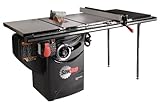
A cabinet table saw and a sliding table saw can both rip and crosscut sheet goods, but they support the work in different ways. On a cabinet saw, the panel rests on the table and you guide it past the blade. On a sliding table saw, the panel is clamped or held against a moving carriage that travels through the cut.
That difference matters most with full-size sheets. A standard 4-by-8-foot panel is awkward to balance while keeping it square and safely against a fence. A sliding carriage carries the panel, so the operator controls its path without having to shove the whole sheet across a fixed tabletop. For smaller parts, solid wood, and occasional panel cuts, a cabinet saw is often the more practical buy.
As an Amazon Associate we earn from qualifying purchases at no extra cost to you.

Quick comparison
| Factor | Cabinet table saw | Sliding table saw |
|---|---|---|
| Panel support | Fixed table, often with an outfeed support | Moving carriage supports and guides the panel |
| Best fit | Mixed shop work, ripping, joinery, smaller panels | Repeated, accurate crosscuts and breakdown of sheet goods |
| Space and setup | Smaller footprint; easier to fit in a general shop | Long carriage needs clear travel space and careful installation |
| Cost | Usually lower for a comparable shop setup | Usually higher, especially for a machine sized for full sheets |
| Main limitation | Large panels need extra support and careful handling | Uses substantial floor space and may be less convenient for routine ripping |
When a cabinet saw makes sense
Choose a cabinet saw if sheet goods are only part of your workload, or if you mostly cut panels into manageable pieces before bringing them to the saw. A reliable rip fence, a flat table, a sharp blade, and a stable outfeed table can handle a lot of cabinet and furniture work without the cost or footprint of a slider.
The catch is panel control. A full sheet can weigh roughly 50 to 80 pounds depending on material and thickness. On a fixed table, that weight can pull the panel away from the fence, twist it into the blade, or make the cut difficult to finish cleanly. A helper, roller stands, or a panel-support system can reduce the strain, but rollers need to be level with the saw table and positioned so they do not steer the work. A support that is too high or low can make a cut less stable, not more.
For occasional sheet breakdown, a track saw is another sensible step before buying a slider. Cut the sheet on a rigid foam surface, then move smaller parts to the table saw for final sizing. A track saw and guide rail can make rough breakdown safer and easier to manage, though it does not replace a table saw for every operation or produce the same workflow for repetitive production cuts.
When a sliding table saw pays off
A sliding saw earns its place when accurate panel crosscuts are routine. The carriage supports the work throughout the cut and gives you a positive reference for keeping the panel square. That makes repeatable sizing less dependent on balancing a large sheet and steering it by hand. It is especially useful for cabinet shops processing plywood, MDF, or melamine panels every day.
Carriage length is a key buying detail. A short travel may handle cabinet parts but not comfortably support a full 8-foot cut. Check the usable stroke, crosscut capacity, and how the panel is secured—not just the machine’s overall length. Also measure the shop: the carriage must travel its full distance, and long panels need room to load and unload. A slider that technically fits against a wall may be frustrating if the carriage or workpiece cannot move freely.
For a shop cutting panels regularly, compare sliding table saws for panel work by carriage capacity, fence adjustment, blade tilt arrangement, dust collection, and availability of service parts. A scoring blade can help prevent chipping on veneered or laminated faces, but it needs correct alignment and adjustment. It is not a substitute for a suitable main blade or a properly supported panel.
Accuracy and cut quality
Neither design guarantees a square cut. On a cabinet saw, check that the fence is parallel to the blade and that the miter gauge or crosscut sled is square. On a slider, check the carriage and crosscut fence against the blade. A small alignment error becomes obvious across a wide panel: an error of 1/16 inch over a 24-inch crosscut can leave cabinet parts visibly out of square.
Blade choice and feed technique matter too. Use a sharp blade suited to the material, keep the panel flat against its reference surface, and avoid forcing a cut that begins to bind. Pinching can burn the edge, spoil the workpiece, or cause kickback. Keep hands out of the blade path and use the machine’s guard and riving knife where the operation allows.
A practical buying decision
Buy a cabinet saw if you need one versatile stationary saw for a mixed woodworking shop, cut full sheets only occasionally, or can break panels down with a track saw first. Put some of the savings toward outfeed support, dust collection, and accurate measuring and alignment tools. A cabinet table saw is the more flexible choice when most workpieces fit comfortably on the table.
Choose a sliding table saw if full-size panels are a regular part of the job and repeatable crosscuts justify the space and setup. If the workload is occasional, the extra capacity may sit unused while the footprint complicates every other operation. Match the machine to the panels you actually process, and verify that the shop has room for both the saw and the work around it.