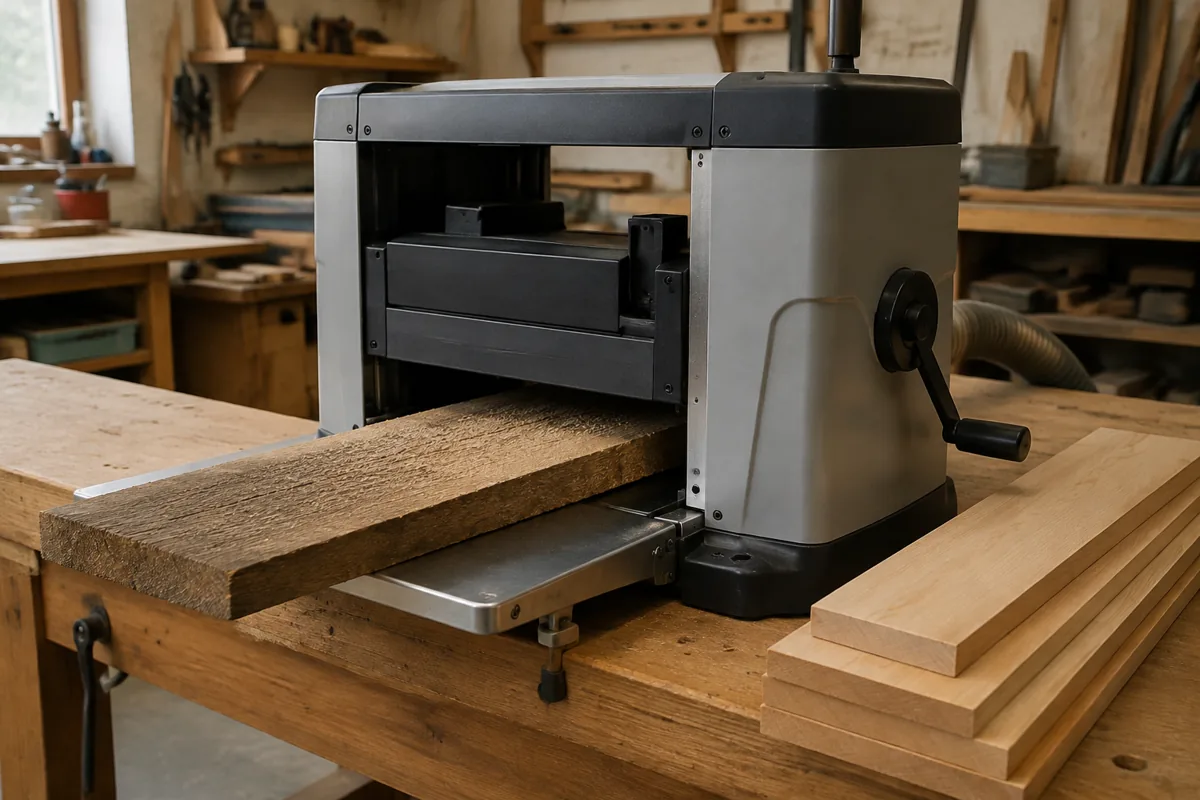
Jointer vs Planer for Preparing Boards with Severe Twist
What's inside
As an Amazon Associate I earn from qualifying purchases. This post may contain affiliate links at no extra cost to you.
A planer does not make a twisted board flat. It makes the two faces parallel. If you feed a severely twisted board straight into a thickness planer, the twist remains; the board may simply come out thinner, with less stock left to remove later.
The usual fix is to establish one flat face first, then plane the opposite face parallel to it. A jointer can do that, but its bed length and width limit the board you can handle. For long, wide, or badly twisted stock, a planer sled is often the more practical solution. The right choice depends on the board’s dimensions, how much thickness you can spare, and whether you need to buy a machine or just get this batch of lumber flat.
Contents
What severe twist means for the machines
Twist is a wind in the board: its four corners do not lie in one plane. Place it on a known-flat surface and press one corner; another corner may rock or lift. A board can also be bowed along its length or cupped across its width. Those defects often occur together, but the remedy is the same at first: create a stable, flat reference face.
A jointer removes material from the face touching its tables and cutterhead. With correct feeding, successive cuts bring that face into one plane. A thickness planer references the face against its bed and cuts the opposite face, so it follows the shape of the face presented to it. That is why a twisted board needs a flat reference face, or a rigid sled that supplies one, before ordinary planing.
Jointer or planer sled?
| Method | Best fit | Main constraint | Typical trade-off |
|---|---|---|---|
| Jointer, then planer | Boards that fit the jointer and have enough thickness to flatten | Jointer width and usable bed length | Fast workflow, but the machine may be costly and undersized for wide stock |
| Planer with a rigid sled | Wide boards or occasional flattening without a wide jointer | Sled stability, planer opening, and setup time | Uses a common machine, but requires shimming and careful handling |
| Hand plane or router sled | One-off boards, very wide slabs, or stock that cannot safely go through a jointer | Labor or fixture-building time | Avoids buying a large jointer; slower than machine jointing |
When a jointer is the better choice
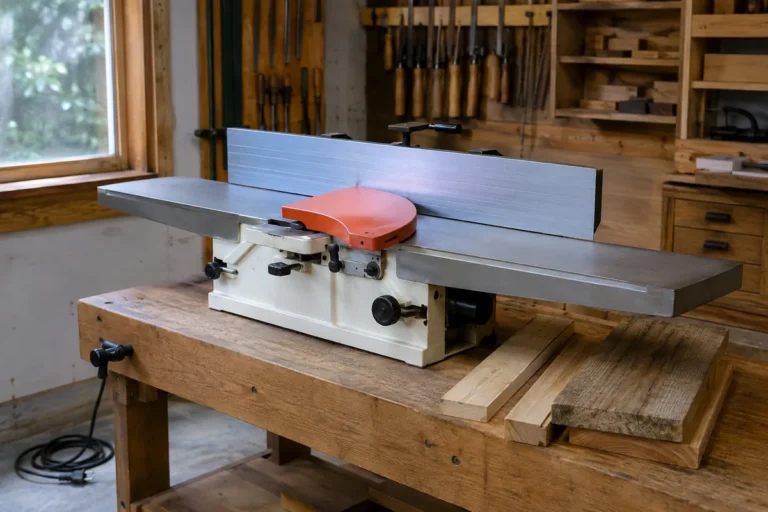
If the board is narrower than the jointer’s capacity and can be supported on its tables, jointing one face is usually the cleanest route. Many shop jointers are 6 or 8 inches wide; a 6-inch machine cannot flatten an 8-inch board in one pass. A longer bed also helps control long stock. A short benchtop jointer may flatten a short board well but can struggle to establish a straight face on a long one.
Take shallow cuts, often around 1/32 inch, and keep the board supported against the fence and tables. Do not try to remove the whole wind in one aggressive pass. High corners can catch or the board can rock, producing a face that is still twisted or a dangerous loss of control. Mark the high spots with pencil or winding sticks, and check progress as you go. Once one face is flat, put that face against the planer bed and thickness the opposite face.
A jointer is worth considering if you regularly prepare solid lumber and your stock fits its capacity. Compare stationary jointers by cutting width, table length, fence quality, and dust collection—not just motor size. For occasional work on wide boards, buying a wide jointer may cost more and use more floor space than the job justifies.
Using a planer and sled
A planer sled lets the board ride on a flat, rigid carrier while shims hold the twisted board still. The sled’s underside rests on the planer bed; the board’s upper face passes under the cutterhead. After you plane one face flat, remove the board from the sled, flip it flat-side down, and plane the second face parallel.
Use a sled long and wide enough to support the board without flexing. A straight piece of plywood or a purpose-built carrier can work, provided it is flat and fits through the planer. Set the board on it without forcing it flat, then shim gaps at the corners and along the length with thin, firm shims. Secure the board so it cannot shift. Loose wedges can move or become projectiles; a board that rocks on the sled can produce uneven cuts or jam.
Take light passes, checking for continuous cutter marks across the face. Stop once the full face is clean rather than removing extra thickness for appearance. Then remove the shims and sled before normal thicknessing. A thickness planer is useful beyond this operation, but a sled does not increase its maximum board width or opening height. Check the machine’s limits, including the sled thickness, before loading the work.
Thickness loss, safety, and common failures
Severe twist can consume a surprising amount of stock. Measure the board at several points and estimate how much must come off the high corners to get one face flat. If the finished part needs to be 3/4 inch thick and flattening would leave only 5/8 inch, the board is not suitable for that dimension without changing the design or using a different method. Do not count on the planer to rescue a board that is already too thin.
Never joint a board that is too short to stay supported, too narrow to control safely, or unstable enough to rock badly on the tables. Avoid jointing stock with loose knots, cracks, or other defects that could break free. On a planer, keep hands clear of the infeed and outfeed, use the manufacturer’s anti-kickback and feeding instructions, and do not pass loose shims or unsecured pieces through the machine. For stock wider than your jointer or awkward to control, a sled is not automatically safe: it must be rigid, stable, and firmly hold the board.
If you prepare only a few boards a year, the cheaper option is often to use a planer sled you build or buy, or have a shop flatten the stock. If you process lumber routinely, a jointer sized for your usual width can save setup time. For severe twist, neither machine replaces careful measurement: the method that removes the least necessary wood while keeping the work stable is the one to choose.