
Key takeaways
- The best wood rasps and files compared: grain grades, half-round, flat and rattail profiles, handles, and care tips for shaping legs, spoons and curves.
What's inside
As an Amazon Associate I earn from qualifying purchases. This post may contain affiliate links at no extra cost to you.
- Top Pick: Narex 3-Piece Cabinetmaker Rasp Set, 200 mm Coarse Cut (854202)
- Runner-up: Shinto 9-Inch Saw Rasp (SR-10)
- Also consider: Stanley Surform Plane, 21-296
A bandsaw leaves a chair leg close to its final shape, but not close enough. The last stretch of shaping, where a square blank becomes a rounded leg, a spoon bowl gets its hollow, or a cabriole curve loses its flats, is where wood rasps earn their place. A rasp cuts with hundreds of individual raised teeth, so it removes stock far faster than sandpaper and works into curves a plane cannot reach. Followed by a finer file, it takes parts most of the way to a finish-ready surface.
As an Amazon Associate, we earn from qualifying purchases.
This guide compares five shaping tools covering the full sequence, from aggressive stock removal to final smoothing: a cabinetmaker rasp set, a Japanese saw rasp, two Surform shavers with replaceable blades, and a basic file set. It also explains grain grades, hand-stitched versus machine-cut teeth, profile choice, and the care habits that decide how long a rasp keeps cutting.
This article contains affiliate links, and fdwoodworking.com may earn a commission if you buy through them at no extra cost to you.
Contents
Quick Answer
Start with a half-round cabinet rasp in a medium grain for chair legs and general curves, add a coarse Shinto saw rasp when stock has to move fast, and keep a fine file or pocket Surform for final smoothing. Match the profile to the surface: flat for flats, half-round for mixed work, round rattail for holes and tight inside curves.
Narex 3-Piece Cabinetmaker Rasp Set, 200 mm Coarse Cut (854202)

For most furniture shaping, this Czech-made set is the sensible core kit. It bundles the three profiles a chair maker reaches for most: a flat rectangular rasp for leveling and edge work, a half-round for curved legs and aprons inside and out, and an 8 mm round rattail for holes and tight concave curves. All three blades are 200 mm long, giving a long, controlled stroke without feeling clumsy on small parts.
The teeth are machine stitched by CNC, producing a uniform pattern that cuts evenly and predictably. The coarse cut, at 16 teeth per square centimeter, removes stock at a useful pace while leaving a surface a finer rasp or file can clean up quickly. The 145 mm hornbeam handles give a secure two-handed grip when a stroke needs pressure.
Specs
- Profiles: flat rectangular (20 mm), half-round (20 mm), round rattail (8 mm)
- Blade length: 200 mm
- Cut: coarse, 16 teeth per square centimeter
- Tooth pattern: machine stitched (CNC)
- Handles: hornbeam, 145 mm
- Overall length: 345 mm
- Model: 854202
- Blade hardness: not stated
View the Narex rasp set on Amazon
Shinto 9-Inch Saw Rasp (SR-10)

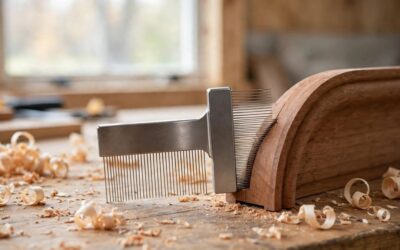
The Shinto takes a different approach to tooth design. Instead of punching teeth into a solid blank, it is built from riveted saw blades, leaving an open structure that sheds shavings instead of packing up. One face is coarse for fast roughing, the other fine for refining, so one tool handles both early shaping and the first smoothing passes.
Because the cutting faces are flat, the Shinto works best on flat and convex surfaces: rounding chair leg blanks, fairing a curved rail, or shaping a paddle or utensil handle. It cannot hollow a concave curve the way a half-round rasp’s rounded back can, so it complements a traditional rasp rather than replacing one. The open teeth clear with a quick brush-down and resist clogging in resinous softwoods. For makers roughing out many small parts, it is the fastest hand tool here for the first stage.
Specs
- Blade length: 9 in
- Construction: riveted saw blades, open tooth structure
- Faces: coarse on one side, fine on the other
- Part number: SR-10
- Country of origin: Japan
- Handle material: not stated
View the Shinto saw rasp on Amazon
Stanley Surform Plane, 21-296

The Surform is a rasp reimagined as a plane. A perforated, replaceable blade sits in a die-cast alloy body with a high-impact polymer handle, pushed like a small bench plane to shave wood down quickly. The standard-cut 10-inch blade flattens the edges of shaped blanks, trims end grain, eases the arrises on chair parts, and knocks down high spots on glued-up panels.
Its real advantage is maintenance. When a conventional rasp dulls, it is effectively done; when a Surform blade dulls, it unclips and a fresh blade takes its place in seconds. It will not reach inside a curve, and it leaves a scratched surface needing file or abrasive work, but for fast, flat stock removal it earns its bench space.
Specs
- Blade: 10 in (250 mm), replaceable, standard cut
- Body: die-cast alloy
- Handle: high-impact polymer
- Model: 21-296
- Also rated for: soft metals, plastics and laminates
- Blade width: not stated
View the Stanley Surform plane on Amazon
Stanley Surform Pocket Plane, 21-399

The pocket version shrinks the same idea into a 6-inch, one-handed tool with a fine-cut blade. That finer blade and short sole make it a smoothing tool rather than a stock remover: it cleans up scratches left by coarser rasps, trims end grain, breaks sharp edges, and refines small pieces like spoon handles where a full-size rasp feels oversized.
The die-cast zinc alloy body keeps it rigid, and the blade swaps with a thumbscrew, no tools needed. Paired with a coarse shaping rasp, it covers the fine end of the sequence without the cost of a dedicated fine-grain hand-stitched rasp.
Specs
- Overall length: 6 in
- Blade: 5-1/2 in (140 mm), replaceable, fine cut
- Body: die-cast zinc alloy
- Blade change: thumbscrew, tool-free
- Model: 21-399
View the Stanley Surform pocket plane on Amazon
TARIST 3-Piece File Set, 8-Inch

Files are the quiet second half of shaping. Their teeth are cut in continuous rows rather than raised as individual points, so they cut more finely than rasps and leave a smoother surface. This TARIST set covers the three standard profiles, flat, half-round and round, in 8-inch carbon steel files, giving a matching fine tool for every rasp profile in the Narex set above.
In practice, the flat file levels the shallow scratches a rasp leaves on a leg facet, the half-round blends rasp facets into a continuous round, and the round file smooths holes and inside curves before sanding. Files also handle fitting work rasps are too coarse for: easing a tight tenon cheek or cleaning up a mortise wall. As a first file set, it covers the smoothing and fitting stage where rasp work ends.
Specs
- Pieces: 3 (flat, half-round, round)
- File length: 8 in
- Material: carbon steel
- Model: FS04-202303
- Hardness: not stated
View the TARIST file set on Amazon
How to Choose
Hand-stitched vs machine-cut teeth
Premium rasps from makers such as Auriou and Liogier are hand stitched: a worker punches each tooth individually, producing a slightly irregular pattern. That irregularity is a feature, because the teeth never line up in rows that track grooves into the work, and the surface left behind is smoother for the grade. Machine-cut rasps, including the CNC-stitched Narex set above, space teeth in a perfectly regular pattern. They cut predictably and cost far less; the trade-off is a more scratched surface needing one extra refining step.
Grain and coarseness grades
French-style rasps are graded by grain number, from about grain 5 for coarse, fast removal to grain 15 for fine finishing, the numbering tied to tooth density for a given length. A sensible progression is a coarse rasp around grain 8 to 10 for roughing, then a finer grain 12 to 14 or a file for smoothing. Files use different vocabulary: bastard cut is coarsest, then second cut, then smooth. Whatever system a listing uses, buy coarse-to-fine rather than expecting one tool to do both jobs.
Shape, size and handles
Match the profile to the surface. Flat rasps level flats and outside edges. Half-round rasps are the all-rounders, flat on one face and curved on the other, shaping convex legs and concave coves with one tool. Round rattails work inside holes and tight curves; rifflers handle carved detail. Longer blades suit larger work like table legs; shorter blades give control on spoons and small parts. Finally, check the handle: a well-fitted handle with a metal ferrule resists splitting where the tang enters and gives the second hand a safe place to guide the tip. A loose or missing handle is unsafe, since the exposed tang can dig into a palm.
Care: brushing, chalk and rust prevention
Rasps keep cutting if their teeth stay clean and dry. Work a brass or stiff bristle file card across the teeth after a session to clear packed shavings; dusting the teeth with chalk before use reduces clogging in resinous woods. Never store rasps loose in a drawer where teeth bang against other tools, since raised teeth chip easily. Keep them in a roll, rack or sleeves, store them dry, and wipe the steel with a lightly oiled cloth in humid shops to hold rust off.
Who Should Skip
Skip rasps and files if your shaping is mostly heavy stock removal on large carvings or chair seats. A power carving disc or a rotary tool with carbide burrs clears that volume far faster; hand rasps become the refining tool afterward, not the main event. Skip them, too, if you expect a finish-ready surface straight from the tool: every rasp and file leaves scratches needing a scraper or abrasives before finish. Spokeshave and drawknife specialists may find a rasp duplicates tools they already control well, and anyone filing mostly metal should buy a machinist file set, since coarse raised rasp teeth are wrong for steel.
FAQ
What is the difference between a rasp and a file?
A rasp has individual raised teeth punched one at a time, making it aggressive and ideal for shaping wood. A file has continuous grooves cut across its face, so it cuts more slowly and leaves a smoother surface. The rasp shapes; the file refines.
Which grain should a first rasp be?
A medium grade is the most useful starting point: around grain 9 or 10 in the French system, or a coarse cabinet cut of roughly 16 teeth per square centimeter in European listings. It removes stock at a satisfying pace on chair legs without leaving damage that takes long to clean up.
Can a dull rasp be sharpened?
Not in any practical home-shop sense. The raised teeth cannot be re-cut with ordinary sharpening gear, so a worn rasp is usually retired to rough work on softwood. Tools with replaceable blades, like the Surforms above, sidestep the problem by swapping in a fresh blade.
How do I stop a rasp from clogging?
Brush the teeth out with a file card as soon as cutting slows, and dust the face with chalk before working resinous or damp wood to keep the gullets from packing solid. The Shinto’s open saw-blade structure clogs least of all, one reason it suits softwoods.
Final Verdict
For a first shaping kit, the Narex three-piece set is the foundation: three profiles, honest coarse teeth, and proper hornbeam handles cover most chair and casework shaping. Add the Shinto when roughing speed matters, keep the Stanley Surform plane for flat work and end grain, the pocket version for one-handed smoothing, and finish with the TARIST files. Bought in that coarse-to-fine order, the five tools form a complete hand-shaping sequence, from bandsawn blank to nearly finish-ready.
Related guides
More from Amazon
Programs that pair well with the guide above. Offers and eligibility are set by Amazon and may change.
A free business account with business pricing and bulk-buying tools for work, shop or home office.
Create a business accountFree shipping on eligible items, Prime Video and more. Eligible new members can start with a free trial.
Start a Prime free trialAudiobooks and podcasts to listen to on the go. Eligible new members can start with a free trial.
Try Audible freeAd-free music streaming. Eligible new subscribers can start with a free trial.
Try Music Unlimited freeAs an Amazon Associate we earn from qualifying purchases.




Write Your Review
No reviews yet. Be the first to share your experience!