How to Choose a Drill Press Swing for Cabinet and Furniture Work
What's inside
As an Amazon Associate I earn from qualifying purchases. This post may contain affiliate links at no extra cost to you.
A drill press’s swing is one of the first specifications to check when you’re buying for cabinet and furniture work. It tells you how far the machine can drill from the edge of a workpiece, which directly affects mortises, hinge plates, dowel holes, hardware installation, and other joinery.
Swing is useful, but it is easy to misunderstand. A larger swing does not automatically mean a better drill press. For furniture work, throat depth, spindle travel, table size, speed range, and runout can matter just as much. The right choice depends on the parts you build and how often you need to drill near the center of a wide panel.
Contents
What drill press swing means
Swing is twice the distance from the drill press column to the center of the spindle. A drill press with a 12-inch swing has approximately 6 inches of throat depth. That means it can drill a hole up to 6 inches from the edge of a workpiece, assuming the workpiece fits on the table and does not hit the column.
The measurement describes capacity, not the maximum width of stock you can casually place on the machine. A 12-inch-swing press may accept a 12-inch-wide panel for an edge-to-center hole, but a panel that is 24 inches wide cannot be positioned to reach its center. You would need to drill from both sides, use a different setup, or choose a press with more swing.
Manufacturers usually state swing as a rounded number: 8, 10, 12, 15, or 17 inches. The actual throat depth can be slightly less than half the advertised swing because of the column, head casting, and spindle geometry.
How much swing furniture work needs
| Drill press swing | Approximate throat depth | Good fit for | Main limitation |
|---|---|---|---|
| 8-inch | 4 inches | Small boxes, narrow rails, basic hardware | Limited access on cabinet sides and wide panels |
| 10-inch | 5 inches | General light furniture and cabinet work | Can feel cramped with large face frames |
| 12-inch | 6 inches | Most cabinet doors, drawer parts, and furniture joinery | Still cannot reach the center of broad panels |
| 15- to 17-inch | 7.5 to 8.5 inches | Wide panels, large casework, frequent production work | Costs more and takes more floor space |
For a typical home cabinet shop, a 10- or 12-inch press is usually the practical middle ground. It handles shelf-pin drilling in narrow cabinet parts, hinge-cup drilling in doors, dowel and confirmat holes, and most small joinery without excessive cost.
An 8-inch press can be enough if you mainly work on drawer parts, small furniture, and narrow rails. It is also a reasonable choice when space and budget are tight. The failure mode is not that it drills poorly; it is that you repeatedly run out of throat depth and start making awkward fixtures or drilling by hand.
Move to 15 inches or more when your work regularly includes wide cabinet sides, large doors, dining-table components, or drilling several inches in from a panel edge. The extra capacity is valuable if you are building furniture every week. It is harder to justify for occasional projects.
Swing and cabinet-making tasks
Hinge-cup drilling is a good example of where swing matters. A cabinet door often fits easily on a small press, but a long or wide door can be awkward to position. The hole may be close to the edge, so a 10-inch press is normally adequate, but the table must support the door without tipping.
Shelf-pin holes are less demanding because the holes run along the front or rear edge of a cabinet side. A fence and a long auxiliary table are more important than extreme swing. For this job, a 12-inch press with a dependable fence is generally more useful than a larger press with a poor table.
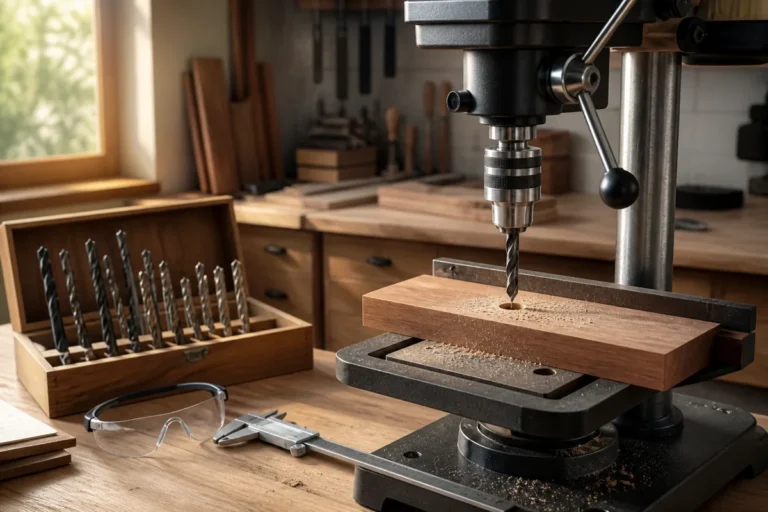
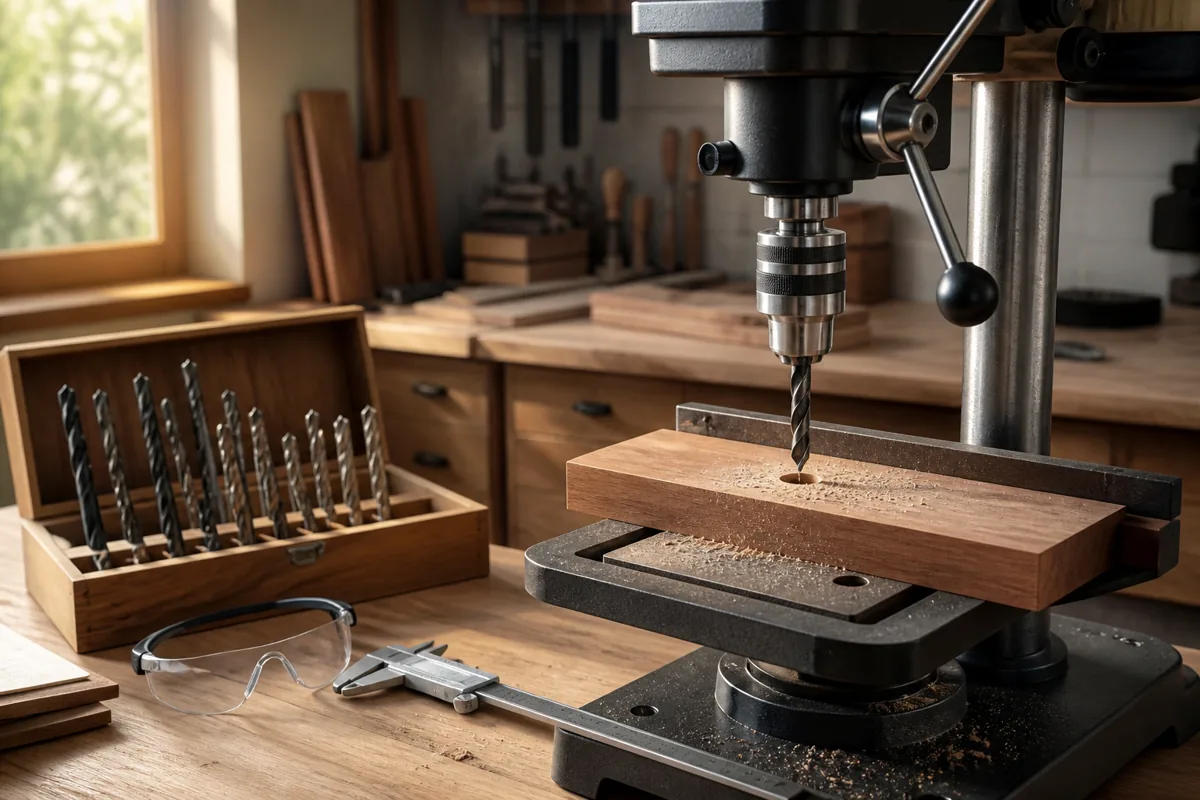
Doweling and loose-tenon work also depend on repeatable positioning. Swing gives clearance, but it does not prevent tear-out or wandering. Use a sharp brad-point bit, clamp the work securely, and support the exit side with scrap. For clean, repeatable cabinet joinery, a drill press fence and table can improve results more than another few inches of swing.
Other specifications that matter
Spindle travel: Look for at least 2-1/2 inches for general furniture work. Three inches is more comfortable for deep boring and layered setups. Swing will not help if the quill cannot reach the work.
Speed range: Variable-speed control or several belt settings are useful. Large Forstner bits, such as 2-1/2-inch hinge-cup or hardware bits, should run much slower than small twist bits. A useful range is roughly 250 to 3,000 rpm, though many woodworking tasks sit between 500 and 2,000 rpm.
Table size and adjustment: A tilting table is less important than a table that locks firmly and has enough surface for your work. A table around 10 by 10 inches is workable; larger is better for doors and cabinet panels. Check whether the table can swing away from the column and whether it stays square after adjustment.
Runout: Excessive chuck or spindle runout causes oversized holes, vibration, and poor-fitting dowels. For furniture work, a machine with roughly 0.003 inch or less of measured runout at the chuck is a sensible target. Marketing claims are not always consistent, so inspect the chuck and test with a dial indicator when possible.
Power: A true 3/4-horsepower motor is plenty for most home furniture work. One horsepower gives more reserve with large Forstner bits, but motor size does not compensate for a dull cutter, an unstable table, or an undersized belt drive.
Buying and using the press
Before buying, measure the widest part you expect to drill and calculate the distance from its edge to the hole center. Add clearance for a fence, clamp, and any angled or oversized workpiece. If that number is 5 inches, a nominal 10-inch press may work, but a 12-inch model gives useful breathing room.
For most cabinet shops, a 12-inch woodworking drill press is the safest general recommendation. Choose a smaller 10-inch drill press when your parts are narrow and the savings or smaller footprint matter. Choose a larger floor press when wide workpieces and frequent production justify its cost.
Whichever size you select, clamp large parts instead of holding them by hand. A spinning Forstner bit can grab suddenly, rotate a door, and damage both the workpiece and your fingers. Set the table height carefully, use backing material to prevent blowout, and let the bit cut at a controlled feed rate. Swing determines where you can drill; safe setup determines whether the hole is usable.