
What's inside
As an Amazon Associate I earn from qualifying purchases. This post may contain affiliate links at no extra cost to you.
The short answer: the best card scrapers for woodworking are flat, evenly ground steel rectangles with square, true edges that you can turn into a fine hook, plus a hard, smooth burnisher to do the turning. A basic set of rectangular scrapers in two thicknesses handles most flat surfaces, a curved or gooseneck scraper handles contours, and a scraper holder is worth considering if your hands tire quickly. Because the cutting edge is something you create yourself, technique and a good burnisher matter as much as the steel.
This guide does not rank products. It explains what card scrapers do, how the shapes differ, how to judge steel and thickness, what a burnisher is and why it matters, and how to keep the process safe. Use it to decide what to look for, then check current specifications and the maker’s instructions before ordering.
Contents
Our Top Picks

Contents
- Why use a card scraper at all
- Shapes and what each is for
- Steel quality and thickness
- The burnisher: the other half of the tool
- Comparison table
- Preparing the edge
- Using a card scraper well
- Safety notes
- Buyer checklist
- Mistakes to avoid
- Frequently asked questions
- Bottom line
Why use a card scraper at all
A card scraper is a thin sheet of hardened steel that, with a properly prepared edge, shaves extremely fine curls of wood instead of grinding it into dust. That changes the result in several ways. The surface it leaves is crisp, because the fibers are sliced rather than torn and abraded. It handles swirling, interlocked or figured grain that makes a plane tear out. It also removes glue squeeze-out, dried finish drips and light blemishes without the rounding-over that sandpaper can cause at edges and joints.
There is a practical bonus: scraping produces shavings, not airborne fine dust, which is pleasant in a small shop. That does not mean dust protection is unnecessary, particularly if you scrape treated or exotic woods, so follow sensible shop habits. For a hobbyist who has fought with tear-out on a tabletop or struggled to blend a repair, a pair of scrapers can be among the least expensive upgrades available.
Where scrapers shine
- Final smoothing of tabletops, panels and drawer fronts before finish.
- Dealing with figured maple, curly or bird’s-eye wood, and other tricky grain.
- Cleaning up dried glue lines in joinery.
- Levelling a veneered surface with care and a light touch.
- Removing old finish in small areas when chemical strippers are not wanted.
- Smoothing curved parts such as chair arms or molded edges, using a shaped scraper.
Shapes and what each is for
Rectangular scrapers
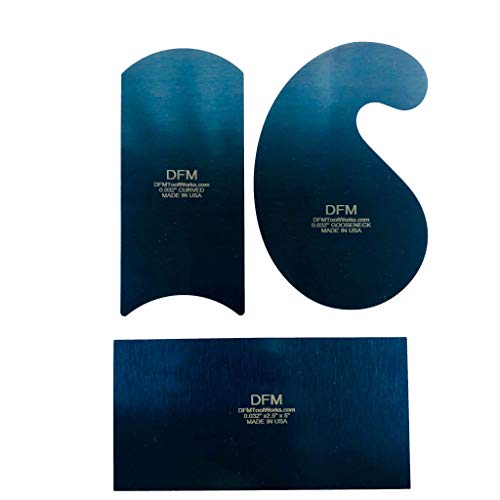
The classic rectangle is the standard recommendation. You flex it slightly between your thumbs and fingers, which makes the edge cut a concave line, and you can use any of its four long edges, so one piece of steel offers several fresh starts. Rectangular scrapers are cheap, easy to store and ideal for flat boards. If you buy only one shape, this is it.
Curved and gooseneck scrapers
A gooseneck scraper has a curved profile along its edge, often with a pronounced recess, and is designed for hollows and contours. It can reach into moldings and the inside of curved rails where a rectangle cannot follow. These are more specialized, and each curve has to be sharpened in a way that respects its shape, so they take a little more patience.
Shaped and profile sets
Some sets include several profiles for specific moldings. They can be useful for restoration or for makers who cut the same molding repeatedly, but a general hobbyist rarely needs more than a rectangle and one curved piece. Be cautious about large sets whose individual pieces you would never use.
Cabinet scrapers and scraper planes
A cabinet scraper mounts a scraper blade in a metal body with a clamp and adjusting screw, so the blade is held at a set angle and you push it like a small plane. This takes the strain off your thumbs and offers consistent results on large surfaces. The trade-off is that the blade usually needs a burr at a more controlled angle, and the tool is bigger and often more expensive than a handheld piece of steel.
Scraper holders and handles
Simple holders grip a card scraper and provide a curved handle, which saves your thumbs and can add control. If you scrape a lot, they are worth a look. Check that the holder fits the thickness of the scrapers you own.
Steel quality and thickness
Thickness: thin for finishing, thick for stock removal
Thinner scrapers flex easily, which suits fine finishing and gentle curves. Thicker ones are stiffer, which resists chatter and is better for aggressive work or for holding a flatter line, but they are harder to flex into a concave shape. Many woodworkers keep two thicknesses and move between them. Check the listing for the stated thickness and compare it against what you have used before.
Hardness and flatness
Scrapers are typically made from hardened steel. A scraper that is too soft will lose its burr rapidly. One that is too hard may be harder to file and prone to chipping when dropped. Equally important is flatness: a warped scraper never cuts evenly. Read buyer reviews for notes about flatness and edge finish, since these are common sources of complaints.
Factory edges
Some scrapers arrive with edges that are rough, rounded or not square. Do not assume the edge is ready to cut. Plan to file and stone the edge square before you raise a burr, as described below.
The burnisher: the other half of the tool
A burnisher is a hard, smooth, rounded rod, usually of hardened steel or sometimes carbide, used to turn the fine metal burr that does the cutting. Without it, a scraper will only scratch or scrape ineffectively, so it deserves as much thought as the scraper itself.
What to look for
- Hardness: The burnisher must be harder than the scraper steel. If it is not, it will wear or dent.
- Surface finish: A smooth, polished surface leaves a cleaner burr and avoids dragging.
- Shape: Round rods work for most users. Some are oval or triangular to reach different curves. A handle improves comfort and control.
- Material: Steel and carbide are common. Carbide is often described as very hard and long lasting, but check the maker’s notes on its brittleness and care.
If you want to pair a scraper with a dedicated tool, you can browse a card scraper burnisher and confirm that its stated hardness suits your scrapers. A card scraper set with mixed thicknesses is a practical way to learn which feel you prefer.
Comparison table
This table compares common scraper tool types in general terms.
| Type | Best for | Advantages | Drawbacks |
|---|---|---|---|
| Thin rectangular scraper | Fine finishing, gentle curves | Flexes easily, gentle on surfaces | Can lose the burr quickly under hard use |
| Thick rectangular scraper | Flat boards, heavier removal | Stiff, steady, resists chatter | Harder to flex for a concave cut |
| Gooseneck or curved scraper | Moldings and hollows | Follows contours | Sharpening takes more patience |
| Cabinet scraper with body | Large flat surfaces | Consistent angle, saves thumbs | Larger, more costly, more setup |
| Holder or handle | Frequent use | Comfort, control | Must match scraper thickness |
| Profile set | Specific moldings | Ready shapes for restoration | Pieces you may never use |
Preparing the edge
Sharpening a card scraper is a short routine, but each step matters. Follow the maker’s instructions where they exist, since different steels and designs can call for slightly different methods. The following sequence is a common approach.
- Secure the scraper. Hold it in a vise between wooden cauls, with the edge protruding just slightly.
- File the edge square. Use a flat file to remove old burrs and make the edge perpendicular to the faces, keeping the file steady and level.
- Stone the edge. Rub the edge on a fine stone, holding the scraper upright, to remove file marks.
- Polish the faces. Lay each face flat on the stone for a few strokes to remove any burr, so the edge is clean and sharp on both sides.
- Draw the edge. Burnish along the edge with light pressure to harden it and prepare the steel.
- Turn the burr. Tilt the burnisher slightly and stroke the edge with firm, even pressure, increasing the tilt just a few degrees from one pass to the next until you feel a tiny hook. Test it with a fingernail, never a fingertip drawn across the edge.
You can feel the difference between a good and bad burr at once. A good edge produces fine curls, while a poor one makes dust. If you get dust, the burr is too small, too rounded or too dull, so go back and refresh the edge.
Using a card scraper well
Grip and flex
Hold the scraper with fingers wrapped around the back edge and thumbs pushing from the front, so that a gentle bow forms. Tilt the top edge forward away from you so the hook bites. Push or pull in smooth strokes, adjusting the bow and the tilt until you see curls.
Work direction and tear-out
Scrape with or across the grain, and change direction when you meet difficult figure. Light, overlapping strokes blend better than deep digging. Keep the scraper moving so you do not create a dip, since the bowed shape can scoop a shallow hollow if you linger.
Finishing and heat
The edge warms up as you scrape, and your thumbs can feel it. If you feel heat, pause or switch to a different edge of the same scraper. After scraping, a light pass with fine sandpaper is optional and depends on your finish; some woodworkers skip sanding entirely because the scraped surface takes finish cleanly.
Safety notes
- The edge is sharp, and so are the corners. Treat the scraper like any blade, and keep it in a sleeve or slot when not in use.
- Do not test with a drawn fingertip. Use a fingernail or look for curls on scrap wood.
- Protect your hands. Gloves can reduce the chance of cuts while sharpening, though some people find they reduce feel when scraping. Choose based on the task.
- Mind the heat. A hot scraper can burn thumbs, so pause as needed.
- Secure workpieces. Clamp the board so that you do not need to brace it with your free hand near the edge.
- Wear eye protection and a dust mask when filing, stoning and scraping, especially with exotic or treated woods.
- Check current instructions. Follow manufacturer guidance for your scraper, burnisher and any holder.
- Be careful with old finishes. Do not scrape old paint or finish until you have checked whether it could contain lead or other hazards in older buildings, and follow local guidance.
Buyer checklist
- Choose a rectangular scraper first, since it is the most versatile.
- Consider two thicknesses so you can match the job.
- Confirm the steel is described as hardened and check for notes about flatness.
- Plan for a burnisher that is harder than the scraper steel.
- Add a small flat file and a fine stone if you do not own them already.
- Think about a holder or cabinet scraper if your hands tire quickly or you work large panels.
- Decide whether you need a gooseneck for contours before buying one.
- Look for clear instructions or a reputable guide with the product.
- Read the return policy in case a scraper arrives warped or chipped.
- Check current specifications and instructions before you order.
Mistakes to avoid
- Treating the factory edge as finished. Most scrapers need to be filed and stoned before the first use.
- Using a burnisher that is too soft. It will not turn a clean burr and may be damaged.
- Turning the hook too aggressively. A heavy hook chatters, gouges and wears quickly.
- Pressing too hard. Heavy pressure produces dust and heat, not curls.
- Scraping in one spot. The bow can create a dip, so keep the tool moving.
- Neglecting flat faces. A burr on the faces interferes with the edge you want.
- Buying every profile at once. Learn on a rectangle before you invest in specialist shapes.
- Skipping protection. A sleeve and sensible handling prevent nicks to hands and tools alike.
Frequently asked questions
1. What is a card scraper used for?
It smooths wood by shaving very fine curls, which is helpful for final surface prep, difficult grain, glue removal and finish touch-ups.
2. Is a card scraper better than sandpaper?
They do different jobs. Scraping can leave a cleaner surface on tricky grain and creates less airborne dust, while sandpaper is faster for general abrasion and shaping. Many woodworkers use both.
3. Do I need a burnisher?
Yes, if you want a scraper that cuts instead of scratches. The burnisher turns the burr that forms the cutting edge.
4. How often should I resharpen?
When the scraper starts producing dust instead of curls. You may only need to re-burnish a few times before it requires a full file and stone refresh.
5. What thickness should I buy?
A thinner scraper is easier to flex and good for finishing, while a thicker one gives stiffness for heavier work. If you are unsure, a mixed set lets you compare feel.
6. Can I use a card scraper on curved parts?
Yes, using flexed rectangles for gentle convex shapes or a curved scraper for hollows and moldings.
7. Why does my scraper only make dust?
The burr may be too small, too rounded or damaged. Re-stone the edge, polish the faces and turn a new hook with steady pressure.
8. Is a scraper safe for beginners?
It is a simple hand tool with a sharp edge. Clamp the work, protect your hands, wear eye protection and follow the manufacturer’s directions, and you can learn the technique safely.
Bottom line
For the best results, begin with a plain rectangular scraper, learn to prepare the edge, and invest in a smooth, hard burnisher. Add thicker or curved shapes later as your work demands them. Check current specifications and the maker’s instructions before buying, then compare a gooseneck scraper or a scraper holder if your projects need more reach or comfort.
Disclosure: As an Amazon Associate, we earn from qualifying purchases. Links marked as sponsored may earn us a commission at no extra cost to you.
Related guides
More from Amazon
Programs that pair well with the guide above. Offers and eligibility are set by Amazon and may change.
A free business account with business pricing and bulk-buying tools for work, shop or home office.
Create a business accountFree shipping on eligible items, Prime Video and more. Eligible new members can start with a free trial.
Start a Prime free trialAudiobooks and podcasts to listen to on the go. Eligible new members can start with a free trial.
Try Audible freeAd-free music streaming. Eligible new subscribers can start with a free trial.
Try Music Unlimited freeAs an Amazon Associate we earn from qualifying purchases.

Write Your Review
No reviews yet. Be the first to share your experience!