Bandsaw Resaw Fence vs Standard Rip Fence for Straight Cuts
What's inside
As an Amazon Associate I earn from qualifying purchases. This post may contain affiliate links at no extra cost to you.
A standard rip fence can guide a bandsaw cut, but it does not guide a resaw cut in quite the same way a table-saw fence guides a rip. A bandsaw blade can drift as it passes through thick stock, and the fence needs to let you correct for that drift. A dedicated resaw fence is shaped and adjusted for this job; a standard fence is often flat and fixed square to the table.
If you mostly cut narrow stock or resaw only occasionally, a standard fence may be enough. If you routinely split boards into thinner slabs, a resaw fence can make setup easier and reduce wandering. The right choice depends as much on blade condition and setup as on the fence itself.
As an Amazon Associate we earn from qualifying purchases at no extra cost to you.

Contents
What the fence does on a bandsaw
On a table saw, a sharp blade and a properly aligned fence usually produce a straight cut when the stock is held against the fence. A bandsaw blade is narrower, runs on wheels, and can deflect under load. Thick or hard stock puts more pressure on the blade, so the cut may travel at a slight angle even when the fence is square to the table.
That angle is called blade drift. A fence that simply sits parallel to the miter slot or square to the table may not track with the blade’s natural path. The operator then has to steer the board, which is difficult to do consistently while keeping it safely against the fence.
Resaw fence vs. standard rip fence
| Feature | Resaw fence | Standard rip fence |
|---|---|---|
| Fence face | Often tall, with a narrow contact area or adjustable face | Usually flat and wider, intended to hold stock against a fixed line |
| Drift adjustment | Commonly pivots or adjusts to match the blade’s tracking angle | May need to be repositioned or shimmed; some fences do not adjust easily |
| Best suited to | Splitting boards through their thickness | Narrow ripping and general guiding when drift is slight |
| Trade-off | Costs more or takes setup; a tall face needs a stable workpiece | Cheaper and versatile, but can require more hand steering on resaw cuts |
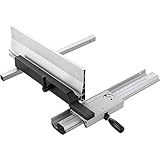
A resaw fence is not automatically more accurate. Its main advantage is that it gives you a practical way to set the fence at the angle that lets your particular blade cut straight. Some versions also offer a narrow face, which reduces the chance that a board’s irregular edge will hold it away from the fence.
When a standard fence is enough
For thin strips, small parts, and occasional cuts in stock around 1/2 to 1 inch thick, a standard fence is often fine if the blade is sharp and the cut tracks straight. It is also a sensible choice if your bandsaw fence can be adjusted for drift or securely shimmed to the needed angle. Check the fence instructions before adding shims; a loose or uneven shim can let the fence shift during a cut.
Test with scrap of the same species and similar thickness as the workpiece. Draw a line parallel to a straight edge, then make a freehand cut while following the line without forcing the board. If the blade naturally follows the line at a consistent angle, set the fence to match that angle and make a fence-guided test cut. A test on thin pine does not prove the setup will work on thick maple: blade deflection changes with stock, feed pressure, and blade condition.
A standard fence is also the better buy if you mainly use the bandsaw for curves and occasional straight cuts. A dedicated resaw fence cannot compensate for a dull blade, poor tension, or a saw that lacks the capacity to resaw your stock.
When a resaw fence earns its cost
Consider a dedicated bandsaw resaw fence if you regularly split boards into veneers or book-matched panels, or if you repeatedly change stock thickness and need to reset the fence. Look for a fence that fits your saw’s table and rail, locks without rocking, and allows the face to be adjusted or positioned for drift.
A tall fence supports the board through a deep cut, but it also magnifies problems with a bowed edge. If the board rocks or has a badly irregular reference edge, a tall face can make the cut worse by locking in that movement. Flatten or joint one edge first, and keep the board firmly against the fence without leaning hard into it.
For occasional resawing, a straight auxiliary face attached to the existing fence can be a low-cost trial. It should be rigid, securely fastened, and tall enough to support the board without obstructing the cut. Avoid a flimsy extension: if it flexes under hand pressure, it will not hold a reliable line.
Blade and setup matter more than the fence
For resawing, use a sharp blade intended for the job, commonly 3/4 to 1 inch wide where the saw’s wheel and guide capacity allow it. A blade with fewer teeth per inch and adequate gullet space clears sawdust better in a deep cut. Do not install a blade wider than the manufacturer’s limit. A dull or narrow blade can wander despite a well-adjusted fence.
Set blade tension and guides according to the saw maker’s instructions, then check that the blade tracks correctly on the wheels. Make a test cut at a steady feed rate. Pushing harder to maintain speed can bend the blade and leave a tapered face; feeding too slowly can also burn the wood and dull the blade. If the cut consistently angles away from the fence, adjust the fence to the tested drift rather than steering the board by force.
Keep both hands clear of the blade path, use a push device for short work, and never stand directly in line with the board if it could kick back or twist. A fence is a guide, not a substitute for controlling the stock.
A practical buying decision
Before buying, check whether your saw’s existing fence can be adjusted to match drift. If it cannot, a compatible adjustable bandsaw fence is useful for frequent resaw work. If you resaw only a few boards a year, try setting your current fence and making scrap tests first. Spend the money on a suitable blade if the one you have is dull, too narrow, or poorly suited to thick stock.
Choose the fence that fits the work you actually do: a standard rip fence is adequate for many straight cuts, while a resaw fence makes drift adjustment and repeated thick cuts more manageable. Neither turns an underpowered saw or a poor setup into a reliable resaw machine.