Best Random Orbital Sander: Where Finish Quality Actually Comes From
Key takeaways
- A buying guide to the best random orbital sander that focuses on pad control, dust capture and vibration rather than spec-sheet numbers.
What's inside
As an Amazon Associate I earn from qualifying purchases. This post may contain affiliate links at no extra cost to you.
Nothing exposes a shop’s weak link faster than sanding. A cabinet door can be milled square, jointed clean and glued flat, and still read as amateur work under a raking light because of swirl marks that only appeared after the first coat of finish. That is why the search for the best random orbital sander matters more than most tool decisions: the sander is the last machine to touch the wood before finish, and it either erases the sins of every previous step or adds its own.
The frustrating part is that spec sheets tell you almost nothing here. Orbits per minute, amps and orbit diameter are all published, all comparable, and all nearly useless for predicting whether a sander will leave a clean surface. What actually separates a good five-inch sander from a fatiguing one is a short list of mechanical details that manufacturers rarely advertise: how well the pad brake controls the disc at startup, how balanced the counterweight is, how rigidly the backing pad is mounted, and whether the dust port truly moves debris off the surface instead of grinding it back in. We judge the category against those criteria below.
As an Amazon Associate we earn from qualifying purchases at no extra cost to you. Product prices and availability are accurate as of the date shown and are subject to change.



How the Main Sander Categories Compare
Before picking a specific tool line, decide which category you are actually shopping in. These four cover nearly all real woodworking use, and the differences in cost and behavior are substantial.
| Category | What It Does Best | Typical Weak Point | Who It Suits |
|---|
| Category | Best Use | Main Weakness | Best Fit |
|---|---|---|---|
| Corded 5 in. random orbit | All-around furniture and cabinet work | Cord management on large panels | Most home and small pro shops |
| Cordless 5 in. random orbit | Site work, assembled furniture, ladders | Runtime and slightly higher weight | Installers and finish carpenters |
| Corded 6 in. random orbit | Tabletops, doors, wide panels | Harder to control on narrow stock | Shops doing large flat work |
| Air-powered random orbit | Long production sanding sessions | Requires substantial compressor | Auto refinish and pro production |
For most readers, the answer is a corded five-inch machine as the primary sander, with a cordless five-inch added later for assembled work and job sites. Six-inch tools cover ground quickly but are less forgiving on rails, stiles and anything narrow, and abrasive selection at six inches is thinner and pricier in US retail.
What Actually Determines Finish Quality
Here is the sequence of details we weigh, roughly in order of how much they affect the finished surface.
Pad brake behavior. A random orbital pad free-spins. If it accelerates to full speed before it touches the wood, the first contact is a gouge or a tight cluster of swirls. Good tools use a brake ring inside the shroud that keeps the pad turning slowly off the work and lets it settle into a controlled rate under load. Cheap machines either lack the brake or wear it out in a season. This is a consumable part on better tool lines, and being able to buy a replacement brake ring is a meaningful sign of quality.
Vibration and balance. Sanding is a long-duration task. A sander that buzzes your palm numb after fifteen minutes means you will stop early, skip a grit, or bear down to finish faster. All three ruin the surface. Balance comes from a properly matched counterweight and a bearing that is not sloppy. You can feel this in a showroom by running the tool free in your hand and noting whether the vibration is a smooth hum or a rattling wobble.
Backing pad rigidity and flatness. The hook-and-loop pad is the interface between motor and abrasive. If it is soft, domed or already deformed in the box, the disc will contact unevenly and cut a shallow hollow. Pads are replaceable, and on well-supported tool lines you can buy soft, medium and firm versions plus low-profile pads for tight spots. That flexibility is worth more than a slightly higher OPM figure.
Dust capture at the pad face. Dust trapped under the disc becomes a loose abrasive that scratches randomly and clogs the paper. Onboard canisters are a compromise; a tool with a well-sealed port that mates to a shop vacuum or dust extractor cuts far cleaner and keeps discs alive noticeably longer. Check whether the port fits standard US hose sizes without an adapter stack, because every added coupler is another place to leak and another thing to knock loose.
Hole pattern and abrasive availability. An eight-hole five-inch pattern is the widest-stocked configuration in US stores. Odd proprietary patterns work fine until you need paper on a Saturday afternoon. Verify what your local retailers actually carry before committing.
Corded 5-Inch Random Orbital Sanders
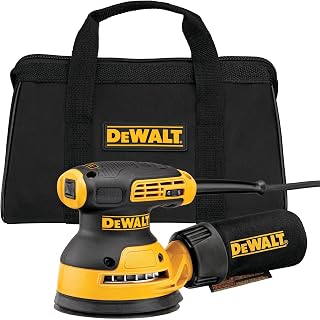
This is the category we recommend for a first serious sander. Look for variable speed, a replaceable brake ring, a hook-and-loop pad you can source separately, and a dust port that accepts a shop vac hose without an adapter tower. Established lines from DeWalt, Makita, Bosch and Milwaukee all field credible corded five-inch tools; buy the one that feels smoothest in your hand and has pads and brake rings on the shelf near you.
Choosing the Best Random Orbital Sander for Your Work
Match the tool to what you build rather than to a general ranking.
Furniture and cabinet shops. Prioritize low vibration and extractor compatibility. You will run the tool for hours at a stretch, and dust control is both a finish-quality issue and a health issue. A corded five-inch with variable speed handles solid wood, veneered panels and finish coats between builds.
Finish carpenters and installers. Cordless wins here despite the weight penalty. Sanding a stair rail or a scribed filler in place with no cord is worth real money in time. Cordless platforms such as DeWalt XR, Milwaukee FUEL and Makita LXT all include sanders, so the deciding factor is usually which battery system you already own rather than the sander itself.
Occasional DIY and refinishing. A mid-tier corded tool plus a good assortment of discs beats a premium tool with cheap paper. Abrasive quality drives cut rate and scratch consistency more than motor pedigree at this level. Budget for name-brand discs in a range of grits and replace them well before they stop cutting.
Anyone sanding tabletops or doors regularly. Consider adding a six-inch machine as a second tool. It is faster across broad surfaces, but keep the five-inch for narrow parts and edges.
Cordless Random Orbital Sanders
Buy into the battery platform you already have. Cordless sanders are heavier at the pad and give up some runtime, but for on-site punch lists and sanding assembled furniture the freedom is decisive. Prefer models with a brushless motor and a dust port option rather than canister-only capture, and keep at least two higher-capacity packs in rotation.
Practical Strengths and Trade-Offs
The random orbital format dominates for good reasons, but it is not the answer to every sanding problem.
- ✔ Random pattern avoids the repeating scratch lines of a straight-line finish sander
- ✔ Fast enough for stock removal yet fine enough for finish prep
- ✔ Abrasives are cheap, widely stocked and available in many grits
- ✔ Works well with a shop vacuum or dust extractor
- ✔ One-handed operation on vertical and overhead surfaces
- ✘ Cannot sand into an inside corner
- ✘ Will round crisp edges and arrises if you let the pad tip
- ✘ Poor dust capture quickly ruins discs and the surface
- ✘ Cheap tools vibrate enough to cause real fatigue
- ✘ Not a substitute for a properly flattened surface from a planer or hand plane
Two habits matter more than the tool itself. First, do not skip grits. Jumping from 80 to 180 leaves 80-grit scratches that only appear once finish darkens them. Move through the sequence, typically 80 to 120 to 150 to 180, and stop where your finish schedule calls for. Second, let the machine float. Downward pressure slows the pad’s rotation, generates heat, loads the paper and cuts unevenly. The weight of your hand is enough.
Frequently Asked Questions
Why does my sander leave swirl marks even at fine grits? Usually three causes, in order of likelihood: dust trapped under the disc, too much downward pressure, or a worn pad brake letting the disc spin too fast on contact. Hook the tool to a vacuum, ease off the pressure, and inspect the backing pad and brake ring for wear.
Is a five-inch or six-inch sander better? Five inches is the better single choice for woodworking. It is easier to control on narrow parts, lighter for overhead work, and abrasives are cheaper and more widely stocked in US stores. Six inches is a productivity upgrade for large flat panels, not a replacement.
Do I still need a sanding block? Yes. Random orbital sanders round over crisp edges and cannot reach inside corners. Keep a cork or hard rubber block and a few sheets of hand paper for edges, profiles and final passes where you want the arris to stay sharp.
Verdict
For nearly every woodworker, the right buy is a corded five-inch random orbital with variable speed, a serviceable pad brake, replaceable backing pads and a dust port that mates directly to a shop vacuum. Choose it by how it feels in your hand and how easily you can buy consumables locally, not by comparing orbit diameters across boxes. Add a cordless five-inch later if you work on site or on assembled pieces, and add a six-inch only if wide panels are a routine part of your week. Then spend the money you saved on better abrasives and a real dust extractor. That combination, not a premium motor, is where clean finishes actually come from.
Check prices on Amazon →