Best Table Saw: Jobsite, Contractor and Cabinet Saws Compared
Key takeaways
- The fence matters more than the motor. Here is how to choose a table saw that stays accurate.
What's inside
- The Fence Decides Everything
- Trunnions, Table Flatness And Alignment
- Dust Collection Is A Design Decision, Not An Accessory
- Jobsite Saws: Better Than They Used To Be
- Contractor And Hybrid Saws: The Useful Middle
- Cabinet Saws: What The Money Buys
- How To Weigh The Criteria Against Each Other
- Mistakes That Cost More Than The Saw
- Safety Features Worth Paying For
- Blades Matter More Than You Think
- FAQ
- The Fence Decides Everything
- Trunnions, Table Flatness And Alignment
- Dust Collection Is A Design Decision, Not An Accessory
- Jobsite Saws: Better Than They Used To Be
- Contractor And Hybrid Saws: The Useful Middle
- Cabinet Saws: What The Money Buys
- How To Weigh The Criteria Against Each Other
- Mistakes That Cost More Than The Saw
- Safety Features Worth Paying For
- Blades Matter More Than You Think
- FAQ
As an Amazon Associate I earn from qualifying purchases. This post may contain affiliate links at no extra cost to you.
A table saw is the most consequential purchase in a woodworking shop, and the specification people fixate on — motor horsepower — is close to the least important. What determines whether a saw is good is the fence, the trunnions and the dust collection. Those three things decide whether your rips come out parallel, whether the blade is still square to the table a year from now, and whether the shop is somewhere you actually want to spend a Saturday.
We judge saws on mechanical criteria you can inspect before money changes hands: how the fence locks and whether it stays parallel when it does, whether the trunnions bolt to the cabinet or hang off the underside of the table, how flat the table and throat plate are, how much of the dust genuinely leaves the machine, and how the saw behaves at the end of a long rip when you are out of position and tired. Power only becomes the deciding factor at the extremes — resawing thick hardwood, or ripping wet construction lumber all day. Everywhere else, the categories below differ less in horsepower than in how much mass and enclosure you are buying.
As an Amazon Associate we earn from qualifying purchases at no extra cost to you. Product prices and availability are accurate as of the date shown and are subject to change.



| Type | Price band | Power | Best for | Weakness |
|---|---|---|---|---|
| Jobsite | $300–700 | Universal motor | Site work, small shops | Noise, dust |
| Contractor | $600–1,000 | Induction, open base | Home shops | Dust collection |
| Hybrid | $900–1,600 | Induction, enclosed | Serious hobbyists | Price |
| Cabinet | $2,000+ | 3HP+ induction | Professional shops | Space, power supply |
The Fence Decides Everything
A fence that shifts a fraction of a millimetre when you lock it will ruin every rip cut you make. Rack-and-pinion fences on modern jobsite saws are a genuine engineering improvement — they keep the fence parallel automatically and they hold. On larger saws, a T-square style fence with a proper lock is the standard to look for.
Test it in the store if you can: lock the fence, then push firmly on the far end. It should not move at all.
Beyond the lock, three details separate a good fence from a frustrating one. The face should be flat, tall enough to support stock stood on edge, and drilled or shaped so you can bolt an auxiliary face to it. The fence should be adjustable — you must be able to bring it parallel to the blade and trust it to return to that setting, because repeatability matters far more than the accuracy of the printed scale. And the cursor and scale are a convenience, not an instrument; on precise work you measure blade to fence directly. On a floor-standing saw a sloppy fence can be replaced later, which is why old cast-iron machines are worth rescuing. On a jobsite saw the fence and rails are part of the frame, so what you buy is what you live with.
Trunnions, Table Flatness And Alignment
Trunnions are the castings that carry the arbor assembly and allow it to rise and tilt. Two things about them matter: what they are bolted to, and how much they weigh. Table-mounted trunnions hang the motor, arbor and tilt mechanism from the underside of the tabletop, so aligning the blade to the miter slot means shifting that whole assembly by tapping it — fiddly, and more likely to drift when the saw gets moved. Cabinet-mounted trunnions bolt to the base, and you align the saw by moving the table instead. Heavier, steadier, and it stays where you put it.
You can check the important things quickly. Raise the blade fully, mark one tooth, and measure from the miter slot to that same tooth at the front and rear of the table; a difference you can feel on a dial indicator will show up as burn marks and pinched cuts. Lay a straightedge across the table diagonally and look for daylight. Press on the throat plate to see whether it sits proud or low, and check whether zero-clearance inserts are available for the model, because a plate you can make yourself is worth more than any accessory in the box.
Dust Collection Is A Design Decision, Not An Accessory
An open contractor-saw base throws fine dust out of the bottom and out through the motor slot, and no bag taped to the back will fix that. Enclosed bases with a 4-inch port at the low point of the cabinet capture what falls; a guard with an over-blade port catches what the blade throws upward, which is the fraction you actually breathe. Match the machine to the extractor, not the other way round: a shop vacuum is a high-suction, low-volume device suited to a 2.5-inch hose, and a dust collector is the opposite, so a 4-inch port choked down to a vacuum hose gives you the worst of both. Jobsite saws generally offer the small port and modest capture, and that is the honest trade for a saw that folds away.
Jobsite Saws: Better Than They Used To Be
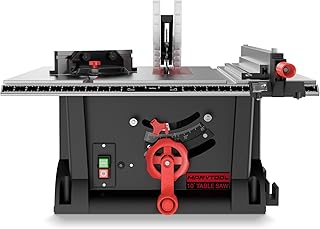
Modern jobsite saws with rack-and-pinion fences and rolling stands handle a surprising amount of furniture work. For a small shop or garage, they fold away, and that matters more than a few extra horsepower.
Within the $300–700 band, the motor is almost never what separates good from bad. Look for the rack-and-pinion fence, a riving knife that comes off and returns to alignment without tools, a table that is flat with a standard 3/4-inch miter slot, and a stand that does not rack when you lean your weight on the corner. The saws that disappoint have friction-lock fences that toe out as you clamp them, thin stamped tables, and riving knives that need a wrench — which means they end up in a drawer, permanently.
Skip the category if your work is mostly thick hardwood, if you want to run a full dado stack (many jobsite arbors are too short for one), or if the saw will live in a fixed shop where noise and dust matter more than portability. Universal motors are genuinely loud, and the extraction is a compromise.
Jobsite table saws
Rack-and-pinion fence, rolling stand, 15A motor. The right choice for anyone without dedicated floor space.
Contractor And Hybrid Saws: The Useful Middle
A contractor saw puts an induction motor on the back of the saw driving the arbor through a belt, under a cast-iron top, on a base open to the floor. What you get for the $600–1,000 band is quiet running, real mass and a proper fence on an ordinary household circuit. What you give up is dust control, and the motor hanging off the back eats space and makes the saw awkward to push against a wall.
Hybrids close the base, move the motor inside and land in the $900–1,600 band. Read the specification carefully, because “hybrid” is a marketing word: two saws at the same price can differ on whether the trunnions are bolted to the cabinet or the table, and that single line matters more than anything else on the sheet. Both categories suit a home shop with floor space and no 220V supply. Skip them if the saw has to fold away between jobs, or if you already have 220V and heavy ripping ahead — in that case the money belongs in a cabinet saw.
Cabinet Saws: What The Money Buys
Mass. A cabinet saw’s cast-iron top and enclosed base absorb vibration, which shows up directly in cut quality. Add a proper 4-inch dust port, a big induction motor that never bogs, and trunnions mounted to the cabinet rather than the table. If you have the space, the power supply and the budget, nothing else compares.
Before you commit, check three practical things. The circuit: most 3HP-and-up saws want 220V, and running that line is an electrician’s job that belongs in the budget. The footprint: the machine is the small part, and the lane you need in front of and behind it is roughly the length of the longest board you intend to rip. And the rails: rip capacity is set by the rails and extension table, so decide between the standard width and extended rails at purchase rather than later. Renters, shared garages and shops that mostly break down sheet goods are better served elsewhere — cabinet saws are heavy, permanent and hold their value precisely because they never really wear out.
Cabinet and hybrid table saws
Heavy, quiet, accurate. Check your electrical supply before buying — many need 220V.
How To Weigh The Criteria Against Each Other
- Space and electrical supply first. These are constraints, not preferences. They eliminate categories before you compare anything else.
- Then the fence. Every rip depends on it, and on portable saws it cannot be replaced.
- Then dust collection. It decides how long you are willing to stay in the shop, which decides how much you build.
- Then mass and trunnion mounting. Cast iron and cabinet-mounted trunnions buy you alignment that holds and cuts that stay smooth.
- Horsepower last. A sharp, correctly chosen blade recovers more cutting ability than the next step up the motor range.
Hold back roughly a fifth of the budget for the blade, a zero-clearance insert, push blocks, outfeed support and a mobile base. A saw bought at the absolute top of your budget with nothing left over cuts worse than the model one step down that is properly set up.
Mistakes That Cost More Than The Saw
- Shopping on peak horsepower figures. Universal-motor claims describe a moment near stall, not sustained output. The honest numbers are the amp draw and the circuit it runs on.
- Never checking blade-to-slot alignment. New saws arrive out of true often enough that this should be the first hour of ownership, not a response to burnt edges.
- Taking the riving knife off “just for this cut”. It comes back off for the next one too. Choose a saw where refitting it takes seconds.
- No outfeed support. Catching a falling board over a spinning blade is how a good day ends badly. A bench, roller stand or plywood table at blade height fixes it.
- Crosscutting with the fence and miter gauge together. That traps the offcut and invites kickback. Clamp a stop block ahead of the blade instead.
- Ripping stock that is not flat and straight on the fence face. The saw cannot correct a bowed edge; joint one face and one edge first.
- Buying the largest saw the room will physically hold and losing the walking space that makes it usable.
Safety Features Worth Paying For
The guard and riving knife you will actually use are the ones that come off and go back on without tools, so treat that as a buying criterion rather than a detail.
- ✔ Riving knife — non-negotiable, prevents kickback
- ✔ Blade guard with anti-kickback pawls
- ✔ Flesh-detection technology if the budget allows
- ✔ A proper push stick and featherboards from day one
Flesh-detection systems work, and they cost money both up front and after an activation, since the mechanism and usually the blade are consumed. What they do not prevent is kickback, which is the more common way people get hurt. That is handled by the riving knife, by featherboards and push blocks, and by never standing directly in line with the blade.
Blades Matter More Than You Think
The stock blade on almost every table saw is mediocre. A quality 40-tooth combination blade transforms cut quality on any saw at any price point. Buy one with the saw, not later.
Choose kerf to suit the motor: thin-kerf blades remove less material and load a 1.5HP-or-smaller saw far less, while a full-kerf plate is stiffer and belongs on the heavier machines. Beyond the combination blade, a low-tooth-count rip blade earns its place in thick hardwood and a high-tooth-count blade prevents chipping in veneered plywood and melamine. Keep them clean — resin build-up feels exactly like dullness and is fixed in ten minutes. And check the arbor length before you order a dado stack; not every saw can take one.
Table saw blades
A good combination blade improves a $400 saw more than $400 of extra saw would.
FAQ
Can I skip a table saw entirely? Yes — a track saw plus a router covers most sheet-goods work, and takes far less space. What you lose is repeatable narrow rips, thin strips, and the jigs and sleds that make joinery quick, so cabinet builders manage fine while furniture makers usually come back to a saw.
How much horsepower do I need? For 3/4″ hardwood, a good 15A jobsite saw is enough. Only heavy resawing needs 3HP. If a saw is struggling, check the blade and your feed rate before assuming the motor is the problem — a sharp thin-kerf blade and a slower push solve most bogging.
Is used worth considering? Old cast-iron contractor saws are excellent value if the trunnions are sound and you can fit a modern fence. Spin the arbor by hand and listen for bearing noise, look for cracks around the trunnion castings and rust pitting on the table, confirm the motor runs on the voltage you have, and budget for a fence, a guard and a riving knife solution if they are missing.
Do I need a 220V circuit? Only for the larger cabinet saws. Jobsite, contractor and hybrid saws run on a standard household circuit, and some cabinet saws are convertible — check the motor plate before buying, and price the electrical work into the total if it is not.
Compare table saw prices →