Kreg Straight Edge Guide Review: Best Guide for Clean Cuts?
What's inside
- Kreg Straight Edge Guide: What It Is
- Key specifications and working limits
- Rail length: the main reason to buy it
- Clamp reach and adjustment accuracy
- Does it stay square on sheet goods?
- Saw compatibility
- Where it beats a track saw—and where it does not
- Ownership realities and common mistakes
- Verdict: who should buy the Kreg Straight Edge Guide?
- Related Guides
- Kreg Straight Edge Guide: What It Is
- Key specifications and working limits
- Rail length: the main reason to buy it
- Clamp reach and adjustment accuracy
- Does it stay square on sheet goods?
- Saw compatibility
- Where it beats a track saw—and where it does not
- Ownership realities and common mistakes
- Verdict: who should buy the Kreg Straight Edge Guide?
- Related Guides
As an Amazon Associate I earn from qualifying purchases. This post may contain affiliate links at no extra cost to you.
The Kreg Straight Edge Guide is a strong choice for clean sheet-good cuts when you need an affordable, long guide for a conventional circular saw, but it is less precise and less universal than a dedicated track-saw system.
As an Amazon Associate we earn from qualifying purchases at no extra cost to you.


Contents
- Kreg Straight Edge Guide: What It Is
- Key specifications and working limits
- Rail length: the main reason to buy it
- Clamp reach and adjustment accuracy
- Does it stay square on sheet goods?
- Saw compatibility
- Where it beats a track saw—and where it does not
- Ownership realities and common mistakes
- Verdict: who should buy the Kreg Straight Edge Guide?
- Related Guides
Kreg Straight Edge Guide: What It Is
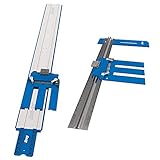
The kreg straight edge guide is a clamp-on cutting guide designed to help a handheld circular saw follow a straight path across plywood, MDF, panels, and other sheet goods. Unlike a track saw, it does not replace the saw’s baseplate or automatically capture the saw in a dedicated channel. Instead, the guide provides a straight reference edge while clamps hold it to the workpiece.
That distinction matters. The guide can produce accurate cabinet and construction cuts, but the final result depends on how carefully you measure, position the rail, keep the saw base against the guide, and prevent the sheet from moving.
Key specifications and working limits
| Characteristic | Kreg Straight Edge Guide | Why it matters |
|---|---|---|
| Guide length | 8 ft nominal, using connected sections | Suitable for full-length plywood and long rip cuts |
| Guide construction | Rigid lightweight guide sections with a straight reference edge | Easier to handle than a solid 8-ft metal bar, but alignment at the joint is important |
| Clamp style | Integrated low-profile clamps | Reduces interference with the saw, although clamp placement still affects access |
| Typical workpiece thickness | Up to approximately 2-1/2 in. within the clamp range | Works on sheet goods and many solid-wood panels, not unusually thick assemblies |
| Primary saw type | Handheld circular saws | Not a universal replacement for a track saw or router guide |
| Long-cut capacity | Up to about 96 in. in the intended setup | Useful for standard 4-by-8-ft panels when the guide is positioned correctly |
The exact usable cut length is slightly shorter than the physical guide because the saw needs room to enter and leave the workpiece. Allow additional space at both ends instead of positioning the blade exactly at the rail’s endpoints.
Rail length: the main reason to buy it
An 8-ft guide is the Kreg system’s biggest advantage. A shorter guide may handle crosscuts across a 4-ft-wide panel, but it cannot guide a full 8-ft rip without repositioning. Repositioning introduces a second alignment operation and creates a visible risk of a step or kink in the cut.
For breaking down plywood, melamine, and insulation panels, the long format is more useful than a compact edge guide. It also gives the saw a longer reference surface, which makes small steering errors less noticeable than they would be with a short guide.
The trade-off is storage. An 8-ft tool needs wall space, ceiling storage, or a location where the sections can remain supported and flat. Do not lean the guide where it can bow or be knocked onto a hard edge. A slightly bent guide can transfer its error directly to every long cut.
Clamp reach and adjustment accuracy
The clamps are intended to hold the guide securely without requiring separate bar clamps across the saw’s path. They are convenient on sheet goods, but they do not eliminate setup work. The guide must be placed from the intended cut line, not from the blade itself.
Use this calculation:
Guide position = desired cut line − distance from the saw’s guide edge to the blade
Measure that offset with the actual saw and blade you will use. The distance can change if you switch between saws, change the blade side, or use a different baseplate. For example, if the saw cuts 1-1/2 in. from the guide edge and the finished cut must be 12 in. from the panel edge, position the guide at 10-1/2 in. from that edge.
For repeat work, make a small reference block or write the offset on the saw. Even then, verify the first cut on scrap. The guide improves straightness; it does not automatically solve measurement errors.
Does it stay square on sheet goods?
It can stay square, provided the guide is aligned against a reliable reference and the clamps are fully engaged. The guide itself does not force a 90-degree crosscut. If its end is merely placed by eye against the edge of a plywood sheet, an out-of-square factory edge will transfer that error to the cut.
For a square crosscut, use one of these methods:
- Measure from the same edge at both ends of the guide.
- Use a framing square or large carpenter’s square before clamping.
- Mark the cut line at both ends and align the guide to those marks.
- Support the panel so it cannot sag, twist, or shift while the saw passes through.
The joint between guide sections deserves special attention. Connect the sections on a flat surface and check the reference edge by sighting along it or comparing it with a long straightedge. A small mismatch at the joint may be harmless on rough construction lumber but visible on cabinet panels.
Saw compatibility
The guide is best matched with a conventional circular saw that has a reasonably flat, stable baseplate and enough base width to ride consistently against the guide edge. Most left- or right-blade circular saws can be used if the saw’s base remains supported on the workpiece and the operator can maintain contact with the reference edge.
Before buying, check four points:
- The saw base must not have protruding depth-adjustment parts that catch the guide.
- The base must provide enough contact area to avoid rocking.
- The blade guard must retract smoothly near the guide.
- The motor housing and dust outlet must clear the clamps during the entire cut.
Battery-powered and corded circular saws are both practical choices. A track saw can sometimes be used only if its base and guide interface are compatible with the guide’s geometry; do not assume that a track-saw base will ride correctly. Likewise, this product is not a router guide, jigsaw guide, or substitute for a dedicated plunge-track system.
Where it beats a track saw—and where it does not
| Situation | Better choice | Reason |
|---|---|---|
| Occasional plywood breakdown | Kreg Straight Edge Guide | Lower-cost way to make long straight cuts with a saw you already own |
| Frequent cabinet panel production | Dedicated track saw | Faster setup, integrated guidance, and easier repeatability |
| Very limited storage | Short guide or compact track system | An 8-ft guide is awkward to store and transport |
| Rough framing cuts | Kreg guide or a homemade straightedge | Maximum precision may not justify a more expensive system |
| Visible cuts in melamine or veneered panels | Track saw with suitable blade, or Kreg guide with careful technique | Chip control and consistent saw pressure become more important |
Ownership realities and common mistakes
The first parts likely to cause trouble are not the main rail but the clamp contact points, connectors, and the guide edge where saw bases repeatedly rub. Keep the guide free of packed sawdust, especially around clamp mechanisms and joining hardware. A soft brush or compressed air used carefully is usually preferable to forcing a dirty clamp.
Do not drag the saw sideways against the guide while starting the cut. Set the saw fully on the panel, allow the blade to reach operating speed, and then move forward while maintaining light, steady contact. Excessive sideways pressure can deflect the saw base or cause the cut to wander.
Support the panel on sacrificial foam or evenly spaced supports. If the offcut falls and pinches the blade, the saw can kick back or pull away from the guide. Also confirm that the blade will not strike a support, clamp, or hidden fastener.
Verdict: who should buy the Kreg Straight Edge Guide?
Buy the Kreg Straight Edge Guide if you already own a circular saw and need clean, repeatable long cuts without investing in a complete track-saw setup. Its long rail, low-profile clamping, and broad sheet-good usefulness make it particularly appealing for occasional remodeling, furniture building, and plywood breakdown.
Choose a dedicated track saw instead if you make precision panel cuts every week, need fast repeatable setup, or expect plunge-cut and splinter-control features. The Kreg guide is accurate when carefully aligned, but it remains a manual straightedge system: measuring, squaring, clamping, and supporting the work are still the user’s responsibility.