
What's inside
- Two kinds of “airless” for walls
- Specs that matter, compared
- Picks by project size
- Tip sizes decoded
- Paint and time math for a typical room
- Common mistakes with airless on interior walls
- Wear parts to budget for
- Which One Should You Buy?
- Spraying Technique for Smooth Walls
- Troubleshooting Spray Problems
- Protecting the Room Before You Spray
- Cleanup and Storage
- Frequently Asked Questions
As an Amazon Associate I earn from qualifying purchases. This post may contain affiliate links at no extra cost to you.
For most homeowners, the best airless paint sprayer for interior walls is one that sprays straight from the bucket and accepts at least a 0.015-inch tip. A 515 tip is the standard for wall latex. The Graco Magnum X7 is the best all-round pick. The Graco Magnum X5 suits smaller jobs, and the Wagner Control Pro 170 and Titan ControlMax 1700 are better choices if you’re worried about overspray in a furnished home. The Graco Magnum ProX19 is worth the step up if you plan to repaint a whole house. To choose, match the sprayer’s flow rate and maximum tip to how many gallons you’ll spray a year and how much masking you’re willing to do.
As an Amazon Associate we earn from qualifying purchases at no extra cost to you.



Contents
- Two kinds of “airless” for walls
- Specs that matter, compared
- Picks by project size
- Tip sizes decoded
- Paint and time math for a typical room
- Common mistakes with airless on interior walls
- Wear parts to budget for
- Which One Should You Buy?
- Spraying Technique for Smooth Walls
- Troubleshooting Spray Problems
- Protecting the Room Before You Spray
- Cleanup and Storage
- Frequently Asked Questions
Our Top Picks
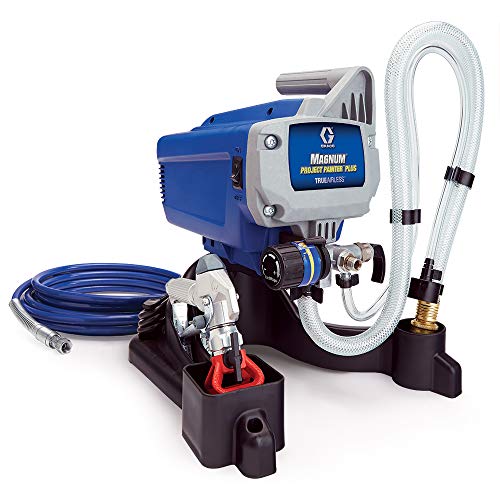 Graco Magnum 257025 Project Painter Plus Paint SprayerNo Size12 x 12 x 13.5 inches15 poundsCheck on Amazon


Two kinds of “airless” for walls
True airless sprayers, like the Graco Magnum line, push paint through the tip at up to about 3,000 PSI. That atomizes unthinned latex well and lays down a thick, even coat quickly. The trade-off is more overspray and a hard-edged mist that drifts across a room.
High-efficiency airless (HEA) sprayers, such as the Wagner Control Pro and Titan ControlMax, run at about 1,500 PSI with tips designed for lower pressure. They produce a softer fan and noticeably less overspray. Manufacturers claim up to about 55 percent less. That matters in occupied rooms, but they can struggle with very thick paints.
Specs that matter, compared
| Sprayer | Type | Max pressure | Flow rate | Max tip | Paint feed | Price range |
|---|---|---|---|---|---|---|
| Graco Magnum X5 | True airless | 3,000 PSI | 0.27 GPM | 0.015 in | Suction tube from bucket | Check on Amazon |
| Graco Magnum X7 | True airless | 3,000 PSI | 0.31 GPM | 0.017 in | Suction tube, cart | Check on Amazon |
| Graco Magnum ProX19 | True airless (pro-grade) | 3,000 PSI | 0.38 GPM | 0.019 in or larger | Suction tube, cart | Check on Amazon |
| Wagner Control Pro 170 | HEA | 1,500 PSI | 0.33 GPM | 0.017 in | Suction tube from bucket | Check on Amazon |
| Titan ControlMax 1700 | HEA | 1,500 PSI | 0.33 GPM | 0.017 in | Suction tube from bucket | Check on Amazon |
Flow rate determines how fast you can work. Maximum tip size determines which tips you can use. Interior wall paint usually sprays well through a 0.015 to 0.017 tip, so every unit here can handle walls. The difference is how comfortably they run a 517 tip all day and how many gallons a year the pump is designed for.
Picks by project size
One or two rooms a year: Graco Magnum X5
The X5 is the most common entry point into true airless spraying. It handles unthinned latex through a 515 tip, has a flexible suction tube that goes straight into a 1- or 5-gallon bucket, and connects to a garden hose for cleanup. Graco designs it for about 125 gallons a year, which covers a few bedrooms and a basement easily.
Whole floors and repainting before a move: Graco Magnum X7
The X7 adds a cart, a stainless steel piston pump, a higher flow rate, and support for a 0.017-inch tip. That makes it easier to keep a wet edge on long walls and to use a slightly larger tip with thicker paint. It’s the best value for most homeowners who paint more than a couple of rooms.
Furnished homes and low overspray: Wagner Control Pro 170 or Titan ControlMax 1700
Both HEA sprayers run at lower pressure and produce a softer spray pattern with less mist, so there’s less paint drifting onto floors and furniture. They’re a good fit for interior walls in occupied homes, especially if you’re new to spraying, since the softer fan is more forgiving of uneven passes. Both are designed for about 300 gallons a year.
Whole-house repaints and frequent jobs: Graco Magnum ProX19
The ProX19 is the step toward contractor equipment. It has a higher flow rate, can run longer hose lengths, and is built for hundreds of gallons a year. For one or two rooms, it’s more than you need. If you plan to repaint every room in a large house, the extra speed and durability start to pay off.
Tip sizes decoded
Airless tip numbers follow a simple code. Double the first digit to get the fan width in inches at about 12 inches from the wall. The last two digits are the orifice size in thousandths of an inch.
| Tip | Fan width | Orifice | Best use indoors |
|---|---|---|---|
| 310 / 312 | ~6 in | 0.010–0.012 in | Trim, doors, enamels |
| 411 / 413 | ~8 in | 0.011–0.013 in | Narrow walls, closets, stairwells |
| 515 | ~10 in | 0.015 in | Standard wall latex |
| 517 | ~10 in | 0.017 in | Thicker latex, primers, faster coverage |
| 619 / 621 | ~12 in | 0.019–0.021 in | Ceilings and high-build primers on larger pumps |
Paint and time math for a typical room
A 12 x 14-foot bedroom with 8-foot ceilings has about 416 square feet of wall. After subtracting a door and two windows (about 40 square feet), that leaves roughly 375 square feet per coat. Rolled paint covers about 350–400 square feet per gallon. Spraying usually uses 20–30 percent more because of overspray and a thicker film. That means about 1.3 gallons per coat sprayed, or roughly 2.5–3 gallons for two coats. Add about a quart that stays in the pump, filter, and a 25- to 50-foot hose and is lost at cleanup.
For time, spraying the walls themselves takes 15–25 minutes per coat. Masking floors, outlets, windows, and trim usually takes 1–2 hours, and cleanup takes 20–40 minutes. Spraying pays off most on empty rooms, multiple rooms in a row, and textured or tall walls.
Common mistakes with airless on interior walls
- Using too much pressure. Turn the pressure up only until the tails at the edges of the fan disappear. Higher pressure adds overspray and wears tips faster.
- Arcing the gun. Keep the gun parallel to the wall at about 12 inches and move your whole arm. Arcing leaves the center of each pass heavy and the ends thin.
- Not overlapping enough. Overlap each pass by about 50 percent for an even film.
- Skipping filters. Strain paint and keep the manifold and gun filters clean. Most tip clogs come from dried skin or debris in the bucket.
- Leaving latex in the pump. Flush with water until it runs clear, then use pump protector for storage. Dried paint ruins piston packings.
Wear parts to budget for
Tips wear out as they spray. A worn tip shows up as a narrower fan with heavier edges. Expect to replace a tip after roughly 15–40 gallons of latex, depending on the paint and pressure. Gun and manifold filters, packings, and inlet valves are the next parts to wear. Graco, Wagner, and Titan all sell rebuild kits, and a sprayer that’s flushed and stored properly can last many years of homeowner use.
Which One Should You Buy?
Match the machine to how often you paint and how much of the house you need to protect from overspray.
| If you… | Choose… |
|---|---|
| Paint one or two rooms a year and want the simplest entry | Graco Magnum X5 |
| Repaint whole floors or prepare a house for sale | Graco Magnum X7 |
| Work in a furnished home and want to limit overspray | Wagner Control Pro 170 or Titan ControlMax 1700 |
| Repaint whole houses or take on frequent jobs | Graco Magnum ProX19 |
Spraying Technique for Smooth Walls
Even a good sprayer leaves stripes if the motion is off. Retail and manufacturer guidance converges on a few habits.
- Prime and test on cardboard. Check the fan pattern on scrap before touching the wall.
- Keep the gun square to the surface. Hold it roughly 12 inches away; some sources allow a slightly wider range, and very large tips need more distance.
- Move your whole arm, not your wrist. Flicking the wrist arcs the spray and deposits more paint in the middle of each stroke.
- Squeeze after the stroke begins and release before it ends. This avoids heavy blotches at the edges of each pass.
- Overlap each pass by about half. Aim the edge of the pattern at the edge of the previous stroke.
- Do corners and edges first. Spray the trim lines and corners, then fill in the flat areas.
Troubleshooting Spray Problems
| Symptom | Likely cause | What to try |
|---|---|---|
| Heavy edges with a thin center (tails) | Pressure too low, worn tip, or paint too thick | Raise pressure gradually until the pattern is even, and check the tip |
| Excess fog and rough texture | Pressure set too high | Lower it to the minimum that still atomizes the paint fully |
| Spitting or pulsing | Air in the system or a clogged filter | Re-prime, then clean the filter and tip |
| Runs and sags | Gun held too close or moving too slowly | Back off, speed up, and use lighter coats |
| Visible stripes | Too little overlap or an inconsistent distance | Keep a steady distance and overlap by half |
Check the manual for your model before adjusting pressure, because ranges differ between machines.
Protecting the Room Before You Spray
- Cover floors and anything that stays in the room, and tape off trim, windows, and outlets.
- Keep doors to other rooms closed, but ventilate the work area as the paint label directs.
- Wear a respirator rated for paint mist, plus eye protection. Airless spray puts paint out under high pressure, and the stream can injure skin, so never place a hand or finger in front of the tip.
- Consider a roller for a second pass on rough or porous surfaces to work paint into the texture.
Cleanup and Storage
Flush water-based paint through the pump, hose, and gun with clean water until it runs clear, then clean the tip and filter by hand. Relieve pressure before taking anything apart. If the sprayer sits unused between jobs, follow the maker’s storage instructions for the pump so seals do not dry out.
Frequently Asked Questions
Do I need to thin latex paint for an airless sprayer?
Often not, since many models spray straight from the bucket. Check the sprayer manual and the paint label, because thinning can reduce coverage and change how the paint behaves.
Do I have to back-roll after spraying?
Not always. Back-rolling helps on rough or porous walls, while smooth, well-primed walls often look fine straight from the gun.
How far should the gun be from the wall?
About 12 inches is the commonly cited distance. Move closer and you get runs, and further away you get more overspray and a dry, textured finish.
Why does the pattern have heavy edges?
Those are tails, most often caused by low pressure that is not fully atomizing the paint. A worn tip or thick paint can also be responsible.
Is airless overkill for one small room?
For a single small room, masking and cleanup can take longer than the painting itself. Airless pays off as wall area, number of rooms, or repaint frequency grows.
Related guides
More from Amazon
Programs that pair well with the guide above. Offers and eligibility are set by Amazon and may change.
A free business account with business pricing and bulk-buying tools for work, shop or home office.
Create a business accountFree shipping on eligible items, Prime Video and more. Eligible new members can start with a free trial.
Start a Prime free trialAudiobooks and podcasts to listen to on the go. Eligible new members can start with a free trial.
Try Audible freeAd-free music streaming. Eligible new subscribers can start with a free trial.
Try Music Unlimited freeAs an Amazon Associate we earn from qualifying purchases.



Write Your Review
No reviews yet. Be the first to share your experience!