Best Professional Dust Collection System for Woodworking Shop
What's inside
As an Amazon Associate I earn from qualifying purchases. This post may contain affiliate links at no extra cost to you.
After running a planer, table saw, and jointer in the same closed shop for years, you learn quickly that dust collection is not about keeping the floor clean. It is about keeping the air breathable, the tools cutting true, and the fine dust out of your finishes and lungs. A weak system leaves a haze that settles on everything overnight and forces you to stop and clear clogged hoses, while a well-matched system disappears into the workflow and lets you move from machine to machine without thinking about it.
What separates a good professional dust collection system from a disappointing one is not just raw suction, but how it handles separation, filtration, capacity, and mobility under real shop loads. The best setups maintain airflow at the tool port, trap the fine particles that matter most for health, empty without creating another dust cloud, and roll or mount where you need them. The weak ones lose suction as the bag fills, leak at the seams, or bog down when you connect more than one machine.
As an Amazon Associate we earn from qualifying purchases at no extra cost to you. Product prices and availability are accurate as of the date shown and are subject to change.




Quick Picks
| Product | Best for | Price |
|---|---|---|
| WEN DC1300 | Best Overall Single-Stage Collector | $391.8 |
| VEVOR 1550 CFM Vortex Cone | Best for Maximum Airflow | $569.9 |
| BUCKTOOL 1-1/2 HP | Best Filtration on a Single-Stage | $350 |
| WEN DC3401 | Best Compact and Wall-Mount | $126.35 |
| DEWALT DXVCS002 | Best Budget Separator for Shop Vacuums | $80.99 |
| Dustopper PRO | Best Low-Profile Cyclone Separator | $66.98 |
| WEN 3410 Air Filtration System | Best for Ambient Air Cleaning | $144.39 |
| Mullet Cyclone | Best Premium Cyclone for Fine Dust | $295 |
How We Picked
We prioritized real-world airflow at the tool rather than motor claims alone, effective separation and filtration that keeps fine dust out of the airstream, collection capacity and ease of emptying without downtime, and shop fit including mobility, port flexibility, and noise. We weighted verified build quality, hose compatibility, and long-term filter maintenance over marketing specs, favoring systems that stay consistent as bags fill and that integrate cleanly with common woodworking machines.
The 8 Best Professional Dust Collection System For Woodworking Shop in 2026
1. WEN DC1300
This is the workhorse for the small to mid-size professional shop that needs strong, centralized collection without stepping up to industrial ducting. With its 1,300 CFM rating, 14-Amp motor, and 50-Gallon collection bag on a mobile base, it handles a table saw and planer running in sequence without constant emptying. Filtration is rated at 5-Micron, which is standard for this class and best paired with a respirator or ambient filter for fine sanding dust.
- Pro: Very large 50-Gallon bag extends run time and the mobile base makes it easy to roll between machines
- Pro: Strong airflow for a single-stage system at this price point
- Con: 5-Micron filtration passes more fine dust than 2-Micron or HEPA-style systems
Skip it if your work is mostly fine sanding or MDF and you need superior fine-particle filtration without adding aftermarket upgrades.
2. VEVOR Dust Collector 1550 CFM Vortex Cone
Built for shops that want to move a lot of air and handle two machines at once, this 3.0HP system is the airflow leader in this roundup with its vortex cone design and dual-bag setup. It comes with two 35-Gallon collector bags and two 42-Gallon filter bags, spinning at 3400 RPM on a 220V plug, which explains the step up in price and power. The 2.5-Micron filtration is a solid middle ground for general woodworking.
- Pro: Highest airflow in this group and dual ports and bags support heavier, multi-tool use
- Pro: Vortex cone helps maintain separation and reduces premature filter loading
- Con: Requires 220V power and more floor space than single-bag collectors
Skip it if you lack 220V service or need a compact mobile unit for a tight garage shop.
3. BUCKTOOL 1-1/2 HP Dust Collector
BUCKTOOL targets the common pain point of single-stage collectors: fine dust blow-through. Its internal dust baffle and 98% 2-Micron filtration stand out, while the 1100 CFM airflow and dual 4-inch ports plus 6-inch main inlet give you flexible hookups for a table saw, jointer, or planer. For a shop that wants cleaner exhaust air without jumping to a full cyclone, this balance is compelling.
- Pro: Excellent fine-particle filtration for the category and efficient internal baffle
- Pro: Versatile port layout adapts to both single large hose and two smaller runs
- Con: Smaller peak airflow than the larger 1,300 and 1550 CFM units under heavy load
Skip it if you routinely need to run long duct branches or two large machines simultaneously at peak suction.
4. WEN DC3401
This compact WEN is ideal for the benchtop shop, small garage, or as a dedicated collector for one machine like a miter saw or small bandsaw. The 5.7-Amp motor and 12-Gallon bag keep the footprint minimal, and the included mobile base with optional wall mount lets you reclaim floor space entirely. It is not a replacement for a full-size collector, but it solves hose-drag and portability problems better than most full-size units.
- Pro: Extremely compact and mountable, perfect for tight spaces or single-tool duty
- Pro: Lowest price among full collectors with genuine mobility
- Con: Limited capacity and airflow compared to full-size professional collectors
Skip it if you need to collect from a planer or jointer producing high chip volume for extended runs.
5. DEWALT DXVCS002 Dust Separator
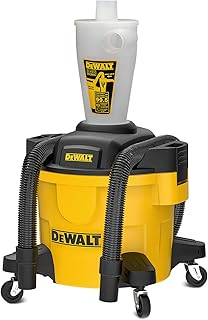
Not a standalone collector, the DEWALT DXVCS002 turns any wet/dry shop vacuum into a two-stage system. The 6-Gallon separator drops out heavy chips and the bulk of fine dust before it hits your vac, which dramatically extends filter life and maintains suction. With a 4.6/5 rating, it is the proven budget path to cyclone-like performance without buying a new vacuum.
- Pro: Inexpensive upgrade that protects vac filters and keeps suction consistent longer
- Pro: Compact 6-Gallon size sits neatly beside or on top of most shop vacuums
- Con: Still relies on the underlying vacuum for airflow and fine filtration
Skip it if you need true high-volume collection for stationary machines rather than shop vac-based tool collection.
6. Dustopper PRO
The Dustopper PRO is a low-profile cyclone separator that delivers 99.9% efficiency for shop vacuums rated 5HP and above. Made in the USA and supplied with 90-degree elbows and hose attachments, it is designed to cut clogged filters and keep fine dust and heavy debris separated in a standard bucket setup. For finish sanding and router work where fine dust kills filters, its separation efficiency is its biggest asset.
- Pro: Outstanding separation efficiency keeps even fine dust out of the vacuum
- Pro: Low-profile design with included elbows improves stability and hose routing
- Con: Requires a separate high-power shop vacuum and collection bucket
Skip it if you want an all-in-one collector rather than a separator to pair with an existing vac.
7. WEN 3410 Air Filtration System
This is not a chip collector but the essential second layer for a professional shop: ambient air filtration. The 3-speed system with RF remote cycles at 300/350/400 CFM and captures the fine airborne dust that even good collectors miss at the tool. Hung from the ceiling, it quietly scrubs the shop air after cuts and during sanding, which is where long-term health protection is won.
- Pro: Remote-controlled three-speed operation makes it easy to run during and after work
- Pro: Effective at clearing fine airborne haze that settles on finishes
- Con: Does not collect chips or replace a dust collector at the machine
Skip it if you only need source collection and already have excellent dust extraction at every tool port.
8. Mullet Cyclone
The Mullet Cyclone is a high-speed separator built to fix the core weakness of shop vac systems: filter clogging from fine dust. Its cut-to-fit PVC design fits any shop vac and it separates both heavy debris and fine dust before the vacuum, keeping airflow strong throughout a sanding or routing session. With the highest rating in this roundup at 4.8/5, it is the premium separator choice for pros who live on a shop vacuum.
- Pro: High-speed separation maintains suction and sharply reduces filter cleaning
- Pro: Universal cut-to-fit compatibility adapts to virtually any vacuum and hose setup
- Con: Higher price than other cyclone separators for vac-based systems
Skip it if you already run a full-size stationary collector and do not need vacuum-based separation.
Buying Guide
Airflow, Power, and Port Layout
Think in terms of airflow at the tool, not just motor power. Single-stage collectors in the 1100 to 1550 CFM range cover most professional small shops, but long hoses, tight bends, and small ports reduce effective suction quickly. Dual 4-inch ports are handy for pairing two machines with blast gates, while a single large 6-inch inlet is better for a short, straight run to one high-volume tool. If you plan to run on 110V, confirm the circuit can handle startup draw; the higher airflow units here require 220V.
Separation and Filtration
Collection is easy, separation is what keeps the system working. A vortex cone, internal baffle, or cyclone stage drops out chips before they load the filter, which preserves suction and extends filter life. For health and finish quality, filtration rating matters more than most buyers expect. A 5-Micron bag is fine for chips but lets more respirable dust through, while 2-Micron and 99 percent plus cyclone efficiency keep the exhaust air noticeably cleaner. Pair any single-stage bag collector with either an upgraded filter or a ceiling-mounted ambient filter for sanding-heavy work.
Capacity, Mobility, and Maintenance
Bag size determines how often you stop to empty, and emptying is where dust goes airborne if the design is poor. A 50-Gallon lower bag or dual 35-Gallon setup buys you hours of planing time, while a 12-Gallon or 6-Gallon separator needs frequent dumps but is far easier to move and store. Look for a stable mobile base with locking casters, quick-release bag clamps, and widely available replacement bags and filters. For shop vacuum users, a cyclone separator is the cheapest way to cut filter changes from every session to every few weeks.
Our Verdict
For most professional woodworking shops, the WEN DC1300 is the top pick. It hits the right balance of strong 1,300 CFM airflow, large 50-Gallon capacity, and roll-anywhere mobility at a price that leaves room for a filter upgrade or air filtration add-on. On a tight budget, the Dustopper PRO is the clear value winner, turning a shop vacuum you already own into a highly efficient two-stage system for a fraction of a collector price. If your priority is the cleanest exhaust air from a single-stage collector without adding a separate cyclone, choose the BUCKTOOL 1-1/2 HP for its 98% 2-Micron filtration and internal baffle.
FAQ
Do I need a dust collector and an air filtration system?
Ideally yes. A collector captures chips and dust at the machine, while a ceiling-mounted air filtration unit like the WEN 3410 scrubs the fine airborne particles that escape the port and linger for hours. Using both gives you cleaner surfaces and meaningfully better air quality.
Can a shop vacuum with a cyclone separator replace a dust collector?
For handheld power tools, sanders, and small benchtop machines, a vacuum plus a high-efficiency separator such as the Dustopper PRO or Mullet Cyclone works very well and is more portable. For stationary planers, jointers, and table saws producing high chip volume, a full-size collector moves far more air and needs less frequent emptying.
What size ports and hoses should I use?
Match the hose to the tool port without choking down if you can avoid it. Use 4-inch hose for most stationary tools and keep runs short and straight with minimal flex. If your collector offers a 6-inch main inlet, use a short 6-inch trunk and branch to 4-inch drops with blast gates to maintain velocity.
How often should I empty bags and clean filters?
Empty the lower collection bag before it reaches three quarters full to prevent carryover into the filter. Check the upper filter bag when you notice suction drop or visible dust in the exhaust. A separator or cyclone stage in front of the filter will greatly extend cleaning intervals.