Floor-Standing Drill Press vs Benchtop Drill Press for Furniture Workshops
What's inside
As an Amazon Associate I earn from qualifying purchases. This post may contain affiliate links at no extra cost to you.
For a furniture shop, a drill press does a lot more than drill holes. It bores precise dowel joints, cleans up mortises, drills angled holes for chairs, and with a drum sander, smooths curves. The choice between a floor-standing and a benchtop model comes down to capacity, rigidity, and how you work, not just price or floor space.
As an Amazon Associate we earn from qualifying purchases at no extra cost to you.

Contents
Footprint and Real Space Cost
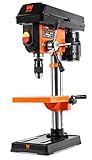
A benchtop drill press looks like the space-saver. The machine itself is typically 28 to 34 inches tall and sits on a 12×18 inch base. But it needs a bench or stand that is sturdy, flat, and at the right height. Once you add a dedicated cabinet or a heavy workbench to support 80 to 120 lbs of cast iron without flex, the footprint is often 24×30 inches anyway – similar to a floor model.
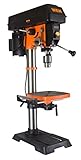
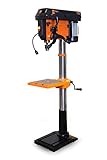
A floor-standing press is 60 to 72 inches tall with a base around 20×12 inches and weighs 150 to 250 lbs. It needs about 2×2 feet of floor, plus clearance to swing long boards. The advantage is that it leaves your bench free for assembly and hand-tool work, which matters in a small furniture shop where bench space is always the bottleneck. The downside is mobility. You will not move it often, and if you do not bolt it down, a tall, top-heavy floor model can tip when you swing a heavy table leg into it.
If your shop is a single-car garage and your bench is on wheels, a benchtop model on a rolling cabinet can be the more flexible option. If you have a permanent station for stationary machines, the floor model uses space more efficiently.
Capacity That Matters for Furniture
Ignore marketing and look at three numbers: swing, spindle travel (quill stroke), and distance from chuck to table.
Swing is twice the distance from the spindle center to the column. A 10-inch benchtop press gives you 5 inches from center to post – fine for drawer fronts, but tight for drilling into the center of a wide chair seat or a cabinet side. Most 12-inch benchtops and 15 to 17-inch floor models give you much more usable room.
Spindle travel is critical. Many 8 to 10-inch benchtop presses offer only 2 to 2-1/2 inches of quill stroke. That is not enough to drill a 3-inch deep mortise for a workbench leg or a 3-1/2 inch deep hole for a bed bolt in one pass without raising the table mid-hole, which ruins accuracy. Most 12-inch benchtops offer 3 to 3-1/8 inches, while floor-standing models typically offer 4 to 6 inches. For furniture joinery, 3-1/4 inches should be your minimum.
Distance from chuck to table also limits you. A benchtop press on a standard 34-inch bench gives you about 12 to 16 inches between chuck and table. That is enough for boxes and small tables, but you will struggle to drill vertically into the end of a 30-inch table leg or a tall chair back. A floor model gives you 30 to 44 inches and a table that cranks up and down with a rack and pinion, so you can drill long, vertical parts without rigging up blocks.
| Feature | Benchtop (10-12 inch) | Floor-Standing (15-17 inch) |
|---|---|---|
| Swing | 10″ – 12″ | 15″ – 17″ |
| Spindle Travel | 2″ – 3-1/8″ | 3-1/2″ – 6″ |
| Chuck to Table (max) | 12″ – 16″ (bench dependent) | 30″ – 44″ |
| Motor | 1/3 – 1/2 HP, often universal | 1/2 – 1 HP, typically induction |
| Speed Range | 500 – 3,100 RPM (5 speeds) | 200 – 3,600 RPM (12-16 speeds) |
| Weight | 70 – 120 lbs | 150 – 250 lbs |
| Best For | Small parts, dowels, hardware, drum sanding | Deep mortises, chair parts, long uprights, large Forstner bits |
Power, Speed, and Bit Performance
Furniture work uses large-diameter bits that need low speed and torque: 2-inch Forstner bits for hinge cups, 1-1/2 inch Forstner bits for chair seats, and drum sanders that need sustained power. Benchtop presses often have 1/3 to 1/2 HP motors and a 5-speed stepped pulley system that bottoms out at 500-600 RPM. That is too fast for a 2-inch Forstner in hard maple – you will burn the wood, dull the bit, and risk grabbing.
A floor-standing press usually has a 3/4 to 1 HP induction motor and a 12 or 16-speed range down to 200-300 RPM. The lower speeds let you bore clean, flat-bottomed holes in white oak or hard maple without scorching. The extra mass also helps maintain torque under load.
Failure mode to watch for: bogging and belt slip. Underpowered benchtop presses will stall with a large Forstner, especially if the belt is not tensioned correctly. You end up pushing harder, which deflects the quill, enlarges the hole, and can snap the bit’s rim. If you plan to do a lot of 1-1/2 inch and larger boring, the floor model’s power and slow speeds are not a luxury – they are what keep holes round and on location.
That said, if your drilling is mostly 1/4 to 3/4 inch dowel holes, shelf pins, and hardware installation in softwoods and plywood, a benchtop drill press has plenty of power and you will not benefit from the floor model’s low end.
Accuracy, Rigidity, and Vibration
Runout and column flex are what separate a furniture-grade hole from a sloppy one. Any drill press will show 0.002 to 0.005 inch of runout at the chuck, but flex under pressure matters more.
Benchtop presses have shorter, thinner columns, typically 2-1/8 to 2-3/4 inches in diameter, and lighter tables. When you lean into a deep mortise with a 1/2 inch brad-point bit, the head can deflect slightly, and the small table can rotate if the clamp is not rock-solid. You will see this as elongated holes and misaligned dowel joints where two pieces do not close without a gap.
Floor models have 3 to 3-1/2 inch columns, heavier heads, and larger tables with better rack-and-pinion support. They resist side load better, and the added weight damps vibration. That damping shows up as cleaner exit holes, less chatter with Forstner bits, and less wandering when you start a hole on an angled chair leg.
Common failure on both types: table not square to spindle. On benchtop presses with a tilting table, the tilt lock can slip or the scale can be off by a degree. On floor models, the table crank mechanism develops play over time. Check squareness with a dial indicator or a bent rod test every few months, and always lock both the table height and the tilt before drilling.
Ergonomics and Day-to-Day Workflow
Height matters for control. A benchtop press on a 34-inch bench puts the quill handle at about 55-60 inches – comfortable for most people. A floor model puts it at a similar height but gives you foot clearance and lets you stand closer to the work. If you are tall, a benchtop on a low cabinet can force you to hunch.
For batch work, the floor model’s crank table is a real time saver. Raising a benchtop table means loosening a collar, wrestling 15 lbs of cast iron up the column, and re-locking while trying to hold your workpiece. With a crank, you can micro-adjust for different board thicknesses in seconds without losing your fence setting.
Accessories also change the equation. A mortising attachment, a large drill press vise, and a fence system all add weight and overhang. A light benchtop table will deflect under a heavy vise plus a large workpiece. If you plan to use a mortiser or do repetitive doweling with a fence, the mass and table size of a floor-standing drill press keep everything more stable.
Which One Should You Buy for Furniture?
Choose a benchtop if your work is mostly small-scale: boxes, small side tables, cabinet hardware, shelf-pin holes, and light drum sanding. It is also the right pick if you need to store the machine or share bench space. Get a 12-inch model with at least 3 inches of spindle travel and a 1/2 HP motor – the 8 and 10-inch models save very little money and cost you capability you will need. Bolt it to a heavy, low cabinet, not a flimsy workbench, and add a decent fence.
Choose floor-standing if you build chairs, tables, beds, or large casework. If you regularly drill deep mortises, bore angled holes in chair seats, use Forstner bits over 1-1/4 inches, or drill into the ends of long parts, the extra stroke, power, low speeds, and rigidity will pay for itself in fewer ruined parts. It is also the better long-term platform if you want to add a mortising attachment or do production-style jigs.
For many furniture shops, the value move is a quality 12-inch benchtop now, upgraded with a good vise and Forstner set, and a floor model later when you start doing chairs or large tables. Do not buy a cheap floor model just to have a floor model – a well-built benchtop with a solid column and an induction motor will outperform a lightweight floor press with a thin column and sloppy quill every time.