Best Drill Presses for Drilling Large Forstner Bit Holes
What's inside
As an Amazon Associate I earn from qualifying purchases. This post may contain affiliate links at no extra cost to you.
Contents
Why Large Forstner Bits Are Different
Drilling a 1/4″ hole and drilling a 2-1/2″ Forstner hole are not the same job scaled up. A large Forstner bit is a rim-guided cutter that scrapes a wide, flat-bottomed hole. It has a large contact area, high friction, and needs a lot of torque at very low speed. On a small, high-speed drill press it will burn, chatter, stall the motor, or grab the workpiece out of your hands.
Most problems come down to speed and rigidity. A 2″ Forstner bit in hardwood should run around 250 to 500 RPM maximum. A 3″ bit wants 200 to 300 RPM. Many 8″ and 10″ benchtop presses bottom out at 600-750 RPM. At that speed, the outer rim is moving too fast, the steel overheats, and the wood scorches. You also lose torque because those machines use small 1/4 to 1/3 HP induction motors with light step-pulley ratios. They simply don’t have the leverage to keep a big cutter turning once it bites.
As an Amazon Associate we earn from qualifying purchases at no extra cost to you.
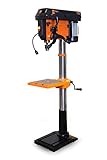

Runout is the other killer. Forstner bits need a true, wobble-free spindle. Even 0.005″ of chuck runout on a 2-1/2″ bit becomes a visible wobble at the rim, which leaves chatter marks, oversized holes, and increases the chance the rim catches and jerks the board. Cheap presses with Morse taper adapters that don’t seat cleanly or low-grade keyed chucks are common sources of this.
What Actually Matters for Big Bits
When you shop, ignore marketing specs like “laser guide” or “16 speeds.” For large Forstners, four things predict success:
1. Low-end speed, not high-end speed. Look for a minimum speed under 400 RPM, ideally 200-300 RPM. This is almost always a belt-driven machine with a large step pulley ratio. Variable-speed DC motors can do this too, but only if they maintain torque at low RPM – many don’t without a mechanical low range.
2. Motor power and type. For bits up to 1-1/2″, a 1/2 HP induction motor is workable. For 2″ to 3″ bits in hard maple, white oak, or ash, you want 3/4 HP to 1 HP continuous. Induction motors are far better than universal motors here. They run cooler, quieter, and hold torque under load.
3. Quill travel and column rigidity. A 2″ deep flat-bottomed hole for a hinge cup or a 3″ hole for a game piece needs at least 3″ of quill travel, preferably 3-1/8″ to 4″. Many 8″ benchtops only offer 2″ to 2-1/2″. Column diameter matters too. A 3″ column and a 70+ lb head will deflect far less than a 1.8″ column on a 35 lb benchtop when you lean into the feed handle.
4. Chuck quality and taper. A proper Jacobs taper (JT33 or better) or Morse Taper #2 spindle with a quality 1/2″ or 5/8″ keyed chuck is non-negotiable. Keyless chucks are convenient for twist drills, but for large Forstners they slip more often unless they are high-end. Any perceptible play when you tug the chuck side-to-side is a red flag.
Speed control is the most common failure point. If the press cannot go slow enough, you will be forced to pulse the cut, lift repeatedly to clear heat, and you will still dull bits prematurely. A burned carbide rim on a $40 Forstner bit costs more than the price difference between a cheap press and the right one.
Comparison: Benchtop vs. Floor-Standing for Forstner Work
| Type | Typical Motor | Lowest Speed | Quill Travel | Realistic Max Forstner in Hardwood | Main Limitation |
|---|---|---|---|---|---|
| 8″ – 10″ Benchtop (light duty) | 1/4 – 1/3 HP | 620 – 800 RPM | 2″ – 2.5″ | 1″ – 1-1/4″ | Too fast, stalls and burns above 1-1/4″ |
| 12″ Benchtop (mid duty) | 1/3 – 1/2 HP | 500 – 600 RPM | 2.5″ – 3.1″ | 1-1/2″ – 1-3/4″ | Marginal torque for 2″+, short column flexes |
| 15″ Floor-Standing | 3/4 – 1 HP | 200 – 350 RPM | 3.1″ – 4″ | 2-1/4″ – 2-3/4″ | Best value for most shops; heavy but manageable |
| 17″+ Floor-Standing / Gear-Head | 1 – 1.5 HP | 150 – 250 RPM | 4″ – 6″ | 3″ – 3-1/2″+ | Expensive, heavy, overkill unless you drill 3″+ often |
The jump from a 12″ benchtop to a 15″ floor model is where most woodworkers see the biggest gain. You drop the minimum speed by 40%, double the torque, and gain serious rigidity from the extra 80 to 120 lbs of cast iron.
What to Buy Based on Your Work
If you drill 1″ to 2″ holes occasionally: A solid 12 inch benchtop drill press with a 1/2 HP motor and a 500 RPM low end will get by. Keep the feed light, clear chips every 1/4″ of depth, and wax the bit. Accept that 2″ holes in hard maple will be slow and you will need to pause to let the motor recover. This is fine if you do it a few times a month. It is not fine if you are drilling 30 hinge cups in a day.
If you regularly drill 2″ to 3″ holes – the sweet spot for most furniture makers: Get a 15 inch floor standing drill press with a 3/4 HP induction motor. Look for 5 or 6 pulley speeds with a low end of 250-300 RPM and at least 3-1/8″ of quill travel. The added table size, longer column, and weight make clamping easier and safer. You can feed steadily without the machine bogging, and you can run a 2-1/2″ Forstner in oak without scorching. This is the category where buying a little more quality pays off for decades.
If you drill 3″+ holes or run production: You need low speed and mass. A heavy 17 inch industrial drill press or a gear-head press that goes down to 150-200 RPM is the right tool. These machines have MT2 or MT3 spindles, 4″+ quill travel, and 1 HP+ motors that don’t flinch. They are expensive and take up real floor space, but they are the only way to drill large holes cleanly and repeatedly without overheating bits or risking the workpiece spinning.
When the cheaper option is fine: If your large Forstner work is almost all in softwood, pine, or plywood, and you stay at or under 1-1/2″, a decent 12″ benchtop is honest value. Soft material needs less torque and tolerates higher RPM. Don’t buy a floor-standing machine just for that. Save the money for sharp, high-quality Forstner bits – a sharp bit in a modest press will outperform a dull bit in a great press every time.
Technique, Failures, and Setup Tips
A good press won’t save bad technique. Large Forstners must be fed straight and held firmly. Always clamp the workpiece. The most common injury with big bits is the board spinning when the rim catches – a 2″ bit can spin a cutting board with enough force to break a wrist. Use a drill press vise or clamp to the table, never hand-hold.
Clear chips often. Forstners don’t eject chips like twist drills. Lift the bit every 1/4″ to 3/8″ of depth, brush off the rim, and let it cool. For deep holes over 1″, score the perimeter first with a light pass, then proceed. Paraffin or dry lubricant on the rim reduces friction but is no substitute for correct speed.
Check these three things before you buy or keep a press for this work: chuck runout with a dial indicator (reject anything over 0.003″ TIR), belt tension and wear (a slipping belt mimics low power), and table flatness and lock-up. A table that tilts under clamping pressure will give you angled holes and binding.
Finally, consider a mortising attachment or dedicated boring machine if your primary goal is flat-bottomed holes deeper than 2″. A drill press can do it, but quill travel becomes the limiter. For most shops, a 15″ floor press with a good fence and a reliable low speed range covers 90% of large Forstner work without needing a second machine.