Best Drill Presses for Mortising Furniture Components
What's inside
As an Amazon Associate I earn from qualifying purchases. This post may contain affiliate links at no extra cost to you.
Contents
Why a Drill Press for Mortises
A dedicated hollow-chisel mortiser is faster if you cut hundreds of mortises a month. For most furniture work — 4 to 20 mortises per project for tables, chairs, and casework — a drill press with a mortising attachment does the job and saves floor space. You drill out the bulk of the waste with a Forstner or brad-point bit, then square the ends with the chisel, or you cut the full mortise directly with the hollow chisel if your press is rigid enough. The key is not power on paper. It is quill rigidity, low-speed torque, and travel.
Mortising punishes a weak press. A 1/2″ hollow chisel needs about 250-500 RPM and steady feed pressure. If the quill deflects 0.005″ or the column flexes, the chisel overheats, the auger binds, and you get scorched sidewalls and an oval mortise. A press that is fine for drilling 3/8″ holes in pine can stall or wander on a 3/8″ x 1-1/2″ deep mortise in white oak.
As an Amazon Associate we earn from qualifying purchases at no extra cost to you.
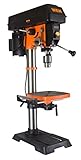
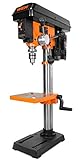
What Actually Matters for Mortising
Quill travel and rigidity. Look for at least 3-1/4″ of travel; 4″ to 6″ is much better for furniture. A standard 2-1/2″ travel benchtop press will not clear a 3″ deep mortise in one setup without raising the table, which introduces alignment error. A quill diameter of 55mm or larger and a well-fitted quill with less than 0.003″ runout will keep the chisel square. Test by extending the quill fully and trying to rock the chuck by hand. Any noticeable play will show up as tapered mortises.
Low RPM range. Hollow chisels need 250-1,000 RPM. Many cheap presses bottom out at 600-750 RPM. At 750 RPM a 1/2″ chisel in hard maple will smoke within seconds and dull fast. Ideal is a press that goes down to 200-400 RPM, either with a stepped pulley system or a variable-speed drive that maintains torque at low speed. Belt-drive presses with 5-6 pulley steps are more reliable here than cheap electronic variable speed that loses torque below 800 RPM.
Mortising attachment compatibility. Most attachments clamp to the quill collar. The collar diameter must match — common sizes are 55mm, 60mm, and 65mm. Cheap presses often have non-standard or plastic collars that will not hold the yoke securely. Steel collar, two-bolt clamp, and a fence with hold-downs are non-negotiable. Without a solid fence and hold-down, the workpiece lifts on the upstroke and the chisel snaps or chips the mortise edge. If you go this route, buy a drill press mortising attachment that matches your quill and includes 1/4″, 5/16″, 3/8″, and 1/2″ chisels, then plan to replace the stock chisels after the first sharpening.
Table and fence. You need a flat cast-iron table at least 10″ x 10″ with T-slots, and ideally a crank or rack-and-pinion height adjustment with a lock that does not slip under feed pressure. A wobbly table that drops 1/32″ under load ruins depth consistency. For furniture, repeatability matters more than size. A simple shop-made fence from Baltic birch with a toggle clamp often beats the flimsy fence that comes with budget presses.
Power. 1/2 HP is the absolute minimum for 1/4″ and 5/16″ mortises in softwoods. For 3/8″ to 1/2″ mortises in oak, ash, or walnut, you want 3/4 HP to 1 HP induction motor. More important than peak HP is continuous torque at low RPM. A 3/4 HP belt-drive press that holds speed under load will outperform a 1 HP direct-drive press that bogs down.
Benchtop vs. Floor-Standing for Mortising
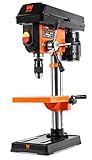
Benchtop presses in the 12″ to 15″ swing range are the sweet spot for furniture shops tight on space. A 12″ swing means 6″ from column to chuck center. That handles most rail and stile work if you support long parts with a roller stand. The downside is mass. A 80-100 lb benchtop press will vibrate and flex more than a 180-250 lb floor model when you lean into a deep cut. Bolt it to a heavy stand or cabinet and the difference shrinks.
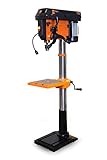
Floor-standing presses with 15″ to 17″ swing and 4-3/4″ to 6″ quill travel are objectively better for mortising. Longer travel lets you cut a 2″ deep mortise without repositioning. Heavier columns (typically 80mm vs 60mm diameter) resist deflection. The trade-off is cost and height. You need 68″ to 72″ of vertical clearance and you will pay $150-$300 more for the same power head on a longer column. If you only cut mortises up to 1-1/2″ deep in material under 8/4, a rigid benchtop is fine and easier to set up for precise depth stops.
Do not buy a 8″ or 10″ mini press for mortising. The quills are short, the tables are small, the low speed is too high (often 620 RPM minimum), and the chucks are usually 1/2″ with poor grip. They will drill holes. They will not mortise furniture hardwoods without burning and binding.
Comparison by Category
| Category | Swing / Quill Travel | Low Speed | Weight | Best For | Limitation |
|---|---|---|---|---|---|
| Budget Benchtop 10-12″ | 10″-12″ / 2-1/2″ to 3-1/8″ | 620-750 RPM | 65-85 lbs | Light mortises: 1/4″ in poplar, pine, occasional 5/16″ | Burns chisels in hardwood, short travel forces table moves |
| Mid-Range Benchtop 12-15″ | 12″-15″ / 3-1/4″ to 4″ | 250-500 RPM | 90-130 lbs | Furniture work: 1/4″ to 3/8″ mortises to 2″ deep in oak/walnut | Needs bolting down, limited throat for wide panels |
| Floor-Standing 15-17″ | 15″-17″ / 4-3/4″ to 6″ | 200-400 RPM | 170-250 lbs | Batch mortising, 1/2″ chisels, deep 2-1/2″ mortises | Cost, footprint, overkill if you mortise rarely |
Setup and Technique That Makes It Work
A good press will still give bad mortises if the chisel setup is wrong. The gap between the auger and the chisel body controls chip flow. Set it to the thickness of a dime — about 0.040″ to 0.050″ — between the chisel shoulder and the yoke. No gap and the auger jams; too much gap and the chisel chatters. Hone the outside faces of the chisel flat on a diamond stone and polish the inside bevel of the auger spur. Factory chisels often arrive with burrs that double cutting force.
Feed pressure should be firm and continuous, not pounding. Clear chips every 1/2″ of depth by retracting the chisel fully. If you smell burning or see fine dust instead of curls, you are feeding too slow or the RPM is too high. Wax the outside of the chisel with paste wax to reduce friction.
Depth stop use matters. Set the mechanical depth stop 1/16″ shy, make the cut, then check with a depth gauge. Creep in the stop under load is a common failure mode on presses with plastic stop nuts — they slip 0.010″ to 0.020″ per mortise. Replace a plastic nut with a brass or steel one if you see depth wandering.
Consider skipping the hollow chisel entirely for long mortises. Drill overlapping 3/8″ holes at 250-600 RPM with a Forstner bit, then clean the walls with a 1/4″ or 3/8″ chisel by hand, or use the press with a benchtop drill press with mortising fence to pare the sides with an end mill. This hybrid method is slower but far less demanding on the press and more forgiving of runout. Many furniture makers prefer it for mortises over 3″ long.
What to Buy
If you mortise occasionally — a few tables a year, mostly 1/4″ and 5/16″ mortises in domestic hardwoods — a rigid mid-range benchtop is the value choice. Look for a 12″ to 15″ model with at least 3-1/2″ quill travel, 6 speeds down to 300-400 RPM, and a cast-iron table with a solid rack. Bolt it to a plywood cabinet filled with sandbags. Spend the savings on good chisels and a proper hold-down. You do not need a floor model to get clean mortises at this scale.
If you batch out chairs or doors and routinely cut 3/8″ and 1/2″ mortises 2″ deep in white oak or hard maple, buy mass and travel. A floor standing drill press 15 inch with 1 HP, 200 RPM low speed, and 5″ of quill travel will cut faster, cooler, and straighter, and it will hold its settings over a 20-mortise run without the table drifting. The upfront cost pays back in fewer ruined parts.
Whichever you choose, budget for accessories: a decent cross-slide vise or at least a dedicated mortising fence with a long hold-down bar, a set of CBN or diamond hones, and a 1/2″ keyed chuck with a JT33 or JT3 taper that you can clean and reseat. A keyless chuck is convenient for drilling but often slips under mortising load. Check runout after installing the attachment; if you see more than 0.004″ TIR at the chisel tip, reseat the chuck or replace it before blaming the chisel.
When Not to Use a Drill Press
If your press cannot reach below 500 RPM, the quill has noticeable side play, or the table cannot be locked solidly, do not force it. You will burn chisels, elongate mortises, and risk grabbing the workpiece. In that case, drill the waste with Forstner bits and square by hand, or put the money toward a benchtop hollow-chisel mortiser. It is a single-purpose machine, but a $350 hollow-chisel mortiser will outperform a $250 drill press for mortising every time because the quill and chisel support are designed for lateral load.
