Best Planers with Dual Feed Rollers for Difficult Stock
What's inside
As an Amazon Associate I earn from qualifying purchases. This post may contain affiliate links at no extra cost to you.
Planing difficult stock is less about horsepower than control. Figured maple, wide glue-ups, short boards, damp lumber, and boards with reversing grain can expose a planer’s weak feed system quickly. The machine may pull the board unevenly, leave ridges, stall under load, or compress the wood at the entrance and release it with a snipe.
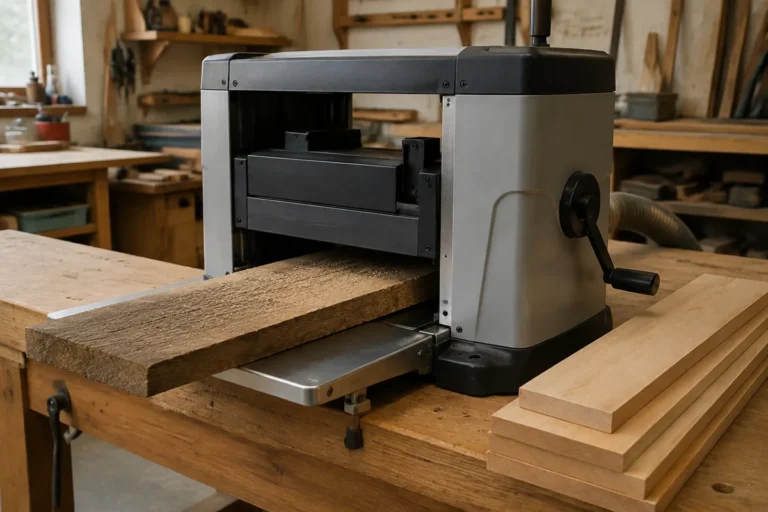
For this work, look for a stationary planer with dual feed rollers: two driven rollers before the cutterhead, or a segmented infeed roller paired with a second driven roller. More contact keeps the board moving when one section encounters a knot or an uneven surface. It also reduces the tipping and chatter common with a single-roller portable planer.
As an Amazon Associate we earn from qualifying purchases at no extra cost to you.


Contents
What dual feed rollers do
A planer’s feed system has three jobs: press the board flat, move it at a consistent rate, and release it without allowing the board to rise into the cutterhead. Two driven infeed rollers distribute that work over a longer area. On wide or warped stock, the first roller can maintain pressure while the second continues pulling the board forward.
Do not confuse two rollers with two feed speeds. A variable-speed planer may have high and low feed rates but only one infeed and one outfeed roller. Speed selection affects cut quality and tear-out; roller count affects grip and stability. The best machines combine multiple rollers with a rigid table, adjustable pressure bars, and enough cutterhead width for the stock you actually use.
The best planer types for difficult stock
For a small shop, a 12- or 13-inch benchtop planer is the affordable starting point. These machines are compact and useful, but most rely on one powered infeed roller and one powered outfeed roller. They can process difficult wood if you take shallow cuts, support long boards, and accept more snipe. Look at 13-inch thickness planers with helical cutterheads when space and budget matter more than maximum feed control.
A floor-standing 15-inch planer is the better choice for repeated work in figured hardwood, heavy slabs, or boards longer than 6 feet. These machines typically offer a longer bed, stronger drive system, larger rollers, and adjustable feed speed. Some use a full-width steel infeed roller; others use segmented rollers that maintain pressure over irregular stock. A 15-inch machine usually needs 240 volts and substantial dust collection, so account for electrical and installation costs.
Industrial planers with two infeed and two outfeed rollers are the most stable option. They are expensive, heavy, and often wider than a typical garage shop can accommodate. Their advantage is obvious when feeding rough, cupped boards continuously: several rollers keep pressure on the work while the cutterhead removes material. Used equipment can be a good value, but worn pressure springs, damaged tables, and unavailable parts can erase the savings.
| Planer type | Best use | Typical limitation | Useful capacity |
|---|---|---|---|
| 12–13-inch benchtop | Occasional furniture parts and moderate-width boards | More snipe and less grip on warped stock | 12–13 inches wide, about 6 inches thick |
| 15-inch floor-standing | Regular hardwood work and wide glue-up parts | Higher cost, weight, and electrical demands | 15 inches wide, commonly 6 inches thick |
| Industrial multi-roller | Continuous production and badly irregular stock | Large footprint and expensive maintenance | 15–24 inches wide or more |
Cutterhead choices matter too
A dual-roller planer with a straight-knife cutterhead can feed aggressively, but knives may produce severe tear-out in reversing grain. A helical or segmented-carbide head uses many small inserts and usually leaves a cleaner surface on difficult hardwood. It also makes damaged inserts easy to replace individually. The trade-off is cost: replacement inserts are not free, and a helical head does not compensate for excessive depth of cut or poor grain direction.
For highly figured material, remove only 1/32 inch per pass, or less when the grain is particularly unstable. A heavy 1/8-inch cut may be reasonable in straight-grained softwood, but it increases motor load and tear-out in maple, cherry, and tropical hardwoods. A variable-speed 15-inch planer with variable feed speed lets you slow the board for a finer finish and use a faster setting for rough dimensioning.
Features worth paying for
Check the roller design before the motor rating. Segmented infeed rollers are valuable when boards have minor cup or twist because each section can maintain contact without lifting the entire roller. Serrated steel rollers grip rough stock well, but they can leave marks that require extra sanding. Rubber rollers are gentler but may slip when covered with dust or resin.
A heavy cast-iron table and extension supports reduce vibration and prevent a long board from levering upward. A bed roller system can help, but rollers set too high make thin stock bounce. Look for an adjustable pressure bar, accessible roller-cleaning points, positive table locks, and a dust port large enough for your collector. A 4-inch port is common; a small shop vacuum is usually inadequate for continuous planer chips.
Automatic carriage locks or a solid four-post column reduce thickness drift during a pass. They do not eliminate snipe. To reduce snipe, support the board level with the table, feed a sacrificial leader board before the workpiece, and keep a matching follower board behind it. Leave at least 12 inches of extra length when the finished part allows it, then cut away the affected ends.
When the cheaper planer is fine
Choose a benchtop machine if you mostly plane straight-grained pine, poplar, or pre-jointed boards under 5 feet long. It is also fine for occasional furniture work if you are willing to make several light passes and inspect every board between cuts. A simple two-roller portable planer is not automatically a poor purchase; it is a poor match for continuous difficult stock.
If you regularly process rough-sawn hardwood, wide panels, or boards with reversing grain, spend the money on a floor-standing machine with multiple driven rollers and a helical head. Search for 15-inch stationary planers with dual feed rollers, then verify the manufacturer’s roller layout rather than trusting a product title. Some listings use “dual feed” to describe only the infeed and outfeed roller pair.
Before buying, measure the machine’s footprint, confirm the required voltage, and check whether replacement knives or inserts are readily available. Feed rollers need periodic cleaning and spring inspection. If a board slips, stop the machine rather than forcing it; a stalled cutterhead can burn the wood, trip the breaker, or damage the drive system. For difficult stock, reliable pressure and controlled passes are worth more than a headline motor rating.