Best Planers for Milling Dense Exotic Hardwood
What's inside
As an Amazon Associate I earn from qualifying purchases. This post may contain affiliate links at no extra cost to you.
Milling dense exotic hardwood is harder on a planer than ordinary construction lumber. Species such as ipe, jatoba, ebony, purpleheart, and hard maple can put heavy loads on the cutterhead, dull knives quickly, and produce tear-out when grain direction changes. The best planer is not necessarily the one with the largest motor. Cutter geometry, feed consistency, dust collection, and the ability to make light finishing cuts matter just as much.
As an Amazon Associate we earn from qualifying purchases at no extra cost to you.

Contents
What to Look for in a Planer
For most serious work, start with a 12- to 15-amp benchtop thickness planer. A machine in this class typically handles boards 12 to 13 inches wide and 6 inches or more thick. That is enough for furniture parts, flooring repairs, cutting boards, and most small-shop projects. A wider 15-inch stationary planer is more capable, but it takes substantially more space and usually requires 240-volt power.
Look for a cutterhead that can accept carbide inserts or high-quality disposable knives. A helical-head thickness planer is usually the best choice for difficult hardwood because its small carbide cutters enter the wood gradually. When one insert becomes damaged, you rotate or replace that insert instead of changing a long knife.
A conventional straight-knife planer is still a valid budget option. It can leave an excellent surface in straight-grained stock, and replacement knives are inexpensive. The trade-off is more noise, more visible tear-out in reversing grain, and a greater chance that a knot or hidden mineral deposit will nick the entire knife. For occasional projects, the lower purchase price may outweigh those disadvantages.
| Planer type | Best use | Advantages | Limitations |
|---|---|---|---|
| Benchtop straight-knife | Occasional milling and moderate widths | Lowest cost, simple knife changes, widely available | More tear-out, louder operation, knives damage across their full width |
| Benchtop helical or spiral | Dense, figured, or difficult hardwood | Quieter, smoother cuts, replaceable carbide inserts | Higher cost and more feed resistance on very deep cuts |
| 15-inch stationary planer | Frequent production work and wide boards | Rigid tables, stronger feed systems, wider capacity | Expensive, heavy, and often needs 240-volt power |
The Best Choice for Most Woodworkers
For dense exotic hardwood, the best general-purpose choice is a benchtop planer with a segmented carbide cutterhead, a two-speed or variable feed system, and solid infeed and outfeed tables. Search for a 13-inch spiral-cutterhead thickness planer if you regularly work with boards wider than 10 inches.
Do not judge a planer solely by its maximum cut. A machine advertised with a 1/8-inch maximum pass may manage that depth in softwood, but dense hardwood should generally be reduced in 1/32- to 1/16-inch passes. Removing 1/16 inch from a 10-inch-wide piece of ipe creates a much heavier load than removing the same amount from pine.
A good feed system is critical. Dense stock can stall a marginal motor, especially if the board is wide, damp, or slightly bowed. A planer with independent gearbox-driven feed rollers is preferable to one that relies on a light-duty mechanism. Weight also helps: a heavier machine tends to vibrate less and maintain a more consistent finish.
Cutterheads, Knives, and Surface Quality
Helical and spiral cutterheads are not identical. A true helical head uses rows of inserts arranged to shear the wood, while some “spiral” heads simply use staggered cutters. Both can work well, but the number, size, and arrangement of inserts matter. Smaller inserts generally reduce the visible impact of each cutter and make localized damage easier to repair.
Carbide inserts last much longer than high-speed-steel knives when cutting abrasive species, but they are not indestructible. Sand, bark, embedded grit, and mineral streaks can chip an insert. Keep a spare set on hand, and inspect the cutterhead when the surface suddenly develops repeating lines or small ridges.
Straight knives make sense when you are buying a cheaper planer, milling mostly clear straight-grained boards, or working on rough stock that will be sanded heavily. Keep two sets of knives. A dull knife increases feed resistance and encourages the operator to force the board, which can worsen snipe and damage the feed rollers.
How to Plane Dense Exotic Hardwood
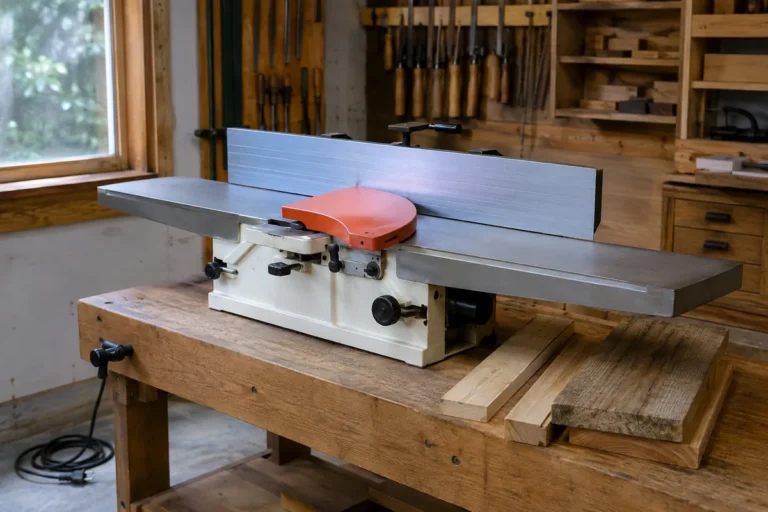
Flatten one face first with a jointer, sled, or router-based flattening setup. A thickness planer makes the opposite face parallel to the reference face; it will not reliably flatten a board that rocks or has a cup. For wider stock, a 15-inch stationary helical planer offers better support and feed stability than a compact benchtop machine.
Begin with a shallow cut, around 1/32 inch, and check the motor sound and chip flow. Increase to 1/16 inch only if the machine feeds without slowing. For the final two passes, use approximately 1/64 inch. Light finishing cuts reduce tear-out and leave less work for sanding.
Support long boards at the exact height of the planer table. If the infeed side is low, the board can dip into the cutterhead and produce snipe. The same problem occurs at the outfeed side when the trailing end drops. Allow several inches of sacrificial length when possible, then cut the sniped ends off.
Feed boards with the grain whenever practical. With reversing or figured grain, there may be no perfect direction. In that case, take very light cuts, reduce the feed speed if the machine allows it, and consider stopping at a thickness slightly above final size. A cabinet scraper or sharp hand plane can remove the last marks more safely than another aggressive pass.
Dust Collection and Safety
Exotic hardwood dust can irritate the skin and lungs, and some species cause stronger allergic reactions. Use a properly fitted respirator, eye protection, and dust collection connected to the planer’s chip hood. A shop vacuum may work for light passes, but many planers produce chips faster than a small extractor can move them. A 1,000- to 1,500-CFM dust collector is a more reliable match for a stationary machine.
Never reach into the planer while the cutterhead is moving, even to clear a jam. Dense boards can kick back or stop abruptly. Disconnect power before clearing chips, changing knives, or rotating carbide inserts. A planer that feeds poorly is not fixed by pushing harder; check cutter sharpness, table alignment, stock moisture, and roller cleanliness instead.
When the Cheaper Planer Is Fine
A basic straight-knife benchtop planer is adequate if you mill a few boards per year, stay below its width limit, and can tolerate occasional sanding. Buy the helical version when you work regularly with abrasive exotics, figured grain, wide panels, or expensive stock where tear-out is costly. The extra price is easiest to justify through reduced knife changes, lower noise, and fewer ruined surfaces—not because it eliminates the need for careful setup.