Best Planers for Dimensioning Long Boards Consistently
What's inside
As an Amazon Associate I earn from qualifying purchases. This post may contain affiliate links at no extra cost to you.
Dimensioning long boards is where a planer’s limitations become obvious. A short board can enter and leave the machine before it has time to misbehave. A 6- to 10-foot board, however, exposes problems with infeed support, snipe, uneven pressure, and inconsistent stock preparation. The best planer is not necessarily the one with the largest motor. It is the machine that keeps the board supported, removes material predictably, and lets you repeat the same setup across a batch.
As an Amazon Associate we earn from qualifying purchases at no extra cost to you.

Contents
What Makes a Planer Good for Long Boards
For long workpieces, look first at bed length and support rather than maximum cutting width. A planer with a 12-1/2-inch capacity can dimension most furniture parts, but its short table may allow the board to sag before the cutterhead grabs it. That sag changes the cutting angle and commonly causes snipe at the leading and trailing ends.
Built-in extension tables help, but they are not a complete solution. Long boards usually need auxiliary roller stands or a sturdy outfeed table adjusted nearly flush with the planer bed. The support should be close enough to prevent the board from dropping, but not so high that it lifts the board into the cutterhead.
A two-speed feed system is useful when you need both reasonable production and a cleaner finish. The faster setting is suitable for rough dimensioning; the slower setting generally leaves fewer visible ridges. Do not expect a slower feed to fix tear-out caused by feeding figured wood in the wrong direction. Cutter geometry, sharp knives, and grain direction still matter.
Planer Types Compared
| Planer type | Best use | Advantages | Limitations |
|---|---|---|---|
| Portable benchtop | Small shops and occasional projects | Lowest cost, easy to store, usually 12- to 13-inch capacity | Short tables, more vibration, louder operation, more snipe risk |
| Heavy-duty benchtop | Regular furniture and cabinet work | Stronger feed mechanism, better support, often two feed speeds | Still requires careful infeed and outfeed support |
| Floor-standing three-knife | Frequent dimensioning and batch work | More stable, faster stock removal, longer beds, smoother feeding | Higher cost, heavier, requires dedicated floor space and dust collection |
| Helical or segmented-head planer | Hardwoods, figured stock, and quieter operation | Reduced tear-out, quieter cutting, individual inserts are replaceable | Higher purchase price and more setup time when replacing inserts |
Best Planer Categories to Buy
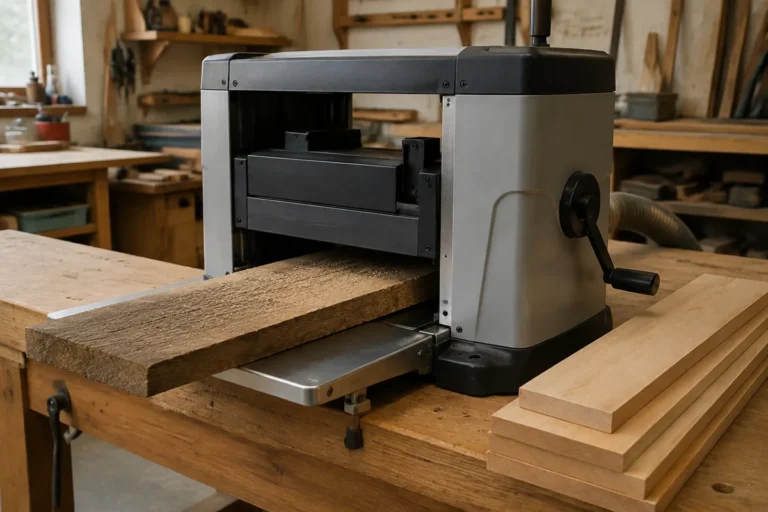
For most home shops, a heavy-duty benchtop planer is the practical choice. Look for a 12- to 13-inch width capacity, a 15-amp motor, positive bed-locking, and extension tables that remain rigid when loaded. A heavy-duty 12-inch wood planer is usually enough for table legs, shelving, cabinet parts, and boards up to about 8 feet when properly supported.
A basic portable model is fine when you only dimension a few boards each month. The cheaper option becomes less attractive when you process wide hardwood repeatedly. Small machines often struggle with deep cuts, and their lighter tables can shift or vibrate. They can still produce accurate work, but you will make more shallow passes and spend more time managing the board.
If you routinely process batches of long boards, a floor-standing machine earns its space. A 15-inch floor-standing wood planer typically has a longer bed and more substantial feed rollers. That reduces the effect of board sag and makes repeated passes more consistent. It also demands a proper dust collector. A shop vacuum is generally inadequate for the chips produced by a large cutterhead.
Helical heads are worth considering if you work with maple, oak, walnut, or figured boards. A helical-head wood planer costs more, but its small inserts tend to reduce tear-out and produce a more uniform surface. The benefit is greatest on difficult grain; for straight-grained softwood, a conventional three-knife head may be entirely satisfactory.
How to Prevent Snipe on Long Boards
Snipe is the shallow dip cut into the first or last few inches of a board. It occurs when the board is supported by only one roller, allowing the end to rise or fall as it enters or leaves the cutterhead. Long boards make the problem worse because their weight creates more leverage.
Start with the planer on a level surface. Set infeed and outfeed support so it is aligned with the bed, then make a test cut on scrap. On many machines, lifting the free end of the board slightly as it enters and exits reduces snipe. Do not force the board upward while the rollers are gripping it; that can cause uneven thickness or a stalled feed.
Lock the cutterhead after setting the depth. If the head drifts during a long run, boards from the same stack will not match. Take no more than about 1/16 inch per pass on hardwood, and use 1/32 inch or less for the final pass. Removing 1/8 inch in one pass may seem efficient, but it increases motor load, tear-out, and thickness variation.
Setup for Consistent Dimensioning
Flatten one face before planing the opposite face. A thickness planer makes the top face parallel to the bottom face; it does not reliably flatten a board that rocks or bows on the bed. Use a jointer, sled, or other appropriate flattening method first. If the bottom is not stable, the planer will copy its defects.
Measure the board at both ends and in the middle before cutting. Set the machine to remove only enough material to clean the highest area, then measure again. For a batch, establish a reference board and verify the planer with calipers or a reliable thickness gauge every few boards. A difference of 0.005 inch can matter when joining panels or fitting drawers.
Keep knives sharp and use dust collection with a short, unobstructed hose. A packed chip chute can reduce feed performance and leave ridges on the board. Inspect the feed rollers periodically; resin and dust on the rollers can cause slipping, especially on long, heavy stock.
Buying Checklist
Prioritize a rigid bed, dependable depth adjustment, positive cutterhead lock, accessible knife or insert replacement, and parts availability. Consider the machine’s actual length and weight, not just its advertised capacity. A planer that moves during a pass is difficult to calibrate.
Also budget for support stands, hearing protection, dust collection, and replacement knives or inserts. For occasional work, a well-supported benchtop planer is the sensible buy. For continuous batches of long hardwood boards, the cost of a heavier floor-standing or helical-head machine is justified by fewer adjustments, less rework, and more predictable surfaces.