Band Saw vs Jointer for Squaring Irregular Hardwood Blanks
What's inside
As an Amazon Associate I earn from qualifying purchases. This post may contain affiliate links at no extra cost to you.
Squaring an irregular hardwood blank is not one operation. You first need a reasonably straight reference edge, then a flat face, then a second edge and face that can be made parallel and square. A band saw and a jointer can both be part of that process, but they solve different problems.
For rough, curved, bark-edged, or live-edge stock, the band saw is usually the better first purchase. It removes waste without requiring a straight edge. A jointer becomes more valuable after one face or edge is already stable enough to ride safely against its tables and fence.
As an Amazon Associate we earn from qualifying purchases at no extra cost to you.



Contents
What Each Machine Actually Does
A band saw cuts along a marked line. It is good at removing large amounts of waste from irregular blanks while producing relatively little sawdust compared with a table saw. The cut edge will usually need jointing, planing, or sanding, but the machine can handle stock that has no trustworthy straight side.
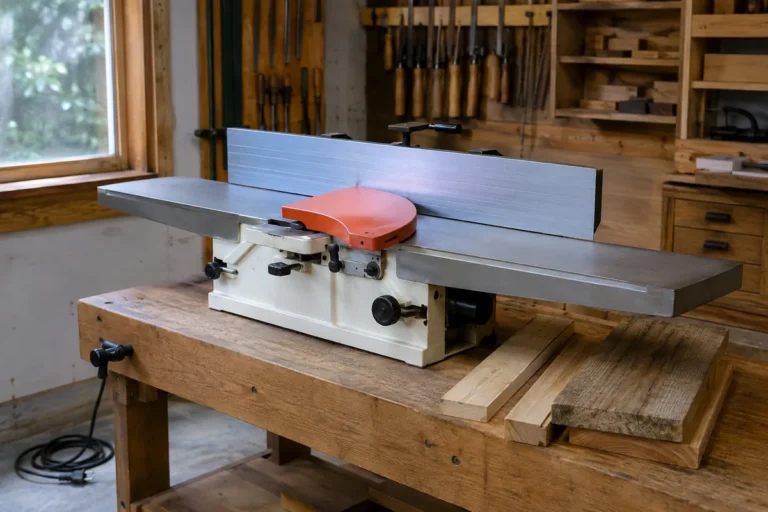
A jointer cuts a flat surface or a straight edge. The infeed table supports the work before the cutter head, and the outfeed table supports it afterward. With correct setup, the jointer can flatten one face and make one edge square to that face. It does not reliably flatten a badly twisted slab in one pass, and it is a poor tool for stock with loose bark, severe bow, or an unstable footprint.
The jointer is a precision reference-making machine. The band saw is primarily a controlled waste-removal machine. Confusing those roles leads to poor cuts, unsafe feeding, and wasted lumber.
Why the Band Saw Usually Comes First
For a blank with one usable face or no straight edge, mark a straight line and cut just outside it. Leave about 1/16 to 1/8 inch for final jointing. On a thick blank, make the cut in stages rather than forcing the blade through a tight curve. A sharp 1/2-inch blade with roughly 3 teeth per inch is a useful general choice for resawing and heavy hardwood waste, while a narrower blade tracks tighter curves.
A band saw also handles wedge-shaped blanks and live edges without the minimum-contact problems of a jointer. Use a long fence or auxiliary guide when cutting a straight reference edge. Keep the work firmly on the table, but do not twist it to follow a line; twisting can pull the blade off course or pinch the kerf.
Capacity matters. A small benchtop band saw may have only 3 to 4 inches of resaw height, while many floor models offer 10 to 14 inches. Measure the blank, including the part you expect to remove. A machine with inadequate throat depth or resaw height may force awkward cuts and multiple setups. For rough hardwood blanks, compare 14-inch band saws with useful resaw capacity rather than judging only by motor horsepower.
When the Jointer Is the Better Tool
If the blank already has a reasonably straight edge and is short enough to control safely, the jointer is faster and more accurate. It can produce a clean reference edge in a few passes, then make that edge square to the flattened face. This is especially useful for boards that will be glued into panels or cut to exact dimensions.
Width is the main limitation. A 6-inch jointer cannot flatten a 9-inch board in one pass, and a 6-inch jointer is not made more capable by taking deeper cuts. Check the actual table width and length. Short tables make long stock harder to straighten, while a long blank can also be difficult to keep stable during the first passes.
For a twisted hardwood blank, take light cuts—often 1/32 inch or less—and identify the high corners before feeding it. If the piece rocks, use a sled, carrier, or another method that creates a stable bottom. Never joint stock with embedded metal, loose knots, detached bark, or a rounded underside that cannot stay planted.
Browse 6-inch jointers if you mostly process ordinary boards. They are often the cheaper choice and are fine when your stock is narrower than the cutter head and already has one manageable face. For wide slabs, a jointer may be the wrong purchase entirely; a router sled or planer sled can flatten the face, followed by a track saw or band saw for the edge.
Band Saw vs. Jointer
| Factor | Band saw | Jointer |
|---|---|---|
| Starting condition | Works with irregular, curved, or live-edge blanks | Needs a stable face or edge to begin safely |
| Main result | Removes waste along a marked line | Creates a flat face or straight, square edge |
| Material loss | Moderate; leave a small jointing allowance | Can remove substantial material from twisted stock |
| Accuracy | Depends heavily on blade setup and operator control | Excellent for straightness and 90-degree edges |
| Main failure mode | Blade drift, wandering cuts, or a pinched blade | Rocking stock, snipe-like taper, or unsafe kickback |
| Best first purchase for rough blanks | Usually yes | Only if stock is already fairly regular |
A Practical Squaring Workflow
Start by inspecting the blank for nails, screws, stones, loose bark, and internal cracks. Mark the usable area and draw the reference edge. Cut that edge on the band saw, staying just outside the line. If the blank is long, support it with an outfeed table or roller stands; unsupported stock can rotate as the waste separates.
Next, joint the sawn edge with the concave side down when possible. Take light passes until the cut removes continuously from end to end. Then use that straight edge against the jointer fence to make the first face square to it. If the face is badly twisted, flatten it with a planer sled or router sled first rather than trying to balance it over the cutter head.
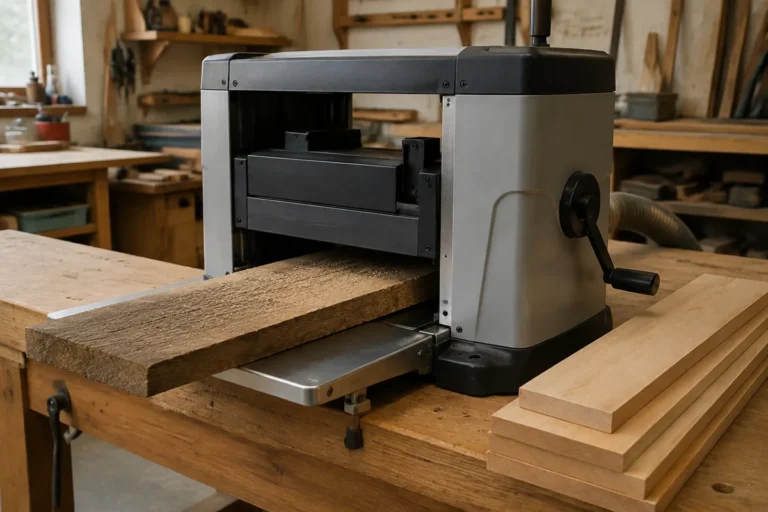
After one face is flat, a thickness planer can make the opposite face parallel. Finally, return to the jointer or use a table saw with the reference edge against the fence to establish the second straight edge. A thickness planer is often the more useful partner for a jointer when the goal is consistent thickness.
Which Machine Should You Buy?
Buy the band saw first if your material is rough, short, irregular, live-edge, or too wide to sit securely on a jointer. It gives you flexibility and removes waste with less dependence on an existing straight edge. Budget for a quality blade, accurate guides, and adequate dust collection.
Buy the jointer first if you mainly buy surfaced or partially milled boards, need square glue joints, and can keep your stock within the machine’s width and table capacity. The cheaper option is fine when your boards already have a flat face and only need edge jointing. It is not a shortcut for flattening large, twisted slabs.
For many small shops, the most efficient combination is a band saw for rough sizing, a planer for parallel faces, and a jointer for the final reference edge. The machines complement one another; neither replaces the other.