Table Saw vs Drill Press for Boring Repetitive Dowel Holes
What's inside
As an Amazon Associate I earn from qualifying purchases. This post may contain affiliate links at no extra cost to you.
For repetitive dowel holes, a drill press is usually the right machine. A table saw can help make the jig, cut a stop block, or size dowel stock, but it is a poor substitute for a machine designed to push a rotating bit straight into the work. The choice becomes less obvious when you already own a table saw and only need a few holes in a simple project.
As an Amazon Associate we earn from qualifying purchases at no extra cost to you.

Contents
What the machines actually do
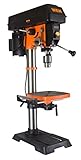
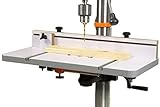
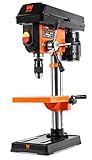
A drill press holds the workpiece on a table and moves the bit vertically through a controlled quill stroke. The spindle stays aligned with the column, and the table can support a fence, stop, or dedicated drilling jig. That combination makes repeated holes predictable.
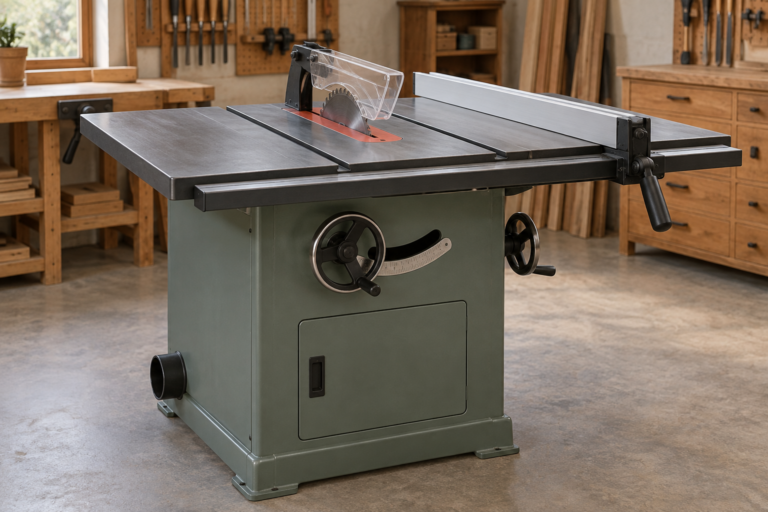
A table saw is designed to move stock horizontally past a blade. Its arbor is not intended for drilling, and the blade guard, riving knife, and table opening are built around sawing operations. You should not mount a drill bit, hole saw, or improvised cutter in the arbor. The result can be dangerous and can damage the saw.
The table saw can still be part of the solution. It can cut a plywood drilling jig, make a square fence, rip spacer strips, and prepare dowel stock. It just should not be the machine doing the boring.
Which machine wins for repetitive holes?
| Factor | Drill press | Table saw |
|---|---|---|
| Hole alignment | Good with a fence, stop, and jig | Not suitable for direct drilling |
| Hole depth | Adjustable depth stop and quill travel | No practical drilling depth control |
| Repeatability | High for rows and batches | Limited to jig-making and stock preparation |
| Typical purchase cost | Entry models are often moderate in price | Usually costs more, especially with a good fence and stand |
| Best use here | Drilling the dowel holes | Building the jig and cutting related parts |
For a row of holes, the drill press has another advantage: you can use a mechanical stop rather than measuring every location. Set the first hole, clamp a stop block to the fence, and index the workpiece from that reference. A simple setup can produce dozens of holes with much less cumulative error than pencil marks and a handheld drill.
Why a drill press is better for dowel joinery
Dowel joints depend on holes being square to the mating faces. Even a small angular error becomes obvious when several dowels must enter matching holes. A drill press does not guarantee perfect results by itself, but its column and table give you a stable starting point.
Use a sharp brad-point bit or a dedicated dowel bit. For a 3/8-inch dowel, use a 3/8-inch bit with a depth stop set slightly deeper than half the dowel length. For a 2-inch dowel joining two boards, that might mean holes approximately 1-1/16 inches deep in each part, leaving a small amount of glue space at the bottom. Always check the actual dowel length and the thickness of the stock before drilling.
Run the bit fast enough to cut cleanly, but not so fast that it burns the wood. Many benchtop drill presses cover roughly 500 to 3,000 rpm. Larger bits need slower speeds; a 1/2-inch bit in hardwood should not be run at the same speed as a 1/8-inch bit in softwood. Clear chips by raising the bit periodically, particularly in deep blind holes.
A benchtop drill press for woodworking is enough for most furniture and cabinet dowel work. Look for a real depth stop, a table that tilts or accepts clamps, at least 2 inches of quill travel, and enough throat depth for the parts you build. A large floor model is only useful if you need more capacity or regularly drill wide panels.
How the table saw still helps
Suppose you need 20 evenly spaced holes along a narrow rail. Use the table saw to cut a straight plywood jig with a fence and a registration edge. Drill one accurate hole in the jig on the drill press, then use that hole as a guide bushing location. Add a stop block so every rail registers at the same point.
The table saw is also useful for cutting a row of thin indexing strips. For example, a 1/4-inch plywood strip can locate successive hole positions if the spacing is 1 inch. The strip should guide the workpiece; it should not guide the spinning bit unless it is properly built as a drilling jig and clamped securely.
Do not hold a small workpiece by hand while drilling on a drill press, either. The bit can grab as it exits and spin the part violently. Clamp short pieces, use a sacrificial backer to reduce blowout, and keep the jig flat on the table. A hold-down is worthwhile when making a batch.
When a table saw owner can skip the drill press
If you need four or fewer holes in one project, buying a drill press may not be justified. A handheld drill with a doweling jig can be cheaper and more flexible. A basic dowel jig for woodworking is fine when the parts are short, the joint is not highly visible, and you can test the setup on scrap.
You can also use a shop-made guide block: drill a straight hole through hardwood on a drill press or with care, clamp it to the workpiece, and run the handheld drill through the guide. This is slower than a drill press and the guide hole eventually wears, but it is adequate for occasional repairs or a small shelf project.
The cheaper option stops being attractive when you need repeated rows, deep blind holes, hard maple or oak, or mating parts that must interchange. In those cases, setup time and rejected parts can quickly exceed the cost of an entry-level machine. A dowel drill bit set with brad-point bits also helps, since ordinary twist bits tend to wander and leave ragged entry holes.
The practical buying decision
Buy a drill press if dowel joinery is a recurring task, if you need consistent hole depth, or if your parts are too awkward to control with a handheld drill. A modest benchtop model, a solid fence, a stop block, and clamps will outperform a more expensive table saw for this specific job.
Buy or keep the table saw for ripping, crosscutting, sizing jig parts, and making accurate reference edges. It is a valuable partner in the process, but not the boring machine. If your budget allows only one stationary tool and repetitive dowel holes are the priority, choose the drill press.