Best Planers for Small-Batch Furniture Component Production
What's inside
As an Amazon Associate I earn from qualifying purchases. This post may contain affiliate links at no extra cost to you.
Small-batch furniture production needs a planer that repeats thickness accurately without turning every board into a setup project. The right machine depends less on maximum cutting width than on stock size, batch volume, dust collection, and how much handwork you are willing to do after milling.
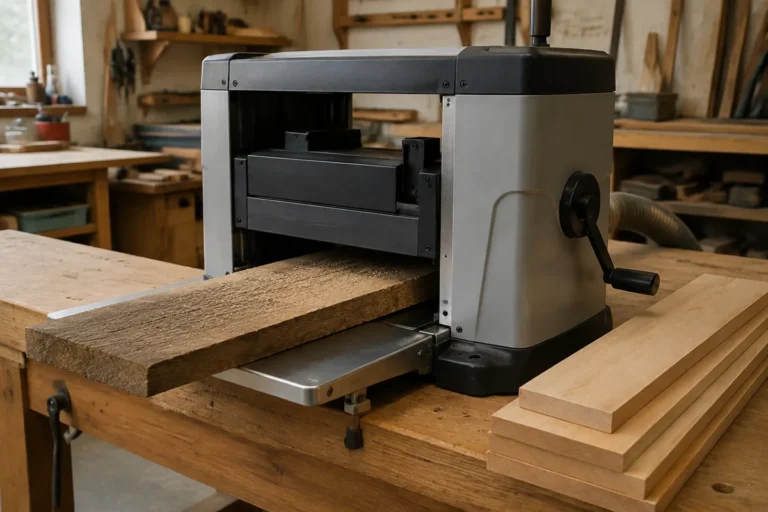
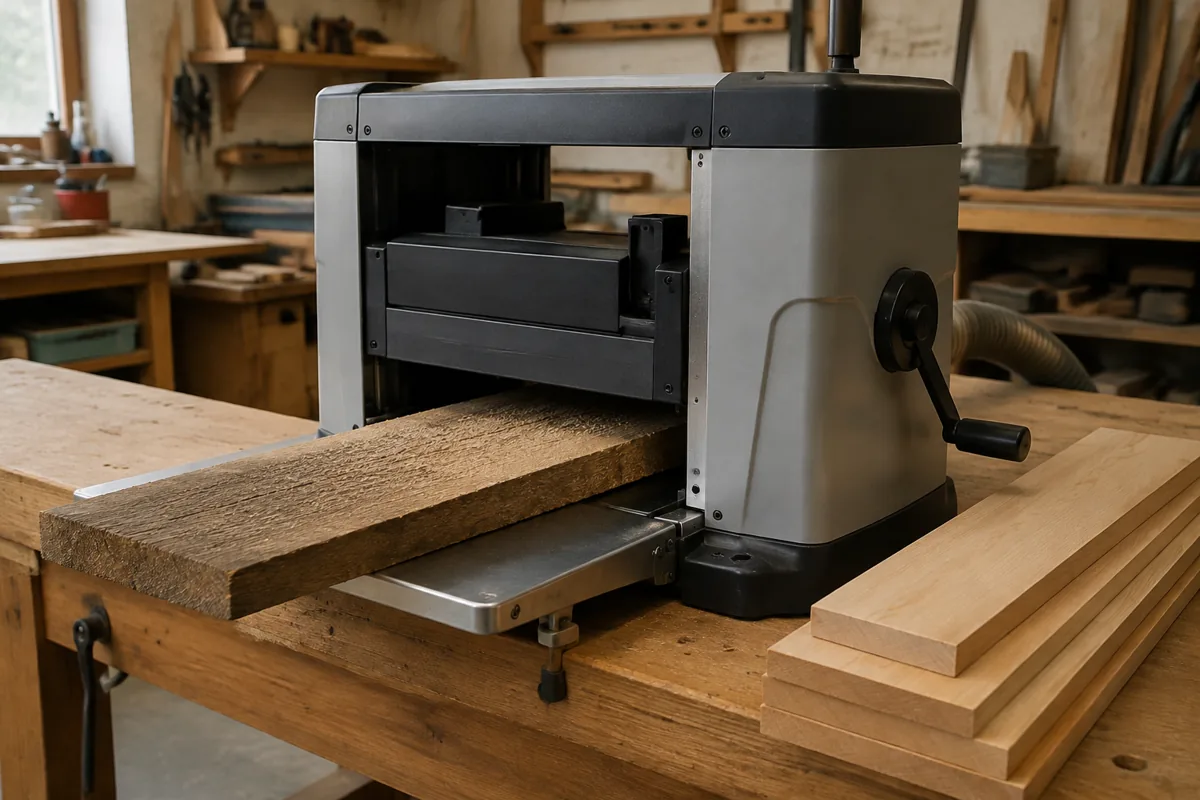
For most small shops, a stationary benchtop thickness planer is the sensible starting point. It can bring rough boards to a consistent thickness quickly, costs far less than an industrial machine, and stores under a bench when not in use. If you regularly process wide hardwood panels, thick slabs, or several hundred board feet per month, a heavier floor-standing planer becomes easier to justify.
Contents
What a planer does—and what it does not
A thickness planer makes the top face parallel to the bottom face and brings the board to a chosen thickness. It does not reliably flatten a twisted, cupped, or bowed board by itself. The cutter head follows the lower surface, so a distorted board can emerge thinner while still distorted.
Use a jointer, sled, or other flattening method to create one flat reference face first. Then run that face down on the planer. For furniture components such as rails, stiles, drawer parts, and table legs, this sequence matters more than buying a machine with a larger motor.
Planers also leave feed-roller marks, a faint ridge at the end of the board, or shallow scallops if the knives are dull. Leave roughly 1/32 inch for a final pass or sanding when appearance matters. For rough, cupped boards, expect more waste; forcing a board to its target thickness can remove useful material before the board has stabilized.
The best planer types for small batches
| Planer type | Typical capacity | Best use | Main compromise |
|---|---|---|---|
| Benchtop portable | 12 to 13 inches wide, about 6 inches thick | Occasional and small-batch furniture parts | Louder, lighter, more snipe and slower feed |
| Heavy-duty benchtop | 12 to 13 inches wide, stronger feed system | Weekly hardwood milling and repeated components | Higher price without a major width increase |
| Floor-standing single-phase | 15 inches wide or more, deeper capacity | Regular production and long stock | Cost, floor space, and electrical requirements |
| Industrial helical-head planer | 15 inches or wider | Continuous production and difficult woods | Expensive tooling and installation |
A basic 13-inch benchtop thickness planer is often enough for cabinet parts and furniture components. The cheaper option is fine when you mill short runs, work mostly with 4/4 and 5/4 lumber, and can tolerate a slower feed rate. Do not mistake portability for precision, though: lightweight machines need a rigid stand and adequate infeed and outfeed support.
Capacity and power decisions
A 12- or 13-inch planer handles most furniture boards, but that width is measured at the maximum opening. Real workpieces need clearance for uneven edges and safe feeding. If your projects routinely use 14- or 16-inch boards, either buy a wider floor machine or plan to rip and glue panels after milling.
Thickness capacity is less important than it first appears. A nominal 6-inch maximum opening covers most table aprons, drawer parts, and cabinet stock. The minimum thickness is usually around 1/8 inch, but thin pieces are difficult to feed safely. A carrier board or sacrificial sled can help, provided the machine manufacturer allows that use and the assembly is rigid.
Motor horsepower alone does not predict performance. Cutter diameter, knife sharpness, feed speed, roller pressure, and chip removal all affect results. A planer that bogs down in hard maple at a fast setting may work well if you take 1/32-inch passes. For production, a two-speed machine is useful: fast for rough sizing and slow for cleaner cuts.
Straight knives versus helical cutter heads
Straight-knife planers cost less and are simple to maintain. They work well on common domestic hardwoods when knives are sharp and properly aligned. Their weaknesses are noise, tear-out in figured wood, and the need to replace or sharpen long knives when one edge is damaged.
Helical or spiral heads use many small carbide inserts. A damaged insert can be rotated or replaced instead of removing an entire knife, and the staggered cutting action is usually quieter. They are particularly helpful with figured maple, curly birch, reversing grain, and abrasive woods. The trade-off is purchase price and the cost of keeping spare inserts on hand.
For occasional production in straight-grained pine, ash, oak, or maple, straight knives are usually the better value. If rework and noise are costing real time every week, a helical-head thickness planer can pay for itself through fewer tear-outs and faster maintenance.
Dust collection and shop workflow
Planers produce a large volume of chips. A small shop vacuum is commonly overwhelmed, and clogged chip ejection causes packed debris, poor finish, and feed problems. A dust collector with a 4-inch hose is the practical choice for a stationary machine. Keep the hose short, avoid sharp bends, and check that the collector can maintain useful airflow under load.
Allow at least 6 to 8 feet of clear space on both sides of the machine for long boards. Folding roller stands are helpful, but they must be level with the planer bed; a low stand can lift the board into the cutter, while a high stand can cause it to drop and create snipe. Mark a reference face on every board before milling so parts do not get accidentally flipped between passes.
Features worth paying for
Prioritize a solid cast or reinforced bed, accessible height adjustment, a clear depth scale, reliable feed rollers, and easy knife or insert changes. A depth-stop turret is valuable when producing repeated parts. A digital thickness readout is convenient but not essential; verify actual thickness with calipers because scales can drift.
Look for a machine with an automatic head lock or a rigid locking mechanism. Without it, the cutter head can creep during a batch, producing parts that vary by several thousandths of an inch. That may not matter for rough framing, but it becomes obvious when drawer sides or cabinet doors are assembled.
A practical buying recommendation
For a first stationary machine, choose a 12- or 13-inch benchtop planer with a strong stand, a dust hood, and readily available replacement knives. Add an infeed table, outfeed table, calipers, and dust collection before spending heavily on electronic features. A replacement knife set for your planer is a better immediate purchase than a marginally larger machine.
Move to a 15-inch floor-standing planer when you are processing long runs, routinely removing substantial material, or losing production time to repeated snipe and slow feeding. Buy the heavier machine for throughput and stability—not because it eliminates the need to joint, measure, support, and inspect the lumber.
Before ordering, confirm the machine’s voltage, maximum stock dimensions, knife availability, dust-port size, and total weight. Also check whether replacement parts are sold through a domestic supplier. A bargain planer that sits idle for two weeks waiting for a belt or insert is not a bargain in a small production shop.