Best Planers with Long Tables for Supporting Cabinet Parts
What's inside
As an Amazon Associate I earn from qualifying purchases. This post may contain affiliate links at no extra cost to you.
Contents
Why table length matters on a planer
Long tables help keep a cabinet panel level as it enters and leaves the cutterhead. That matters most when surfacing long, narrow parts: a board that tips at the infeed or outfeed can dip into the knives, leaving a deeper cut at the end. The result is snipe—one or both ends are thinner than the rest. Longer support reduces the chance of that happening, but it does not guarantee snipe-free work.
Planers are for bringing a board to consistent thickness; they do not flatten a twisted face. For rough lumber, flatten one face with a jointer or a planer sled before thicknessing. Trying to plane a cupped or twisted board directly can preserve its shape, or make it unsafe to feed.
What to buy for cabinet parts
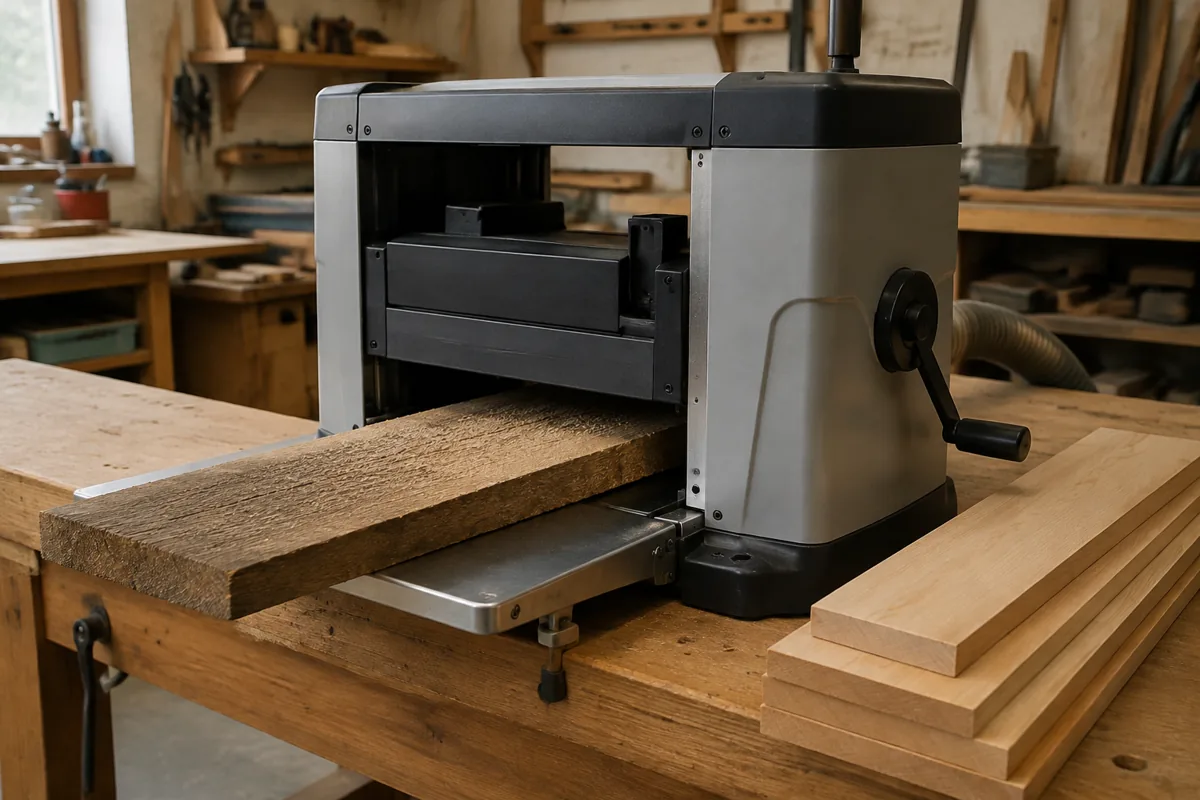
For most small shops, a portable benchtop planer with fold-out or bolt-on extensions is the practical choice. It takes less floor space than a stationary machine, and its tables can support typical cabinet stiles, rails, and panel stock when set up carefully. Look for a cast-metal bed, sturdy extensions, adjustable table support, and a cutterhead width that fits your work. A 12- to 13-inch capacity covers many cabinet parts; wider panels may need a different workflow or a wider machine.
Compare benchtop thickness planers with long tables by the actual table length and rigidity, not just the advertised maximum board width. A light extension that flexes or sits out of alignment may be less useful than a shorter, well-supported bed.
A stationary floor planer is worth considering if you routinely process long, heavy stock or work at production pace. Its mass and fixed tables make it less prone to shifting, but it costs more, takes up substantial space, and may require 240-volt power. For occasional cabinet projects, the extra capacity can be hard to justify.
Planer options compared
| Option | Table support | Best fit | Main trade-off |
|---|---|---|---|
| Benchtop planer with extensions | Moderate; extensions need setup and support | Small shops and typical cabinet components | More sensitive to stand stability and snipe |
| Benchtop planer on a long, rigid stand | Good when the stand is level and extensions align | Longer boards without a floor machine | Uses more shop space; stand and rollers add cost |
| Stationary floor planer | Usually the most stable support | Frequent milling of long or heavy stock | Higher cost, weight, space, and often power needs |
Set up the tables before judging the machine
Put the planer on a rigid stand or bench that will not rock under feed pressure. Check that the infeed and outfeed extensions are level with the main bed, or set them slightly high at their outer ends if the manual calls for it. A low extension lets the board nose down; a high or misaligned one can lift the work and cause uneven cuts. Use a straightedge across the bed and extensions, then test with scrap.
Roller stands can help with very long stock, but their height must match the planer bed. A stand set too high can push the board into the cutterhead; too low, and it does little to prevent sag. For cabinet parts, support the board near its free end without forcing it upward. Keep hands away from the feed rollers and cutterhead, and do not reach over the machine to catch an exiting board.
Reduce snipe and protect your parts
Leave extra length on parts if the design allows. Snipe often appears in the first or last few inches, so plan to crosscut those ends after thicknessing. Feed boards with the same face orientation and keep consistent pressure on the bed without pushing down hard at the ends. Some machines have adjustable rollers or cutterhead locks; follow the manual rather than assuming an adjustment will solve every case.
Take light passes on figured hardwood and near final thickness. Removing roughly 1/32 inch per pass is a reasonable starting point for difficult grain, while a stable board in straight-grained stock may tolerate more; the machine’s instructions and motor load should guide the limit. Deep cuts can cause tear-out, slow feeding, or stall a small planer. A dull or damaged knife can leave raised grain and ridges, so inspect the knives when cut quality declines.
Plan for dust, noise, and capacity
A planer throws chips quickly. Connect a dust collector sized for the machine’s outlet and keep the hose clear; a clogged port can pack chips into the housing and mar the work. Wear hearing protection, and use eye protection. Planers are loud enough that a short run can still be uncomfortable without protection.
Check the maximum thickness, minimum thickness, and depth-of-cut limits before buying. Capacity figures describe what can pass through, not what the machine can plane well in every species. Long cabinet sides are also awkward to handle alone, even if the planer can accept them. Have a clear outfeed path and a helper for heavy panels when needed.
Choose for your workload
If you make cabinets occasionally, a benchtop planer with extensions, a stable stand, and carefully matched roller support is usually enough. Spending more on a rigid setup may improve consistency more than buying a larger machine you rarely use. Browse stationary thickness planers with long infeed and outfeed tables if you routinely mill long, heavy boards and have the room and power for one.
Before buying, measure your longest stock, available floor space, and the distance needed for safe infeed and outfeed. Then check table length, extension alignment, knife availability, dust-port requirements, and whether the machine’s stand is included. Those details determine whether long cabinet parts feed predictably—not the word “long” in a product description.