How to Choose a Band Saw Riser Block for Resawing
What's inside
As an Amazon Associate I earn from qualifying purchases. This post may contain affiliate links at no extra cost to you.
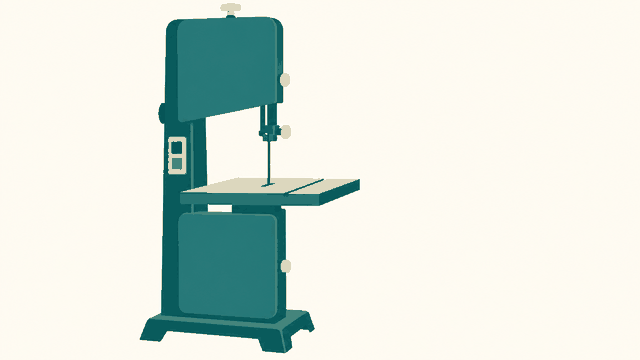
A riser block can add several inches of resaw capacity to a band saw, but it is not a universal upgrade. It must match the saw’s frame, blade guides and wheel alignment, and it raises the upper guide assembly along with the cutting height. Before buying one, check the saw’s manual and measure the stock you actually plan to resaw.
Contents
Check the saw’s compatibility
Riser blocks are made for particular band saw designs, not just particular blade widths or wheel sizes. The block bolts between the saw’s frame and upper wheel assembly; the mounting pattern, frame shape, blade length and guide-post arrangement all matter. Two saws with the same nominal wheel diameter may not use interchangeable blocks.
Look for an accessory listed by the saw’s manufacturer for your exact model, or confirm compatibility with the block maker before ordering. Check whether the kit includes the longer blade and any required hardware. A block that fits the bolt holes but puts the wheel, blade guides or tensioning parts out of alignment is not a usable fit.
Also verify the manufacturer’s stated maximum resaw height after installation. A block marketed as adding 6 inches does not necessarily give you 6 inches of safe cutting capacity: the original upper-guide clearance and the saw’s design can limit the result.
Decide how much capacity you need
Measure the thickest board you expect to cut, then allow room to raise the upper blade guide above it. That clearance helps keep the exposed blade length short and the guide close to the work. If your usual stock is 5 inches thick and the saw already handles 6 inches, a riser may add cost and setup work without helping much.
For a compact saw that is otherwise suitable, a compatible block is often less expensive than replacing the machine. It can make sense for occasional resawing of boards within the upgraded saw’s rated capacity. For frequent work with wide, dense hardwood, however, more height alone may not solve the problems: frame stiffness, motor power, blade tracking and table support still affect cut quality.
Compare the options
| Option | Best fit | Main trade-off |
|---|---|---|
| Compatible riser block kit | Occasional resawing when the existing saw is otherwise capable | Needs correct fit, a longer blade and careful realignment |
| Use the saw as-is | Stock stays within current capacity, or taller cuts are rare | Limits the thickness you can resaw in one pass |
| Step up to a larger band saw | Frequent resawing, thicker stock or a need for greater rigidity | Higher purchase cost and more floor space |
If you decide a block is appropriate, start by checking band saw riser block kits by saw model. Treat marketplace listings as a starting point, not proof of fit; compare the part number and included blade length against the manufacturer’s documentation.
Choose the right blade
A riser block usually requires a longer blade, commonly about 6 inches longer for a block that adds 6 inches, but use the saw or kit maker’s specified length. Do not assume that the extra height translates directly to blade length: the wheel path and design determine the required size. A blade that is too short may not tension properly; one that is too long may leave the tensioning mechanism at its limit.
For resawing, blade width and tooth pattern matter. Use the widest blade the saw’s manual permits and the guides can support. A wider blade is generally more resistant to wandering through a tall cut, but it needs enough power and correct tension. For many general-purpose resaw jobs, a blade around 3/4 inch wide with roughly 3 teeth per inch is a reasonable starting point, if the saw accepts it. Thick, dense stock may call for a coarser tooth pattern to clear sawdust; a very fine blade can heat up or clog.
Check the manual’s blade recommendations before buying. A resaw blade in the specified length and width is a better choice than selecting by tooth count alone.
Installation and alignment
Unplug the saw before removing covers or working near the wheels. Follow the kit’s instructions, support the upper assembly while loosening its fasteners, and do not force bolts into misaligned holes. The assembly can be awkward to handle, and a binding bolt may indicate a fit or alignment problem rather than a need for more torque.
After installation, set blade tension according to the saw and blade instructions. Then check that the blade tracks correctly on both wheels, the wheels turn freely, and the blade sits properly in the guides. Reposition the upper guide post for the taller cutting height, then set the side guides and thrust bearing with the clearances specified by the manual. Make a test cut in scrap before committing a valuable board.
Watch for warning signs: the blade drifting despite a straight fence, persistent vibration, unusual wheel noise, a tension indicator at its limit, or a cut that burns and wanders. These can point to a dull or inappropriate blade, poor tension, incorrect tracking, insufficient feed control or a saw being pushed beyond its practical capacity. Do not compensate by forcing the work through the blade.
When to skip the riser
Choose the cheaper option—no modification—if your stock already fits, your saw has little reserve power, or the manufacturer does not offer a compatible block. A riser cannot strengthen a flexible frame or make an underpowered saw cut thick hardwood cleanly. If resawing is frequent and precision matters, compare the installed cost of the block, longer blade and setup time with a larger saw designed for the work. The right choice is the one that handles your typical stock reliably, not the one with the biggest advertised capacity.