Best Planers for Consistent Thickness on Long Hardwood Boards
What's inside
As an Amazon Associate I earn from qualifying purchases. This post may contain affiliate links at no extra cost to you.
Long hardwood boards expose the weaknesses of a planer quickly. A machine may leave a short board looking smooth yet produce uneven thickness, snipe at the ends, or struggle to feed a wide, dense plank. For consistent results, prioritize a stable bed, adequate cutting width, reliable feed rollers, and a cutterhead suited to how much you plan to plane—not just motor horsepower.
Contents
What consistent thickness requires
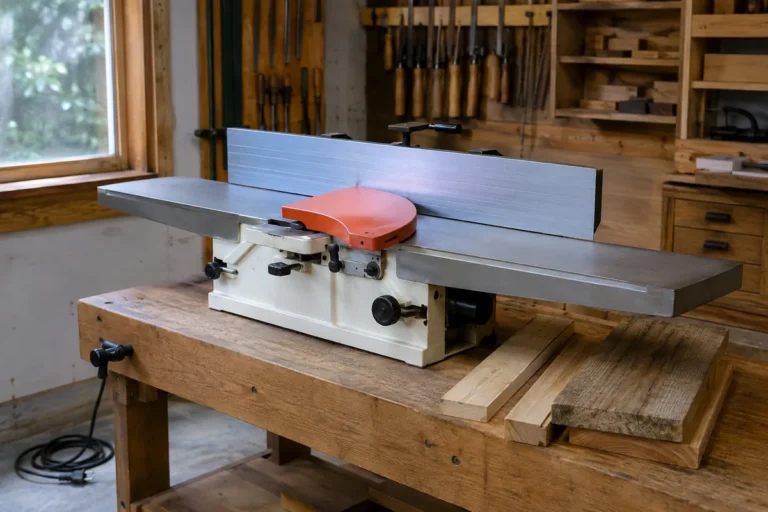
A thickness planer makes one face parallel to the other; it does not flatten a warped board. If a board rocks or bows on the bed, the planer can reproduce that shape at a thinner dimension. Flatten one face first with a jointer, a planer sled, or another reliable method, then plane the opposite face parallel. A jointer and planer do different jobs.
Long boards also need support before and after the machine. Set infeed and outfeed supports level with the planer bed, and leave room for the full board to travel. A board that dips as it enters or exits can lift against the cutterhead and create snipe—an area at one or both ends cut thinner than the middle. Many portable planers leave some snipe even when adjusted well. Take a final pass with sacrificial blocks at the ends, or plan to trim a small amount off after surfacing.
Planer types for long hardwood
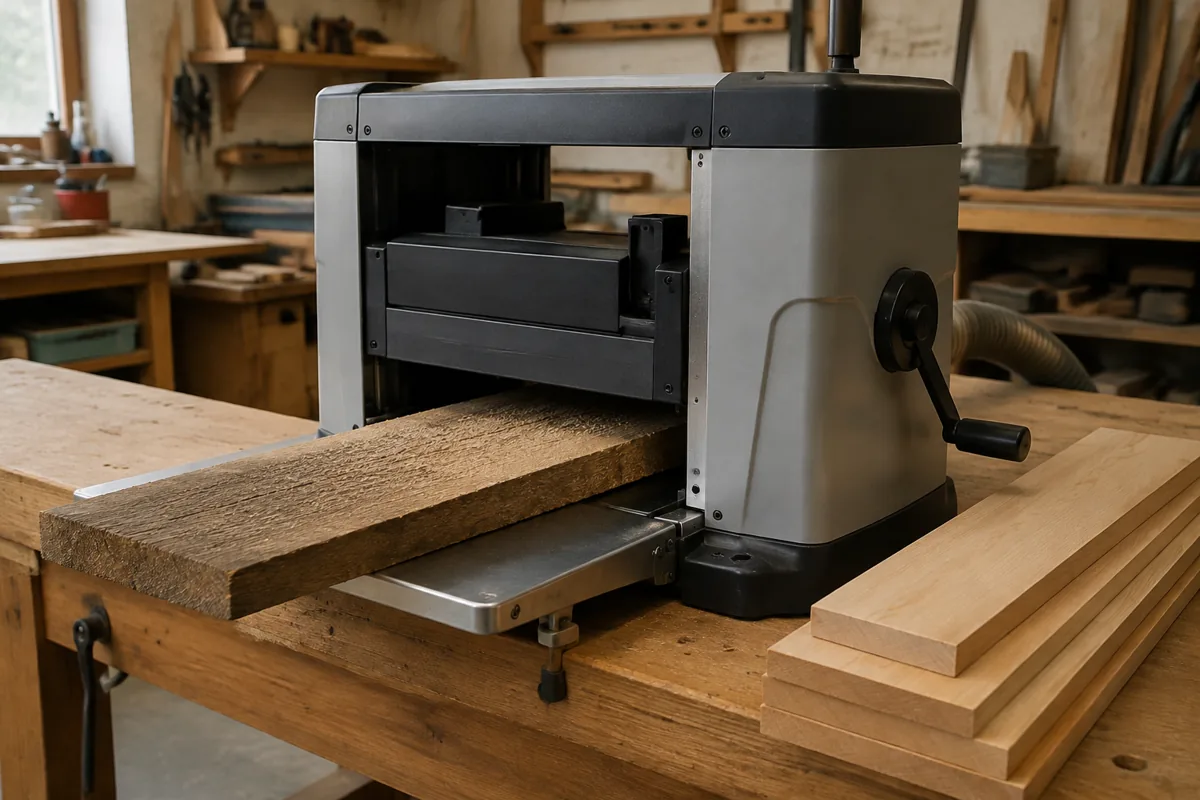
For most home shops, a benchtop planer is the practical starting point. Common models accept stock around 12 or 13 inches wide and roughly 6 inches thick, though check the actual specifications. They cost less and take up less floor space than stationary machines, but their shorter beds and lighter construction make support and snipe control more important. They can handle hardwood if you take light passes and keep the knives or inserts sharp.
A larger stationary planer is a better fit for frequent work, wider stock, or a shop where stable setup and higher throughput matter. A heavier frame and longer tables can make long boards easier to manage, but the machine still cannot correct a cupped or twisted face. These planers need more floor space, suitable electrical service, and a dust collector capable of handling the chips.
For either type, a helical or segmented carbide cutterhead usually costs more than straight knives but can be quieter in use, leave a good finish, and keep working when a small insert is nicked by a defect. Straight knives are less expensive to replace or sharpen, but a damaged edge can leave a noticeable line across the board. Neither cutterhead excuses dull edges or overly aggressive cuts.
Compare the main choices
| Planer type | Best fit | Advantages | Trade-offs |
|---|---|---|---|
| Benchtop, straight knives | Occasional projects and moderate-width stock | Lower purchase cost; knives are familiar and relatively inexpensive | More sensitive to support and snipe; knife changes and alignment take care |
| Benchtop, segmented cutterhead | Frequent hobby use and cleaner work in figured wood | Replaceable inserts; localized damage usually affects a smaller area | Higher initial cost; inserts add replacement expense |
| Stationary planer | Regular production, wide boards, or a dedicated shop | More mass, capacity, and often more stable stock handling | Higher cost, larger footprint, and greater dust and power demands |
Choosing capacity and cutterhead
Buy for the widest stock you expect to process, with some room to spare. A 12-inch planer cannot surface a board wider than its stated capacity in one pass; flipping the board is not a reliable workaround because the faces may not remain aligned. If your usual material is 8 to 10 inches wide, a 12-inch machine may be enough. If wide tabletops are routine, consider a machine with more capacity or a plan to joint and glue up narrower boards.
Stock length matters as much as width. For boards over about 6 feet, use roller stands or long support tables, adjusted so they guide the board without pushing it upward. Check that stands do not bind or sag under the board’s weight. For very long, heavy planks, a helper can guide the far end without forcing the stock; hands stay clear of the cutterhead and feed rollers.
Look for a two-speed feed option if you value a finer finish, but treat it as a convenience, not a cure for tear-out. Slower feed generally gives the cutter more opportunities to make cuts along the surface, while sharp cutters, correct grain direction, and shallow passes remain critical. For a first purchase, compare 13-inch benchtop thickness planers by capacity, cutterhead, dust-port size, and available replacement parts—not by the highest advertised horsepower alone.
Set up for even results
Inspect each board for nails, screws, grit, and loose knots before feeding it. Metal can damage knives or carbide inserts and may be thrown from the machine. Mark the high spots and check the board with winding sticks or a straightedge. Remove twist and cup from one face before thicknessing, then make light cuts. On dense hardwood, a pass of about 1/32 inch is a sensible starting point; reduce that amount for wide, figured, or difficult stock. If the motor bogs, the surface tears, or the board stalls, back off the depth of cut and check the cutter condition.
Feed boards with the grain where possible. Reversing a board can sometimes reduce tear-out when grain direction changes, but it may make the result less predictable. Keep the board flat on the bed as it enters and exits, and avoid stopping it midway through a pass. If several boards need to match, plane them in sequence at the same setting, then measure at multiple points rather than trusting the machine scale alone. Scales are useful for rough adjustment, but their readings can vary by machine and setup.
When a cheaper planer is enough
A basic benchtop model is a reasonable buy for occasional furniture parts, shelving, and boards narrower than its capacity. It can produce consistent thickness when the stock is prepared correctly, the cutters are sharp, and long-board support is handled well. Pay more for a larger or better-equipped planer when you regularly surface wide hardwood, need faster throughput, or want to reduce the time spent managing snipe and cutter changes. If you are comparing cutterhead options, benchtop planers with segmented cutterheads are worth considering for frequent use, but a straight-knife machine remains capable work equipment.
Before buying, confirm the machine’s maximum width and thickness, feed rate, replacement-cutter availability, dust port, and electrical requirements. A planer that fits the boards you actually use—and can be supported safely in your shop—will do more for consistent thickness than a premium feature you rarely need.