How to Choose a Band Saw for Resawing Wide Boards
What's inside
As an Amazon Associate I earn from qualifying purchases. This post may contain affiliate links at no extra cost to you.
Resawing is cutting a board through its thickness to produce thinner slabs, book-matched panels, or veneer. It is also one of the hardest jobs for a band saw. A saw that handles curves well may struggle to keep a wide board straight, especially in dense hardwood. For this work, capacity, blade control, and rigidity matter more than a long list of advertised features.
Contents
Start With the Board Size
The first specification to check is resaw capacity: the maximum distance between the table and the upper blade guide. A saw advertised with 12 inches of resaw capacity may not comfortably cut a full 12-inch board. Allow room for the board, blade guide, and your hands. For reliable work, choose a machine with at least 1 to 2 inches more capacity than the thickest stock you expect to cut.
| Typical work | Useful resaw capacity | Practical saw size |
|---|---|---|
| Small panels and narrow boards | 6 to 8 inches | 14-inch-class saw or compact saw with a riser |
| Most cabinet and furniture stock | 10 to 12 inches | 14-inch saw with a riser or larger |
| Wide slabs and thick hardwood | 14 to 16 inches or more | 18-inch-class saw with a strong frame |
Capacity is not the same as usable capacity. A tall cast-iron frame may have adequate clearance, but a small motor, flexible guides, or a weak table can still make a 10-inch cut frustrating. If you routinely resaw boards wider than 10 inches, look at 18-inch band saws for resawing rather than assuming a smaller saw with a riser will do the same job.
Motor Power and Wheel Size
Motor ratings are useful only as a rough guide. A 1-1/2-horsepower motor is enough for occasional resawing in pine, cedar, and other softwoods. It can also handle moderate hardwood work if the blade is sharp and the feed rate is controlled. For frequent resawing of 8- to 12-inch hardwood boards, 2 horsepower is a more comfortable target. Very wide stock, dense species, or production work justify 3 horsepower and a heavier machine.
Do not confuse electrical input with delivered horsepower. Some machines advertise an optimistic peak rating. A rigid frame with a properly tensioned blade often outperforms a lighter saw with a larger number on the nameplate.
Wheel diameter affects how smoothly the blade runs and what blade length the saw accepts. A 14-inch saw is a practical minimum for serious furniture work. Larger 16- and 18-inch wheels generally provide more room, heavier construction, and better support for wide blades, but they cost more and occupy more floor space. They are not automatically more accurate; setup still determines the cut.
Choose the Blade Before the Saw
For straight resawing, a wide blade is usually better. A 3/4-inch blade is a useful general-purpose choice. A 1-inch blade can track more confidently on a large saw, but only if the machine can tension it correctly. Small saws may list a wide blade as compatible even though the frame cannot tension it adequately.
Use a blade with a low tooth count, commonly 2 to 3 teeth per inch, and a deep gullet. This clears sawdust from the cut instead of packing it between the teeth. A hook or variable-pitch tooth pattern can feed efficiently, but it may cut aggressively. Keep a finer blade available for thinner stock. A 1/2-inch, 3-tooth-per-inch blade is often a sensible option for a smaller machine; a 3/4-inch or 1-inch blade suits larger saws.
Expect blades to dull sooner than they do during ordinary curve cutting. A dull blade wanders, overheats, burns the board, and encourages you to push harder. Those symptoms are not fixed by increasing tension.
Look for Rigidity and Adjustment
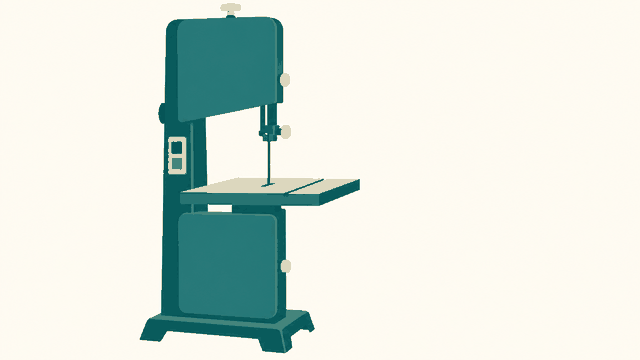
Good blade guides should support the blade close to the work without rubbing during normal operation. Ceramic guides, thrust bearings, and roller guides can all work. The important points are smooth adjustment, adequate support behind the blade, and a guide post that locks firmly without shifting.
Blade tension is critical. A wide blade needs more tension than a narrow scroll-cutting blade. The built-in tension scale is only a starting point and is often inaccurate. Set the blade according to the manufacturer’s guidance, then check whether it tracks correctly and stays stable under load. If the frame flexes when tension is applied, the saw will be difficult to tune no matter how good the guides are.
Look for a heavy table that locks square to the blade and a rip fence that is tall enough to support the board. A fence around 4 inches high is useful for many resaw cuts. A low fence may work for 6-inch stock but becomes awkward with taller boards. Some woodworkers prefer a tall auxiliary fence because it can be adjusted to match the blade’s drift.
Account for Drift and Feed Control
Most band saw blades do not travel perfectly parallel to the edge of the table. The angle at which the blade naturally cuts is called drift. A fence set exactly parallel to the miter slot may force the board sideways, causing wandering or burning. Before resawing valuable stock, make a test cut in scrap and adjust the fence to follow the blade’s path.
A wide board also needs consistent support as it enters and exits the cut. The saw table should be large enough to hold the board flat. For very wide or long boards, add an outfeed table or roller support, but keep supports aligned so they do not lift the work into the blade.
Feed steadily rather than forcing the board. If the motor bogs down, the blade is dull, the tooth pattern is wrong, the guides are misadjusted, or the cut is too ambitious for the machine. Pushing harder usually makes the blade deflect and produces a wavy surface that wastes stock in later planing.
Do Not Ignore Dust and Safety
Resawing creates a large volume of sawdust. A band saw with a reasonably sealed lower cabinet and a 4-inch dust port is easier to keep clean. A small shop vacuum may collect some dust, but a dedicated dust collector generally performs better for long cuts. Packed sawdust can interfere with the lower wheel, clog guides, and increase heat.
Use a 3/4-inch resaw blade suited to your saw and material, and keep the upper guide only slightly above the board. Wear eye protection and hearing protection, and never reach around the blade to retrieve a cutoff. For boards with a split, loose knot, or internal tension, consider whether the cut could pinch the blade or eject a piece.
When a Cheaper Saw Is Enough
A compact or 14-inch saw is a reasonable choice if you resaw occasionally, work mostly with boards under 8 inches wide, and accept slower feed rates. Spend the saved money on quality blades, a solid fence, and dust collection. Those upgrades can make a modest machine much more useful.
Choose the heavier saw when wide hardwood resawing is central to your work. The extra capacity, motor reserve, frame stiffness, and table area reduce the number of cuts that go wrong. A large band saw with high resaw capacity is not necessary for every shop, but it is cheaper than repeatedly losing valuable boards to drift, burning, and uneven cuts.