How to Calculate Band Saw Resaw Capacity for Thick Stock
What's inside
As an Amazon Associate I earn from qualifying purchases. This post may contain affiliate links at no extra cost to you.
Contents
What resaw capacity actually means
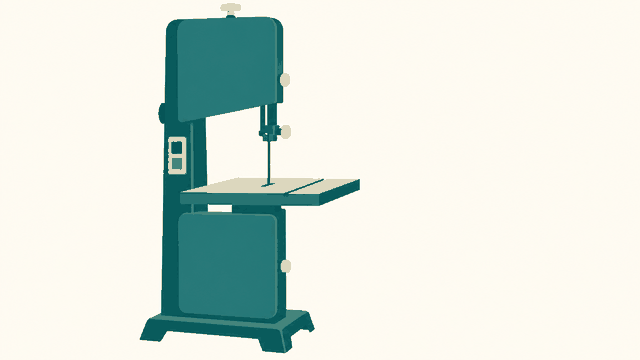
Resaw capacity is the maximum height of stock a band saw can cut when the board is standing on edge. It is usually limited by the vertical distance between the saw table and the upper blade guides, not by the machine’s throat depth. A saw advertised with 6 inches of capacity can, in principle, resaw a board about 6 inches tall; it cannot resaw a 6-inch-wide board laid flat just because its throat is wide enough.
For a specific job, measure the board’s height in the position it will pass through the blade. Add a little clearance for uneven faces, movement, and the guides. If your stock is 7 inches tall after milling, a saw with exactly 7 inches of clearance is a poor fit. Aim for at least ½ inch of spare height, and more if the board is rough or irregular.
Calculate the capacity you can use
Measure from the table surface to the lowest part of the upper guide assembly that the stock must pass under. On many saws, the guide post raises and lowers, so check the full usable travel rather than relying only on the catalog specification. Remove any fence or accessory that obstructs the measurement, but do not count space that the blade guards or guides occupy.
Then compare that measurement with the board’s finished standing height. For example, a board measuring 8¼ inches tall needs more than 8¼ inches of actual opening. If the guide assembly leaves only 8 inches, the board will not fit, even if the saw is described as having “8-inch resaw capacity.” Check the manufacturer’s stated capacity and, when possible, verify the opening in person.
Capacity is only a physical fit test. A saw may accept a tall board but lack the frame stiffness, motor power, blade support, or fence setup to resaw it accurately. For thick stock, those limits can matter more than an extra half inch of opening.
Do not confuse capacity with throat depth
Throat depth is the distance from the blade to the saw frame. It determines how wide a panel can be cut, measured from its edge toward the center. Resaw capacity is the vertical opening above the table. A 14-inch-throat saw may have only 6 inches of resaw capacity, while a taller saw may accept stock that would be awkward to cut on a smaller machine.
Also separate resaw height from blade length. A taller frame generally needs a longer blade, but fitting a long blade does not increase the space under the guides. Confirm blade length and width from the manual before buying blades; do not assume that a blade listed for a similar-looking saw will fit.
What limits a successful resaw
Blade width and condition: Wider blades resist twisting and often track straighter in thick stock, but the saw must be able to tension them properly. A narrow blade may fit the wheels yet wander under load. Use the widest blade permitted by the saw’s manual, commonly a ½- to ¾-inch blade on larger machines, and choose a suitable resaw tooth pattern. A dull blade heats the wood, drifts, and can stall even when the stock fits.
Power and feed rate: A motor’s advertised horsepower does not tell the whole story, but a small saw driven too fast through dense hardwood is likely to slow or stop. Feed steadily without forcing the cut. If the blade flexes, the motor bogs, or the cut face develops pronounced waves, stop and check blade sharpness, tension, guides, and feed rate. Continuing can ruin the stock or damage the blade.
Setup and stock: A bowed or twisted board may rock against the fence, making the cut curve or taper. Mill one face and one edge flat where possible, then use the flat face against the table and the straight edge against the fence. Keep hands out of the blade path and use push blocks or another safe method for controlling the trailing end.
Compare saw types by usable capacity
| Machine type | Typical useful range | Best fit | Main trade-off |
|---|---|---|---|
| Compact bench-top saw | About 3–5 inches | Small projects and occasional thin resawing | Limited opening, blade choice, and cutting stamina |
| 14-inch floor saw | Often about 6–12 inches, depending on riser and frame | General shop work and moderate resawing | Capacity and performance vary widely; check the actual opening and blade support |
| Larger resaw saw | Often 12 inches or more | Frequent thick-stock work and wider, consistent cuts | Higher purchase cost, floor space, and electrical demands |
These are broad ranges, not guarantees. A riser block can increase the opening on some 14-inch saws, but it does not automatically improve motor power or frame rigidity. It may also require a longer blade and careful alignment. If you only need to resaw a 5-inch board once or twice a year, a sound smaller saw may be the economical choice. For regular 10-inch hardwood resawing, buying solely on the basis of a riser’s added height is a risky shortcut.
Choose capacity around your stock and frequency
List the tallest boards you expect to cut after flattening, not their rough-sawn dimensions. Add clearance, then check the saw’s opening, blade-width range, and recommended electrical supply. If your normal stock is 5 inches tall and your occasional stock reaches 7 inches, a machine with a verified 7½- to 8-inch opening gives useful margin. If the stock is taller than the saw’s capacity, do not tilt or force it through; have it milled, cut it with suitable equipment, or choose a larger saw.
When comparing machines, look for a sturdy fence or a reliable way to guide tall stock, adequate table support, easy guide adjustment, and blades available in the widths and tooth patterns you need. A quality resaw band saw blade can improve a capable saw, but it cannot overcome an undersized frame or insufficient opening. If the machine is close to your limit, compare a 14-inch floor-standing band saw with larger saws by actual capacity and blade support, not by wheel diameter alone.
Test a representative board before a big cut
Before resawing valuable stock, fit a sharp, appropriate blade, set the guides close to the work, and make a test cut in scrap of similar species and height. Measure the cut at both ends. A widening gap or a curved face points to drift, blade deflection, poor fence alignment, or unstable stock. Correct the cause before cutting a full-length board. For a single wide board that exceeds your machine’s practical capacity, paying a lumberyard or mill to resaw it can cost less than buying a larger saw—and avoids asking a marginal machine to do a job it cannot control.