
Key takeaways
- Compare the best japanese hand planes for fine woodworking, from a 58mm blue steel smoothing kanna to chamfer and rabbet planes, with setup tips included.
What's inside
As an Amazon Associate I earn from qualifying purchases. This post may contain affiliate links at no extra cost to you.
As an Amazon Associate we earn from qualifying purchases.
A Japanese hand plane, or kanna, looks simple: a thick laminated blade wedged into a wooden body called a dai, with no frog, no lever cap and no depth wheel. Yet a tuned kanna takes shavings thin enough to read through and leaves a surface that often needs no sanding. The catch is that a kanna works nothing like a Western bench plane. It cuts on the pull stroke, its blade is set by tapping rather than turning a knob, and its wooden dai needs fitting before it cuts properly. None of the five planes below is ready to use straight out of the box, and that is normal for the type.
This article contains affiliate links. If you buy through them, we may earn a commission at no extra cost to you.
Contents
Quick Answer
For most fine woodworking, the KAKURI Professional 58mm is the kanna to build around: its Blue Paper Steel No.2 laminated blade and white oak dai are sized for smoothing panels and furniture parts. The SUIZAN 50mm double-blade plane is the gentler starting point, the SUIZAN 42mm covers small work, and KAKURI’s chamfer and rabbet planes handle edges and joinery.
KAKURI Professional Japanese Hand Plane 58mm

This is the standard smoothing kanna of the group, the one to choose for surfacing panels, table tops and furniture parts. KAKURI lists the blade steel as Aogami Blue Paper Steel No.2 laminated to soft iron: the hard edge steel does the cutting, and the softer iron backing makes the blade easier to hone. The listing gives the 58mm size class a 50mm cutting width, and the maker’s catalogue gives the white oak dai a length of 255mm and the plane a weight of 890g. A chipbreaker is included, and the listing’s setup note tells you to tap the iron and chipbreaker lightly with a hammer to set the edge before use.
Expect real setup time. The blade must seat evenly in the dai, the chipbreaker must sit close to the edge, and the sole may need conditioning so the plane contacts the wood only where it should. Once tuned, the pull stroke lets you lean your body weight into the cut and feel grain changes through the light wooden body, which is why these planes are favoured for final surfacing on figured stock.
Specs
- Blade: Aogami Blue Paper Steel No.2, laminated to soft iron
- Size class: 58mm; cutting width 50mm as listed
- Chipbreaker: included
- Body (dai): Japanese white oak
- Body length: 255mm; weight 890g per maker catalogue
View the KAKURI Professional 58mm on Amazon
SUIZAN Kanna Japanese Wood Planer 42mm

The small kanna of the group is SUIZAN’s 42mm model, a block-plane-size tool for chamfering edges, trimming small parts, fitting boxes and cleaning up joints where a full-size smoother is clumsy. Amazon’s listing information gives a beech wood body of 15 x 5.5 x 4 cm and a weight of 170g, with a Japanese steel blade. This linked version is the single-blade model: SUIZAN also sells the 42mm size as a double-blade version, and the two should not be confused, because this one has no chipbreaker and relies on a sharp edge and a light cut.
With no chipbreaker, this is the simplest kanna here to learn on: one blade to fit, one edge to hone, depth set by tapping the blade and checking its projection against the sole. It still needs the dai checked and blade seated before first use, and its narrow cut makes it a poor choice for wide boards. For end grain on small parts, edge breaks and one-handed trimming, the size is the point.
Specs
- Blade: Japanese steel, single blade
- Blade width: 42mm (1.7 inch) as listed
- Chipbreaker: not included on this single-blade version
- Body (dai): beech wood per Amazon listing information
- Dimensions: 15 x 5.5 x 4 cm; weight 170g per listing
- Model: SK-001
View the SUIZAN Kanna 42mm on Amazon
KAKURI Chamfer Plane P-150C
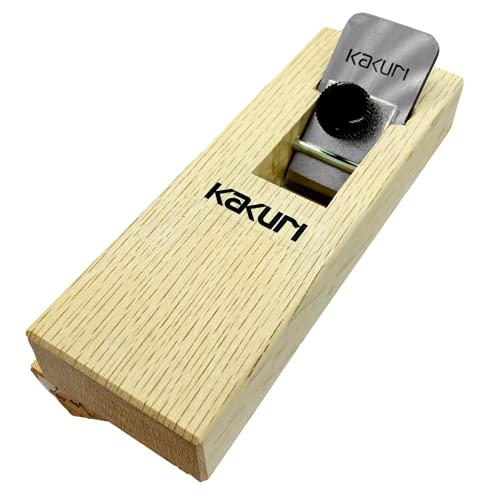
A chamfer kanna, or mentori kanna, exists for one job: putting a clean, repeatable bevel on an edge. KAKURI’s P-150C carries a triangular guide rail that sets the chamfer angle, and the maker prints three positions, 30, 45 and 60 degrees, changed with a screwdriver. The maker’s catalogue lists an SK85 monolayer blade of 30mm width in a white oak body 151mm long, at 275g; the listing describes the blade as Japanese high-carbon steel. Because the guide gives the cut a fixed reference, matching chamfers on four table legs or a run of box edges is a matter of counting passes, not judging by eye.
Two limits are worth stating plainly: there is no depth stop, so pencil-marking the chamfer lines first is the sensible routine, and the guide suits outside corners rather than inside ones. Depth is still set by tapping the blade, and the dai needs a first fitting before the plane tracks straight. Within those limits, this is the fastest route in the group to crisp, consistent bevels.
Specs
- Blade: SK85 steel, monolayer per maker catalogue
- Blade width: 30mm per maker catalogue
- Chamfer angles: 30, 45 and 60 degrees via triangular guide rail
- Chipbreaker: not listed; single-blade design
- Body (dai): white oak per maker catalogue
- Overall length: 151mm; weight 275g per maker catalogue
- Model: P-150C
View the KAKURI Chamfer Plane on Amazon
KAKURI Rabbet Plane 12mm

Rabbet work is where a flat-bottomed plane earns its place, and this KAKURI is the Japanese take on the side rabbet plane. The listing describes a 12mm adjustable double side blade: it can be set to cut from either side of the body, so one tool trims both walls of a groove or rabbet and works into corners facing either direction. The blade is Japanese steel, the body is oak, and the cut depth is adjustable, so you can widen a groove in controlled passes instead of forcing one heavy cut.
A 12mm cutting width is a joinery size, not a stock-removal size. This plane tunes tongue-and-groove fits, cleans up dadoes and trims rabbets on frames and boxes after the main cut is made by saw or router. As with every kanna here, the blade is tapped into adjustment and the dai checked before first use; a rabbet plane slightly out of tune cuts a tapered wall. Keep expectations joinery-sized and it fills a slot no smoothing plane can cover.
Specs
- Blade: Japanese steel, double-sided, cuts from either side
- Cutting width: 12mm, depth adjustable, as listed
- Chipbreaker: not listed
- Body (dai): oak as listed
View the KAKURI Rabbet Plane on Amazon
SUIZAN Hand Plane 50mm Double Blade

The starter pick is SUIZAN’s 50mm kanna, the size SUIZAN itself describes as the versatile choice for general woodworking. It is a double-blade plane, so a chipbreaker is included behind the main blade to help control tear-out on reversing grain, making it more forgiving on ordinary lumber than a single-blade plane of the same size. The blade is Japanese steel, 50mm wide with a cutting width of about 43mm, and maker-aligned listings give the oak body a length of about 240mm and the plane a weight of about 650g.
As a first kanna it teaches the full routine: fitting blade and chipbreaker to the dai, tapping the iron down in small increments, backing it off by tapping the body, and reading the shaving to judge the cut. That learning curve is the honest cost of entry with any kanna, and this model keeps the stakes low while remaining useful for panels, doors and furniture parts. If you mainly want board smoothing in a larger format, step up to the KAKURI 58mm instead.
Specs
- Blade: Japanese steel, double blade
- Blade width: 50mm (2 inch) as listed; cutting width about 43mm
- Chipbreaker: included
- Body (dai): oak per maker-aligned listings
- Body length: about 240mm; weight about 650g per maker-aligned listings
- Model: SK-002
View the SUIZAN Hand Plane 50mm on Amazon
How to Choose
Start with the job. Smoothing panels and furniture surfaces calls for the widest blade you can control, which is the 58mm class; small parts, boxes and edge work suit the 42mm size; chamfers and rabbets are specialist jobs with dedicated planes, and no smoothing kanna substitutes for them. Next, decide on the blade arrangement. A double-blade kanna with a chipbreaker, like the KAKURI 58mm and the SUIZAN 50mm, resists tear-out better on difficult grain but adds a second part to fit. A single-blade plane is simpler to set up and capable on straight-grained stock.
Read the steel description exactly as the maker prints it. The KAKURI Professional’s blade is Aogami Blue Paper Steel No.2 laminated to soft iron; the other blades here are listed as Japanese steel or SK85 without a lamination claim, and should be judged as printed. Body wood matters the same way: white oak and beech dai are both traditional, and what matters more is that the dai is sound and properly fitted. Finally, budget time rather than accessories. Every kanna needs its dai tuned, blade seated and sole checked before first use, and depth is set by tapping the blade with a small hammer, corrected by tapping the body. If that ritual sounds like friction rather than craft, a Western plane with a depth wheel is the better tool.
Who Should Skip
Skip this group if you want a plane that cuts perfectly in the first five minutes, because a kanna rewards setup time and punishes impatience. Skip the small SUIZAN 42mm if your work is mostly wide panels, since its narrow cut turns flattening into a long afternoon. Skip the chamfer and rabbet planes if you rarely cut those joints; they are single-purpose tools. And skip Japanese planes altogether if you will not sharpen on waterstones or equivalent abrasives, because a dull laminated blade is worse than a mediocre Western plane with a fresh edge.
FAQ
Do Japanese hand planes really cut on the pull stroke?
Yes. A kanna is drawn toward the body rather than pushed away, which lets you use your legs and torso for power and keeps the light wooden dai easy to guide. The technique feels reversed at first if you learned on Western planes, then becomes natural.
Are kanna ready to use out of the box?
No. The dai must be fitted to its blade, the blade and any chipbreaker seated and tapped into alignment, and the sole checked before the first real cut. Plan on a setup session with scrap wood first.
How is blade depth adjusted without a knob?
By tapping. Light taps on the back of the blade drive it deeper, taps on the corners correct sideways alignment, and a tap on the body backs it off. Work in small increments and read the shaving after each one.
What is a chipbreaker on a kanna?
It is a second, shorter blade fitted just behind the cutting edge of a double-blade kanna. Set close to the edge, it curls the shaving sharply as it rises, limiting tear-out on reversing or figured grain. Single-blade kanna omit it and rely on a keen edge and a fine cut.
Final Verdict
The KAKURI Professional 58mm is the centre of this group: a proper smoothing kanna with a Blue Paper Steel No.2 laminated blade, an included chipbreaker and a white oak dai. The SUIZAN 50mm is the recommended first kanna, the SUIZAN 42mm covers small and one-handed work, and the KAKURI chamfer and rabbet planes round out the joinery edges. Choose by the cut you actually make, and accept the setup ritual as part of the tool.
Product and ASIN Reference
| Product | ASIN |
|---|---|
| KAKURI Professional Japanese Hand Plane 58mm | B0CNH7FNQS |
| SUIZAN Kanna Japanese Wood Planer 42mm | B071CF33BG |
| KAKURI Chamfer Plane P-150C | B002TYZQ3G |
| KAKURI Rabbet Plane 12mm | B09GV37HB4 |
| SUIZAN Hand Plane 50mm Double Blade | B0764FXQYV |
Related guides
More from Amazon
Programs that pair well with the guide above. Offers and eligibility are set by Amazon and may change.
A free business account with business pricing and bulk-buying tools for work, shop or home office.
Create a business accountFree shipping on eligible items, Prime Video and more. Eligible new members can start with a free trial.
Start a Prime free trialAudiobooks and podcasts to listen to on the go. Eligible new members can start with a free trial.
Try Audible freeAd-free music streaming. Eligible new subscribers can start with a free trial.
Try Music Unlimited freeAs an Amazon Associate we earn from qualifying purchases.


Write Your Review
No reviews yet. Be the first to share your experience!