
Key takeaways
- Compare the best lacquer finishes for wood: brushing lacquer quarts, clear spray cans and a pre-catalyzed aerosol for furniture and cabinets.
What's inside
As an Amazon Associate I earn from qualifying purchases. This post may contain affiliate links at no extra cost to you.
As an Amazon Associate we earn from qualifying purchases.
Lacquer is the finish that built the twentieth-century furniture industry, and it still does something no curing finish can copy: each new coat softens and merges into the coat beneath it, because lacquer dries purely by solvent evaporation rather than by a chemical cure. Coats go on in quick succession, runs and dust nibs are levelled by the next coat instead of sanded out, and a damaged spot years later can be repaired by re-dissolving the film around it. The trade-offs: the solvents are strong-smelling and flammable, and the dried film is thinner than a catalyzed or polyurethane coating.
The buying decision breaks into three questions. First, chemistry: traditional nitrocellulose lacquer is the warm, forgiving default; pre-catalyzed lacquer adds a catalyst at the factory for a harder film; and water-based acrylic lacquers trade the solvent smell for a water-white film that does not amber. Second, format: a brushing quart suits flat furniture work, a gallon suits a spray gun and a run of cabinets, and an aerosol suits small parts and repairs. Third, sheen: gloss and satin are separate listings, so buy the exact sheen named on the can.
Disclosure: this page uses affiliate links, and the site may earn a commission when you buy through them at no added cost to you.
Contents
Quick Answer
For brush-on furniture work, start with Deft Clear Wood Finish in gloss or the Watco quart in satin; both are traditional lacquers that level well and recoat fast. If you spray cabinets, the General Finishes Enduro Pre-Cat gallon is the harder, water-based option. For small parts and repairs, choose the Mohawk pre-catalyzed aerosol or the Watco spray can.
The 5 Products Compared
1. Deft Clear Wood Finish Brushing Lacquer, Gloss, 1 Quart (DFT010)

The Deft Clear Wood Finish in Gloss is the reference brushing lacquer: Deft’s own technical sheet lists the product type plainly as nitrocellulose lacquer, in a quart can. The maker describes a self-leveling formula that resists brush marks and needs no sanding between coats, because each coat melts into the last.
Per Deft’s data sheet, it is dry to the touch in 30 minutes and ready to recoat in 2 hours at 77 degrees Fahrenheit and 50 percent relative humidity, with coverage up to 500 square feet per gallon. Cleanup is with lacquer thinner. Two limits are printed just as plainly: it is an interior finish, Deft excludes floors, and the data sheet gives a flash point of 53 degrees Fahrenheit — a reminder that this is a genuinely flammable solvent product.
- Type: nitrocellulose brushing lacquer, per the maker’s technical sheet
- Format: 1 quart can; brush, pad or roller application
- Dry to touch: 30 minutes; recoat in 2 hours, per the maker’s data sheet
- Coverage: up to 500 sq ft per gallon, per the maker
2. Watco Lacquer Clear Wood Finish, Satin, 1 Quart (63241)
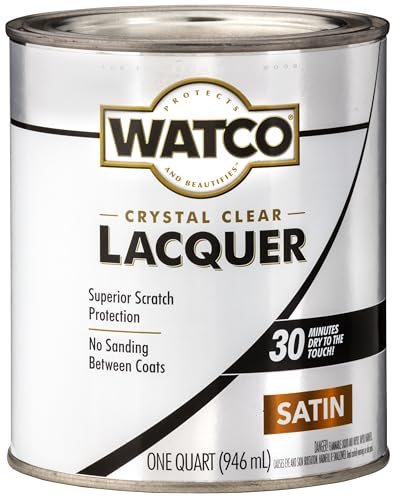
The Watco Lacquer Clear Wood Finish in Satin is Rust-Oleum’s brushing lacquer, sold here as a 946 millilitre quart in a clear satin: the same idea as the Deft above, in the softer sheen most furniture actually wears. The product information lists brush application and coverage of 290 square feet per quart, the most generous per-quart number here.
Watco’s own description makes one claim worth repeating carefully, because it is the maker’s claim and not a general lacquer property: the company says this lacquer fills in the pores of most wood types, eliminating the need for a separate wood filler on those woods. Test that on an offcut of open-pored oak or ash rather than trusting it for every species. The stated uses are interior furniture, doors, cabinets and paneling; floors and exterior work are excluded.
- Type: clear brushing lacquer, per the listing
- Format: 1 quart (946 ml) can
- Sheen: satin
- Coverage: 290 sq ft per quart, per the product information
3. General Finishes Enduro Pre-Cat Lacquer, Satin, 1 Gallon

The General Finishes Enduro Pre-Cat Lacquer is the professional entry, and it differs from the two quarts above in almost every way. General Finishes describes it as a water-based, self-crosslinking acrylic lacquer with the catalyst already in the can: a pre-catalyzed formula sold by the gallon for spray application only, with a 1.1 to 1.3 millimetre HVLP needle recommended. It is not a brushing product, and the gallon format (part GPCS) assumes a spray setup.
In exchange, you get the clearest film here. The maker lists the colour as water white in the can, drying clear with no ambering: the pick for pale maple and birch where nitrocellulose warmth is unwanted. General Finishes recommends 3 coats, lists coverage at 450 square feet per gallon, and gives an average stack time of about 8 hours. Two cautions come straight from the maker: it is interior only, and clear topcoats should not be applied over bright white paint, because yellowing can occur from a reaction with the substrate.
- Type: water-based self-crosslinking acrylic pre-catalyzed lacquer, per the maker
- Format: 1 gallon; spray only, 1.1 to 1.3 mm HVLP needle per the maker
- Coverage: 450 sq ft per gallon, per the maker; 3 coats recommended
4. Mohawk Pre-Catalyzed Clear Finish, Satin, 13 oz Aerosol (M102-0412)

The Mohawk Pre-Catalyzed Clear Finish in Satin puts a pre-catalyzed lacquer into a 13 ounce aerosol can, the format finishers reach for on chair rungs, drawer fronts and repairs. This can (part M102-0412) belongs to Mohawk’s pre-catalyzed aerosol line: the catalyst is in the formula from the factory, so the film is a step harder than a straight nitrocellulose spray, without any mixing, thinning or gun cleanup.
Thirteen ounces covers small work, not a dresser; finish quality depends on light, even passes rather than one heavy coat; and an aerosol of solvent lacquer carries the same flammability and ventilation rules as the quarts.
- Type: pre-catalyzed lacquer aerosol, per the maker
- Format: 13 oz aerosol can
- Sheen: satin
5. Watco Lacquer Clear Wood Finish Spray, Satin, 11.25 oz (63281)

The Watco Lacquer Clear Wood Finish Spray is the straightforward nitrocellulose aerosol: an 11.25 fluid ounce can (model 63281) of clear satin lacquer for small furniture and trim. It is the spray counterpart to the Watco brushing quart above, for pieces too small or awkward to brush without runs. The product information lists coverage of about 11 square feet per can: a chair or a few small boxes per can, not a room of cabinets.
Because it is a conventional lacquer rather than a pre-catalyzed one, its film is the repairable kind: a later coat re-dissolves the surface of the earlier one, so a scuffed spot can be blended in with a fresh pass instead of stripped. The standard solvent rules apply: spray outdoors or with real ventilation, away from sparks and pilot lights.
- Format: 11.25 fl oz aerosol can (model 63281)
- Sheen: satin (clear)
- Coverage: about 11 sq ft per can, per the product information
How to Choose
Start with chemistry, because it decides both the look and the workload. Nitrocellulose lacquer (the Deft and the two Watcos) is the traditional choice: warm in tone, fast to recoat, self-levelling because each coat burns into the previous one, and repairable. Pre-catalyzed lacquer (the Mohawk aerosol, and the acrylic General Finishes gallon) trades some of that repairability for a harder film with better resistance to water and household chemicals. Water-based acrylic lacquer suits pale wood, because the maker states it dries clear without ambering, while nitrocellulose adds a warm cast.
Next, match the format to the job size. A brushing quart covers a dresser, a table or a few chairs and needs only a brush and lacquer thinner. The gallon only makes sense with a spray gun and enough cabinet doors to justify masking. Aerosols are for small parts and repairs: their per-can coverage is measured in single square feet, so cost per piece climbs fast on anything large.
Then check the sheen on the exact listing, not the product family: gloss, semi-gloss and satin are separate cans with separate listings for every brand here. Finally, plan the safety setup. Solvent lacquer and its thinner are flammable, with vapour that must be kept away from water heaters, furnaces and open flame; work with moving air, wear the respirator the maker’s safety data calls for, and deal with solvent-soaked rags the way the can directs, typically drying them flat outdoors or storing them in a sealed, water-filled metal container per local rules.
Who Should Skip
Skip lacquer entirely if the piece lives outdoors, sits in standing water, or takes daily heat and alcohol abuse on a kitchen table: a curing varnish or polyurethane fits those jobs better, and every maker here rates these products for interior use. Skip the solvent quarts and aerosols if you cannot ventilate the space or keep ignition sources away. Skip the General Finishes gallon if you own no spray equipment, and skip the aerosols for anything bigger than a chair. Finally, skip lacquer over an existing polyurethane finish: its solvents can wrinkle a cured film they cannot dissolve, so strip first or choose a compatible topcoat.
FAQ
Can lacquer be brushed, or does it have to be sprayed?
Both, depending on the product. Brushing lacquers such as the Deft and Watco quarts are formulated with slower-evaporating solvents so the film stays open long enough to level out, and their makers approve brush application. The General Finishes gallon is labelled spray only. Do not brush a spray-only product and expect it to level.
Will lacquer yellow or amber the wood over time?
Traditional nitrocellulose lacquer adds a slight warm cast when it goes on and ambers further as it ages: flattering on walnut and cherry, unwelcome on pale maple or white paint. The water-based acrylic lacquer here is listed by its maker as water white in the can and non-ambering, though that maker still warns against clear coats over bright white paint, because the substrate itself can yellow in reaction.
Can I put lacquer over shellac or polyurethane?
Over shellac, generally yes: dewaxed shellac is a standard sealer under lacquer, and lacquer’s solvents do not attack a dried shellac film the way they attack lacquer itself. Over polyurethane, no: lacquer thinner can soften and wrinkle a cured polyurethane film it cannot dissolve into. Strip the polyurethane or use a finish designed to go over it.
How do I work with lacquer safely?
Treat it as the flammable solvent product its data sheet says it is. Work with strong ventilation, keep the finish and its thinner away from pilot lights, furnaces and sparks, and wear the respirator specified in the maker’s safety data rather than a paper dust mask. Handle used rags as the can directs: dry them flat outdoors or keep them in a sealed metal container with water, following local disposal rules, never wadded into a bin.
Final Verdict
For most readers, the choice is between the two brushing quarts: the Deft gloss for a bright, high-sheen film with the fastest printed recoat schedule, and the Watco satin for the softer sheen and the highest stated coverage per quart. Sprayers with a run of cabinets should go straight to the General Finishes gallon, the only water-based, non-ambering pick here and the hardest film of the five. Keep the Mohawk aerosol for small work where its harder film matters, and the Watco spray can for quick satin repairs.
Product and ASIN Reference
| Product | ASIN |
|---|---|
| Deft Clear Wood Finish Brushing Lacquer, Gloss, 1 Quart (DFT010) | B074P5LQVR |
| Watco Lacquer Clear Wood Finish, Satin, 1 Quart (63241) | B001000MP2 |
| General Finishes Enduro Pre-Cat Lacquer, Satin, 1 Gallon | B07BJBPK2S |
| Mohawk Pre-Catalyzed Clear Finish, Satin, 13 oz Aerosol (M102-0412) | B07NC4HCJV |
| Watco Lacquer Clear Wood Finish Spray, Satin, 11.25 oz (63281) | B0002YQDVE |
Related guides
More from Amazon
Programs that pair well with the guide above. Offers and eligibility are set by Amazon and may change.
A free business account with business pricing and bulk-buying tools for work, shop or home office.
Create a business accountFree shipping on eligible items, Prime Video and more. Eligible new members can start with a free trial.
Start a Prime free trialAudiobooks and podcasts to listen to on the go. Eligible new members can start with a free trial.
Try Audible freeAd-free music streaming. Eligible new subscribers can start with a free trial.
Try Music Unlimited freeAs an Amazon Associate we earn from qualifying purchases.
Write Your Review
No reviews yet. Be the first to share your experience!