How to Choose a Table Saw Fence Length for Cabinetmaking
What's inside
As an Amazon Associate I earn from qualifying purchases. This post may contain affiliate links at no extra cost to you.
Contents
Why Fence Length Matters in Cabinetmaking
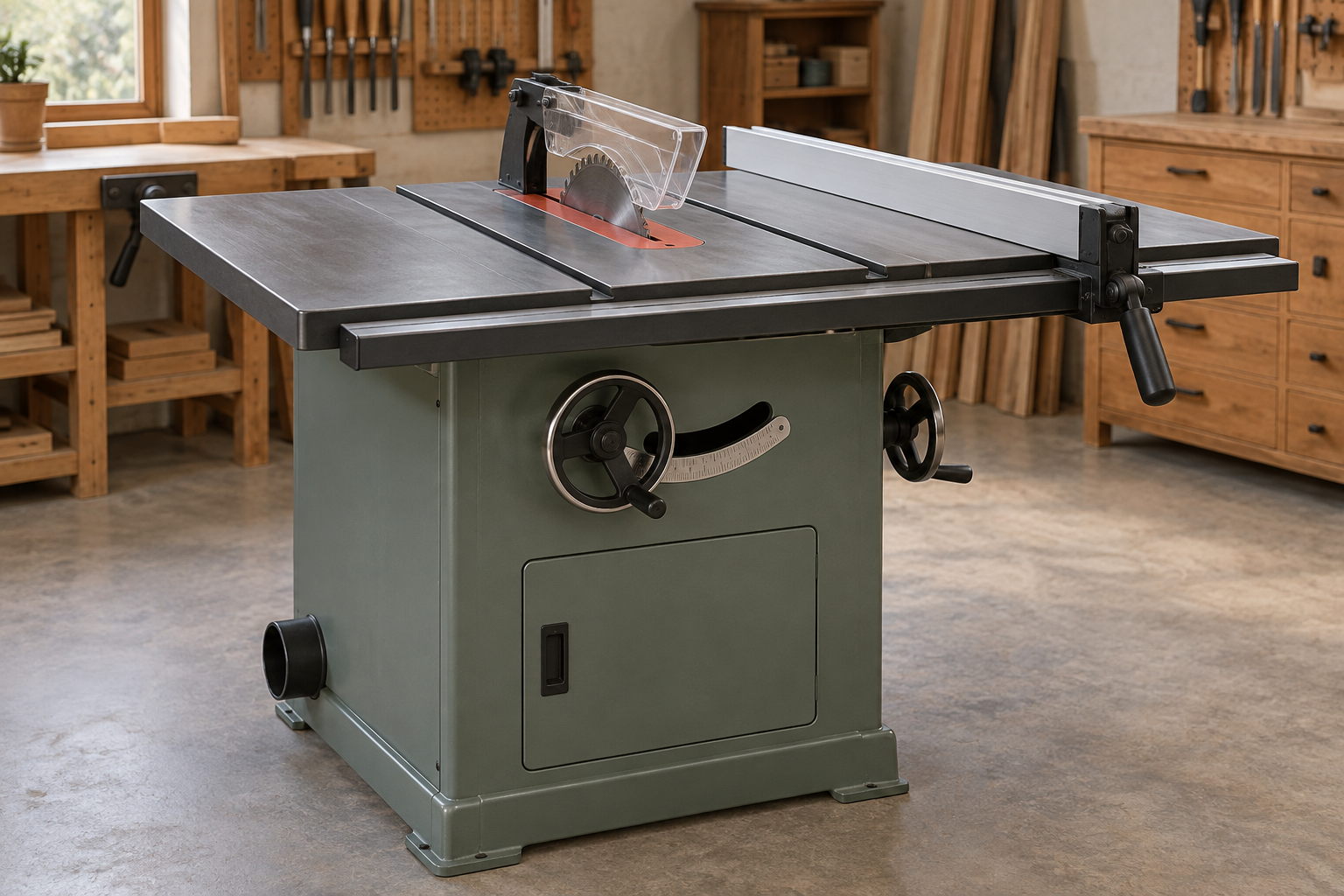
A table saw fence must keep the workpiece running parallel to the blade, but cabinetmaking puts more demand on it than ordinary crosscutting or rough ripping. You may be cutting 24- to 30-inch-wide cabinet sides, ripping long face-frame stock, trimming plywood panels, and making repeated cuts where a small change in alignment ruins a whole batch.
Fence length affects stability, support, and ease of setup. It does not directly determine cutting accuracy. A well-made 36-inch fence can be more accurate than a poorly supported 50-inch fence. The important questions are how far the fence extends in front of and behind the blade, how well the rails support it, and whether the fence stays locked without deflecting.
The Right Length for Common Cabinet Work
For most cabinet shops, a fence that supports at least 24 inches of rip capacity to the right of the blade is a practical minimum. That lets you cut common 24-inch-deep cabinet parts and many sheet-good strips without constantly moving the fence or using awkward auxiliary setups.
| Fence and rail capacity | Best use | Main limitation |
|---|---|---|
| 24-inch rip capacity | Small cabinets, face frames, shelving, narrow plywood parts | Limited for full-depth base cabinet sides and wide panels |
| 30-inch rip capacity | General cabinetmaking and most 24-inch-deep cases | Still benefits from outfeed and side support |
| 36-inch rip capacity | Frequent sheet-good work, larger cabinet parts, small production shops | Costs more and needs a stronger rail system |
| 50-inch or more | Breaking down full sheets and unusually wide components | Requires substantial space, support, and careful handling |
These figures describe rip capacity, not the physical length of the fence extrusion. A fence may be 50 inches long while providing only 30 inches of cutting capacity, depending on where it sits relative to the blade and how the rails are arranged.
How Much Fence Should Extend Past the Blade?
For normal ripping, the fence should extend several inches beyond the blade toward the outfeed side. This keeps the workpiece guided as it passes the teeth and reduces the chance of the trailing edge drifting away from the fence. About 12 to 18 inches of support behind the blade is useful for long cabinet parts, although the exact amount depends on the fence design.
More length is not automatically better. Once the workpiece has cleared the blade, extra fence behind it cannot correct poor feeding technique. Excess length can also interfere with a router table, outfeed table, or shop traffic. A 50-inch fence that projects into a walkway is a practical failure, even if its specification looks impressive.
The front portion matters as well. A fence that is too short in front of the blade may be difficult to position accurately for narrow rips. It can also leave the locking mechanism close to the blade area, making adjustments less convenient. For cabinet work, choose a system that locks firmly with the fence positioned anywhere across the normal rip range, not just at one favored location.
Choose the Rail System Before the Fence
Long capacity depends more on the rails and table support than on the fence extrusion. A 36-inch setup normally needs front and rear rails that stay straight under load. If the front rail flexes when you lean against it, the fence can move enough to change a cabinet panel by 1/16 inch or more.
Check the saw’s manual for compatible rail spacing and mounting points. Some contractor-style saws accept long aftermarket rails, while others need a substantial extension table or new support brackets. The added weight can also make a mobile saw harder to move and can change its balance.
If you need more than about 30 inches of rip capacity, plan on a stable extension table. The table should be flush with the saw surface, square to the blade, and rigid enough that a plywood sheet cannot pull it down. For sheet goods, an outfeed table support and a separate side support often improve results more than buying a longer fence.
Fence Features That Pay Off
A reliable locking mechanism is more important than a fancy face profile. Lock the fence, push sideways near the front and rear, and confirm that it does not shift. The fence should remain parallel to the miter slot or blade within the tolerance recommended by the saw manufacturer.
Replaceable faces are valuable in cabinetmaking. A straight hardwood or MDF face lets you close the gap around the blade for narrow work and attach an auxiliary face when cutting tall panels. Look for a fence that accepts standard screw-on faces rather than a permanently sealed extrusion.
Tall auxiliary faces are useful for ripping cabinet doors, panels on edge, and narrow stock with a featherboard. However, they raise the effective center of pressure and can expose weakness in the locking system. If you regularly cut parts taller than 3 or 4 inches, use a fence and rail system designed for a tall face, or add a properly supported auxiliary fence.
A table saw aftermarket fence system makes sense when the original fence slips, has limited capacity, or cannot accept an auxiliary face. It is not automatically an upgrade if the existing fence already locks squarely and your work stays within 24 inches.
When a Shorter Fence Is the Better Buy
A 24- or 30-inch system is usually enough for a one-person shop making face frames, drawer parts, narrow shelves, and cabinets from pre-cut panels. It costs less, occupies less floor space, and places less stress on a mobile saw. You can safely cut wider panels by using a track saw or circular saw to break down sheets before bringing them to the table saw.
Do not use a long fence as a substitute for sheet-goods handling. A full 4-by-8-foot panel is difficult to control against any fence without infeed and outfeed support. If the panel lifts, catches, or twists, the fence length will not prevent kickback. Use a helper, panel support, or a table saw panel support roller, and keep the fence aligned before starting the cut.
A Practical Buying Checklist
Measure your actual cabinet parts, not the largest project you might build someday. Choose at least 24 inches of capacity for basic cabinet work, 30 to 36 inches for regular plywood and casework, and more only when your shop has the support and space to use it safely.
Before buying, verify rail compatibility, extension-table requirements, fence travel, lock strength, replaceable faces, and the location of the dust hose and mobile base. Then check the fence with a straightedge and a test board. If the cut varies by more than a few thousandths over a cabinet side, correct the rail alignment and blade setup before blaming the fence length.