Best Drill Presses for Cabinet Door Hardware Installation
What's inside
As an Amazon Associate I earn from qualifying purchases. This post may contain affiliate links at no extra cost to you.
Installing cabinet door hardware is a small job that exposes every weakness in a drill press. Hinges need repeatable cup holes, handle holes must stay square to the door, and a slight positioning error can leave a door crooked or a bank of pulls visibly uneven. The best drill press for this work is not necessarily the largest machine in the shop. It is the one with enough throat depth, low-speed control, a stable table, and a quill that returns to the same position every time.
As an Amazon Associate we earn from qualifying purchases at no extra cost to you.


Contents
What Matters for Cabinet Hardware
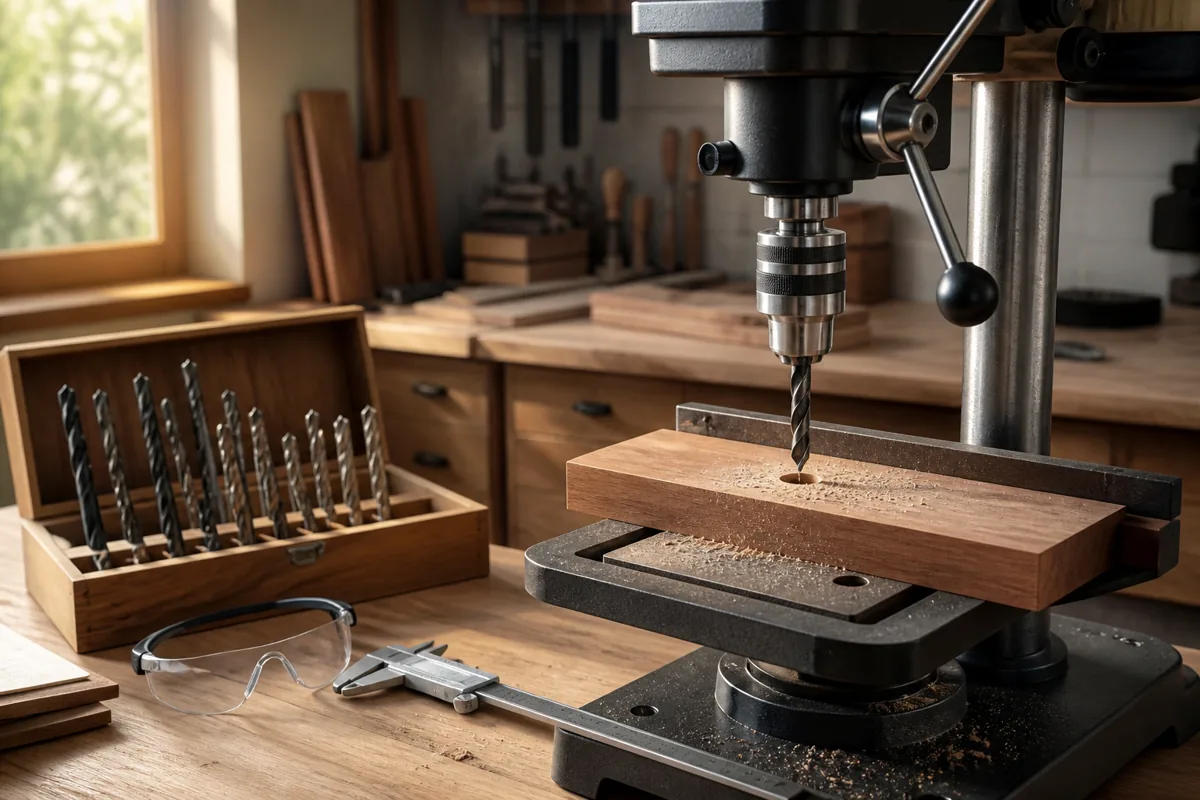
For concealed European-style hinges, you will commonly bore a 35 mm cup hole about 12 to 13 mm deep. The drill press must accept a Forstner bit or hinge boring bit and let you set a reliable depth stop. For handle and knob holes, the requirements are less demanding, but the chuck still needs to hold a small twist bit without noticeable wobble.
Look for a machine with at least 8 inches of swing. That gives roughly 4 inches from the bit center to the column, enough for most doors when the work is positioned carefully. A 10- or 12-inch benchtop press is more comfortable, especially for wide doors or long jigs. More swing does not automatically mean more accuracy, though. A stiff column and properly adjusted quill matter more than a large capacity number.
Variable speed is useful because a large Forstner bit should run much slower than a small twist bit. For a 35 mm cutter in hardwood, a practical starting range is about 500 to 800 rpm. A 3 mm or 1/8-inch bit may run around 1,500 to 2,500 rpm, depending on the material and bit. Do not rely on a single high-speed setting intended for general drilling.
Best Drill Press Types for the Job
| Type | Best use | Advantages | Limitations |
|---|---|---|---|
| Compact benchtop | Occasional hinge and handle installation | Low cost, small footprint, adequate for most doors | Less throat depth, lighter table and column |
| 10- to 12-inch benchtop | Regular cabinet work and shop use | Better reach, stronger quill, more stable setup | Costs more and needs a solid bench |
| Floor-standing | Production work or large doors | More capacity, stand-alone height, usually better adjustment range | Expensive, heavy, excessive for occasional hardware |
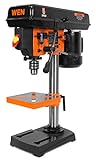
For most homeowners and small cabinet shops, a quality 10- or 12-inch 10- or 12-inch benchtop drill press is the sensible choice. A compact 8-inch press is fine if you are installing hardware on a few doors and already have a stable bench. The cheaper option becomes frustrating when the table flexes, the quill has excess play, or the door cannot reach the bit without awkward repositioning.
A floor-standing press is worthwhile when the machine will also drill joinery, metal parts, or large panels. It offers more working height and often a larger table, but it does not guarantee better hinge placement. If your main task is cabinet doors, spend first on a good bit, a reliable jig, and a machine with a usable depth stop.
Features Worth Paying For
A rack-and-pinion table adjustment is convenient when changing from a small drawer front to a wide door. The table should lock firmly at the column and should not rotate when pressure is applied. If the table has a small surface, add a flat sacrificial board or auxiliary fence, but make sure it is clamped and cannot contact the spinning bit.
The quill should move smoothly with minimal side play. With the machine unplugged, lower the quill and gently push it sideways. A slight amount of movement may be adjustable; obvious looseness will show up as oversized or ragged holes. Check the chuck as well. A keyed chuck is often inexpensive and secure, while a keyless chuck is faster for repeated bit changes. Either is acceptable if it grips small bits concentrically.
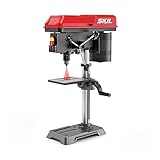
A positive depth stop is essential for hinge cups. Threaded stops are simple and dependable. Graduated scales are useful for setup but should not be treated as precision instruments until checked against a rule. Some presses have laser guides, but these are helpful only for rough alignment. A physical fence, stop block, or boring jig is more accurate.
Choose a 35 mm cabinet hinge boring bit designed for a drill press. Cheap bits can cut a usable hole, but dull cutters generate heat and may tear the back side of the door. A backing board under the work reduces breakout, although a hinge cup hole is normally stopped before it passes through.
How to Set Up the Press
Make a test hole in a scrap piece matching the door thickness. Set the depth stop so the bottom of the cup leaves at least 2 to 3 mm of material. Confirm the hinge fits before drilling the actual doors. This catches both depth errors and mistakes in the jig or bit diameter.
For consistent placement, use a hinge-boring jig or a shop-made fence with a stop block. Mark the door’s top and hinge side clearly. Clamp the door flat, keep the finished face oriented consistently, and use the same reference edge for every door. A 1 mm change in the distance from the edge can be visible across a row of cabinets.
For knobs and pulls, a cabinet hardware drilling jig is usually more valuable than a larger press. Drill a small pilot hole first, then follow with the final bit if the hardware requires a larger opening. Clamp a scrap board behind the door to prevent splintering as the bit exits.
Common Failure Modes
Drilling too fast overheats large bits and can burn the door surface. Forcing the quill causes the bit to wander and can tear veneer. A loose table lets the hole shift as pressure changes. A door held by hand can spin or lift when the cutter catches, so clamp the work or use a properly supported jig.
Before buying, check that the machine’s minimum speed is low enough for a 35 mm cutter, its quill travel is sufficient for the hinge depth, and its table accepts clamps. If those three details are right, a modest benchtop drill press will install cabinet hardware accurately. If they are wrong, extra horsepower and a taller stand will not fix the underlying problem.