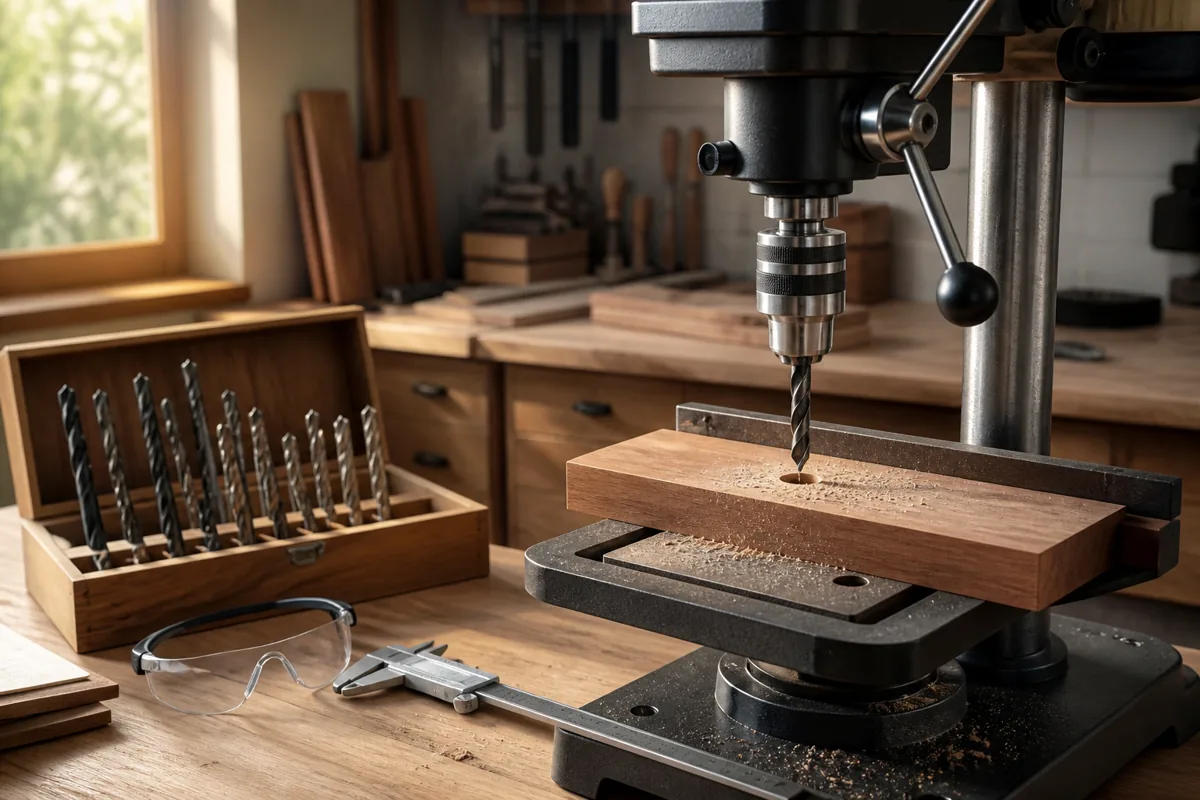
Best Drill Presses with Quill Travel for Deep Joinery
What's inside
As an Amazon Associate I earn from qualifying purchases. This post may contain affiliate links at no extra cost to you.
For deep mortises, long holes, and thick workpieces, quill travel determines how far the drill press spindle can descend in one stroke. A press with short travel may force you to reposition the table or workpiece mid-hole, increasing the chance of a stepped bore or a wandering bit. But maximum travel alone does not make a press suitable for joinery: throat depth, spindle runout, speed range, and table support matter too.
Contents
What quill travel means for joinery
Quill travel is the distance the spindle moves down when you lower the feed handles. Many benchtop presses offer roughly 2 to 3 inches; larger floor presses commonly provide about 3 to 6 inches. Check the manufacturer’s specification rather than judging by press height or handle length.
For a deep hole, the useful depth is less than the stated travel. A long bit needs some of its fluted length inside the chuck, and the point starts above the work surface. If you need a clean 4-inch bore in a thick blank, a press with 4 inches of travel may still require a reset—or may not have enough clearance for the bit and workpiece together. Measure the full setup before buying.
A reset is not automatically a problem. For ordinary through-holes, raising the table or shifting a firmly clamped workpiece can be perfectly adequate. It becomes a liability when the hole must stay straight and coaxial, such as a deep dowel hole or a bore approached from both ends.
Compare press types
| Type | Typical travel range | Best fit | Main trade-off |
|---|---|---|---|
| Benchtop drill press | About 2–3 in. | Small parts, shallow holes, occasional deeper work with careful resets | Limited travel and table capacity; often easier to move and less expensive |
| Floor drill press | About 3–6 in. | Thick stock, deep bores, larger workpieces | Costs more and takes up floor space; a long quill does not guarantee low runout |
| Radial-arm drill press | Varies by model | Large panels or work that needs extra reach | More adjustable, but the extended arm can flex; lock it securely before drilling |
These are broad ranges, not promises about any particular machine. Two presses with the same travel can behave quite differently under load. Look for a rigid column, a table that locks without shifting, and a chuck and spindle assembly with low runout.
Features that matter more than a big number
Throat depth is the distance from the column to the spindle center. It limits how far into a wide board you can drill. A long-quill press with shallow throat depth may reach deeply downward but still fail to reach a hole location far from the board’s edge.
Runout and rigidity affect hole quality. Runout is side-to-side movement at the bit; excessive movement can make a hole oversize, especially with a small bit or a long boring tool. If possible, check the manufacturer’s runout figure or test a used machine with a dial indicator at the chuck. A loose quill, worn bearings, or a poorly seated chuck can spoil accuracy regardless of advertised travel.
Speed range matters for wood. A small twist bit can run faster than a large Forstner bit, which needs a slower setting to reduce heat and grabbing. Belt changes are common on traditional presses; a variable-speed mechanism is quicker to adjust but adds complexity. Use the bit maker’s guidance, and slow down as diameter increases.
Table and workholding are not optional details. A table that tilts or rotates should lock firmly, and the work must be clamped—not held by hand. A Forstner bit can catch and spin a loose workpiece hard enough to injure you. For deep joinery holes, a fence, stop block, or drill-press vise helps keep repeated setups consistent.
Choosing a press for the job
If deep joinery is occasional and your holes are within a few inches, a well-built benchtop unit can be the sensible buy. Search for a benchtop drill press for woodworking with enough throat depth and a table that locks solidly. The cheaper machine is fine when you can safely reset the work and your accuracy needs are moderate.
For frequent deep bores or thick stock, compare floor models by actual quill travel, throat depth, spindle speed range, and table size—not horsepower alone. A floor drill press with long quill travel can reduce resets, but it is a poor value if the table is cramped or the spindle has noticeable play. Confirm the maximum distance from chuck to table and from chuck to base as well; those clearances determine whether your workpiece fits.
For wide panels with holes far from an edge, consider a radial-arm style only if its extra reach solves a real layout problem. Keep the arm as short as practical and locked tightly. For many furniture shops, an ordinary floor press with a larger table is more rigid and easier to set up repeatably.
Drilling deep holes without a stepped bore
Mark the center accurately, then use a brad-point bit or a Forstner bit suited to the hole. A Forstner bit gives a flat-bottomed hole, but it generates heat and chips quickly in a deep bore. Drill in short advances and withdraw the bit often to clear chips; packed sawdust can burn, bind the cutter, or push the workpiece upward.
Set the depth stop only after accounting for the bit point and the distance from the chuck to the work. Test on scrap of the same thickness. If the quill cannot complete the depth, stop with the bit clear of the work, raise or reposition the setup, and align using the existing hole before continuing. Do not let the bit rub against the hole wall while repositioning.
For holes deeper than the bit’s effective cutting length, use a bit designed for the depth and verify that its shank fits the chuck’s capacity. Long bits flex more and amplify runout. If a hole must be exceptionally straight through thick stock, drilling from both faces to a marked centerline can help—but only with a reliable alignment method. Otherwise, the two bores may meet with a visible step.
A practical buying check
Write down the deepest hole, widest workpiece, and largest bit you expect to use. Add the bit length and required table clearance, then compare that setup with the press’s stated travel and throat depth. If the numbers leave little room for clamping or chip clearing, choose a larger machine or change the process. A press that fits the work securely is more useful than one with impressive travel on paper.