Best Drill Presses for Boring Deep Holes in Hardwood
What's inside
As an Amazon Associate I earn from qualifying purchases. This post may contain affiliate links at no extra cost to you.
Deep holes in hardwood expose every weakness in a drill press: limited quill travel, a flexible column, a slow-speed motor, poor chuck grip, or a table that cannot stay square. A machine that drills clean 1-inch holes through soft pine may struggle badly with a 3-inch-deep hole in maple, oak, or beech.
For this work, prioritize quill travel, low-speed control, spindle stiffness, and accurate depth stops over a large advertised horsepower number. A 1/2-inch chuck is usually enough for woodworking bits, but the drill press should run smoothly at roughly 250 to 600 rpm for large Forstner bits. Smaller machines can work, but they demand more frequent clearing and sharper tooling.
As an Amazon Associate we earn from qualifying purchases at no extra cost to you.

Contents
What Makes a Drill Press Good for Deep Hardwood Holes
Quill travel determines how far the spindle can descend in one operation. Many benchtop presses offer only 2 to 3 inches. That is adequate for ordinary joinery, but a 4-inch hole may require retracting the quill, adding an extension, or drilling from both sides. A floor-standing press with 3-1/2 to 5 inches of travel is more convenient and keeps the hole aligned.
Low-speed range matters more than top speed. A large Forstner bit generates substantial heat and cutting resistance. At 300 to 500 rpm, the bit can remove material without burning as quickly. A variable-speed or stepped-belt machine is preferable to a press whose lowest setting is 600 rpm.
Stiffness controls accuracy. Watch for a thick column, a table that locks firmly, and minimal play when you pull the quill sideways. A little flex becomes a wandering hole, especially when the bit is deep in the stock and packed chips increase friction.
Depth-stop design is also important. A threaded depth stop with a positive lock is much more useful than a loose collar. For repeat work, it should return to the same setting without creeping under load.
Best Drill Press Types for the Job
| Type | Typical travel | Best use | Main compromise |
|---|---|---|---|
| Compact benchtop | 2 to 2-1/2 inches | Small holes and occasional deep boring | Limited depth and lower stiffness |
| Full-size benchtop | 3 to 3-1/2 inches | Most furniture and cabinet work | Less throat depth and table area than a floor model |
| Floor-standing | 3-1/2 to 5 inches | Deep holes, large bits, and repeated work | Higher price, larger footprint, and heavier setup |
| Radial-arm drill press | Varies | Wide stock and unusual reach requirements | More adjustment points and potential alignment issues |
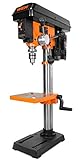
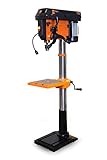
For most serious hardwood boring, a floor-standing drill press for woodworking is the safest recommendation. It gives you more room under the quill, a larger table, and generally better low-speed performance. You do not need an industrial machine, however. A solid 3/4-horsepower consumer press is enough for common 1-1/2- to 2-1/2-inch Forstner bits if you feed steadily and clear chips.
When a Benchtop Press Is Enough
A full-size benchtop press is the better value when deep holes are occasional rather than routine. It is fine for holes up to about 2-1/2 inches deep, provided the quill has at least 3 inches of travel and the workpiece fits between the chuck and table.
Choose a variable-speed benchtop drill press if shop space and budget are tight. Variable speed avoids repeated belt changes and makes it easier to slow down for large bits. The trade-off is that many electronically controlled benchtop machines have less torque at their lowest settings than a belt-driven floor press. Check that the machine can maintain speed under load.
A cheap compact press can still be the right choice for small holes, pilot holes, and dowel work. It becomes a poor choice when you regularly use bits over 1 inch, need more than 3 inches of depth, or must hold a long workpiece square without repositioning.
Bits and Drilling Technique
For deep flat-bottomed holes, use a sharp Forstner bit with a clean rim and relief behind the cutters. A bit with a center point and aggressive spurs can work, but dull spurs increase heat and leave torn fibers. For holes that pass completely through thick hardwood, a brad-point bit or auger-style bit usually clears chips better than a large Forstner bit.
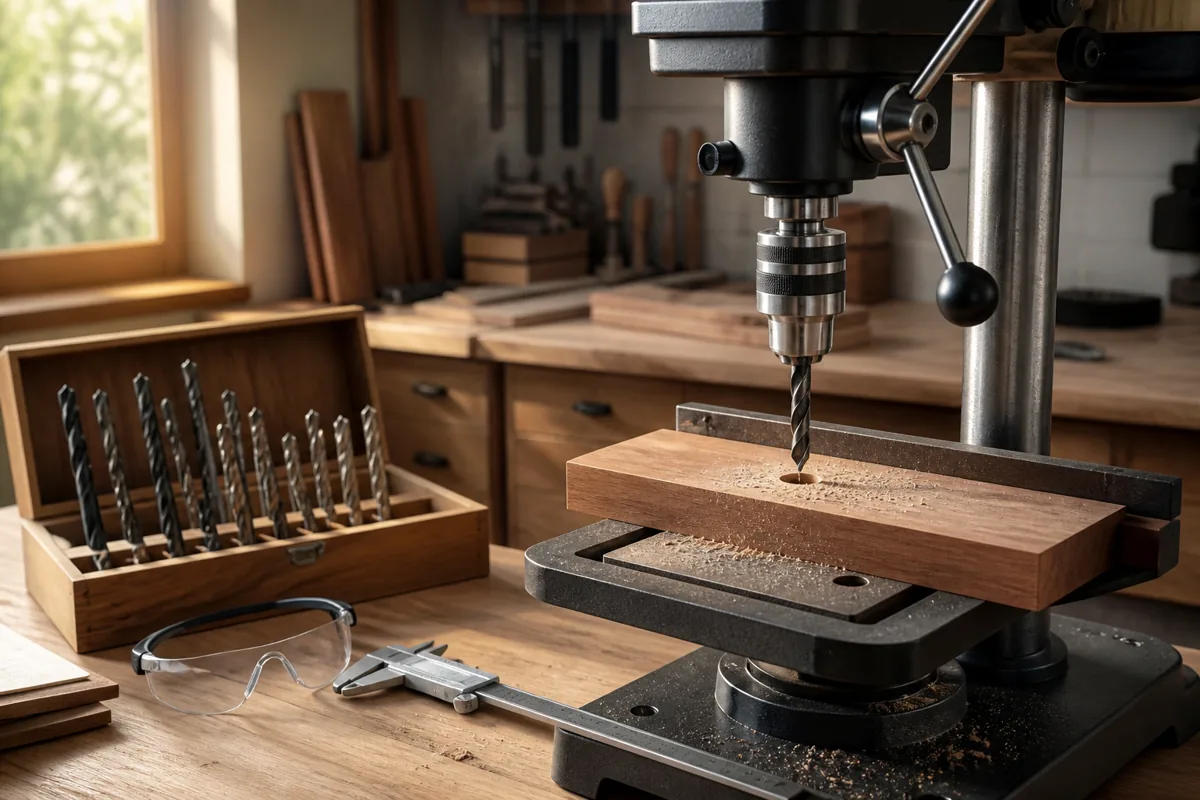
Do not attempt to plunge a large Forstner bit through several inches in one continuous feed. Drill 1/4 to 1/2 inch, then retract the bit fully to clear chips. In dense maple, retracting every 1/4 inch may be necessary. Packed chips can seize the bit, scorch the hole, or stall the motor. If smoke appears, stop immediately; increasing feed pressure usually makes the damage worse.
Set the speed according to bit diameter. As a practical starting point, use about 1,500 rpm for a 1/2-inch bit, 750 rpm for a 1-inch bit, and 300 to 500 rpm for a 2-inch bit. These are starting points, not rules. Harder wood, duller cutters, and deeper holes require slower speeds and more frequent clearing.
Setup and Alignment
Clamp the workpiece whenever possible. Hand pressure is not enough to control a large bit, and a Forstner bit can grab suddenly as it breaks through or encounters a knot. Support long stock with an auxiliary stand so the piece cannot sag and tilt the hole.
Use a sacrificial board under through-holes to prevent blowout. For very deep blind holes, mark the required depth on the bit with tape, but rely on the press depth stop for repeatability. Check that the table is square to the spindle with a reliable square before drilling. A table that is only a few degrees off can produce a hole that exits noticeably out of position.
If the hole is deeper than the press’s quill travel, do not force the quill beyond its stop. Retract, raise the table or reposition the workpiece carefully, and verify alignment with a test piece. For a hole that must be perfectly straight over a long distance, a boring machine or guided router setup may be more appropriate than an inexpensive drill press.
Buying Checklist
Look for at least 3 inches of quill travel, a lowest speed near 300 rpm, a keyed chuck with minimal runout, a rigid column, and a table that tilts only when you deliberately release its lock. A quality Forstner bit set for hardwood is a better upgrade than chasing extra horsepower.
Before buying, measure the largest stock you expect to drill and compare it with the machine’s throat depth and maximum height. For occasional deep holes, a sturdy benchtop model plus sharp bits is economical. For repeated boring in thick hardwood, pay for the floor-standing machine: its extra travel, mass, and low-speed control reduce both work time and ruined parts.