Best Planers for Consistent Thickness Across Wide Boards
What's inside
As an Amazon Associate I earn from qualifying purchases. This post may contain affiliate links at no extra cost to you.
Contents
What a planer can—and cannot—do
A thickness planer makes the two faces of a board parallel, reducing the board to a chosen thickness. It does not reliably flatten a bowed, twisted, or cupped board on its own. A planer follows the face resting on its bed, so an uneven underside can come out the same shape, only thinner. Flatten one face first with a jointer, a router sled, or a planer sled; then plane the opposite face.
For wide boards, capacity is only one part of the decision. Check the maximum cutting width, maximum and minimum thickness, cutterhead type, bed support, dust collection needs, and how much space you have for long infeed and outfeed. A board that fits through a machine can still be difficult to feed safely if it is long, heavy, or badly supported.
As an Amazon Associate we earn from qualifying purchases at no extra cost to you.


Choose a planer type for your stock and workload
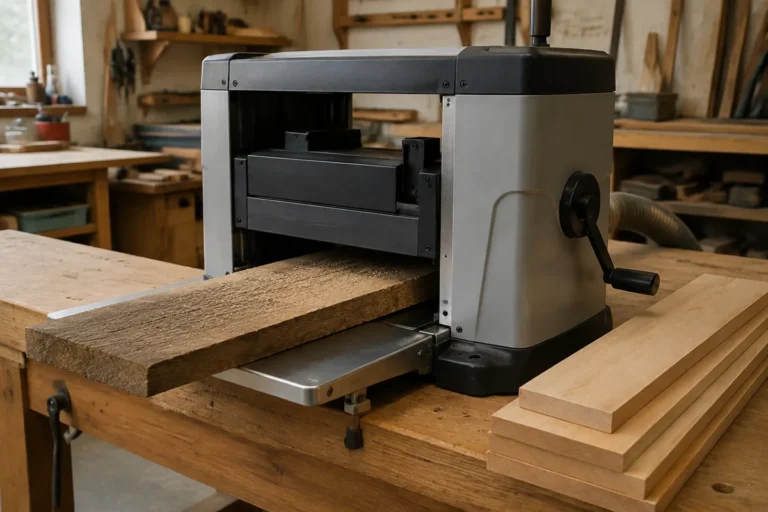
Benchtop planers are the practical choice for most home shops. Many handle boards about 12 or 13 inches wide and up to roughly 6 inches thick. They are portable compared with floor-standing machines, but they can be loud, need strong dust collection, and may need extra bed support to control snipe. If your stock regularly exceeds their width capacity, a larger machine or a different milling plan is necessary.
A floor-standing planer is worth considering for frequent work, heavier stock, or wider boards. Typical capacities vary; some machines accept boards around 15 inches wide, while larger industrial units handle substantially more. The gains are usually more mass, better support, and greater capacity—not a guarantee of flawless finish. Check the electrical requirements, machine weight, cutterhead cost, and whether the shop can accommodate the footprint.
For a budget-conscious shop that planes only occasionally, a benchtop thickness planer is often enough. If wide stock is the normal workload, compare 15-inch stationary planers rather than buying a smaller machine you will immediately outgrow.
Compare the main buying choices
| Choice | Best fit | Main trade-off |
|---|---|---|
| Benchtop, straight knives | Occasional use and moderate-width boards | Lower entry cost; knives need sharpening or replacement, and tear-out can be more noticeable |
| Benchtop, helical-style cutterhead | Regular use where finish and quieter cutting matter | Higher purchase price; individual inserts can be rotated or replaced, but they still cost money |
| Floor-standing planer | Frequent milling, heavier stock, or greater capacity | More space, weight, power, and upfront cost |
“Helical” is used loosely in product listings. Compare the actual cutter arrangement, insert availability, and replacement cost rather than relying on the label. A straight-knife planer can produce good work with sharp knives and careful feeding; an insert-head machine is not automatically the better value for occasional use.
Features that matter on wide boards
A wider board places more demand on the cutterhead and feed system. Look for consistent feed speed, a stable table, solid extension support, and a depth scale that is easy to read. A two-speed feed can be useful: a slower rate usually improves finish, while a faster rate saves time on rough dimensioning. A scale is a starting point, not a substitute for measuring the board with calipers or a reliable thickness gauge.
Check the permitted cut depth at the width you plan to plane. Removing 1/16 inch from a wide, hard board in one pass may overload a small machine, even if the same cut is manageable on a narrow piece. Start around 1/32 inch or less on difficult stock, listen for bogging, and take lighter cuts if the motor slows, the surface tears, or the board stops feeding smoothly. Follow the manual’s limits.
Knife adjustment and dust handling affect day-to-day use. A clogged chute can leave chips trapped between the board and cutterhead, damaging the surface or stressing the feed. Connect a suitable dust collector, keep the hood clear, and avoid running a planer without the required guarding. A shop vacuum may not move enough air for some machines, especially with long or narrow hoses.
Control snipe, tear-out, and thickness variation
Snipe is a shallow dip near one or both ends, often caused by the board lifting or pressing down as it enters or exits. Support long boards level with the planer bed, and raise or lower extension tables as the manual directs. Feed a second board close behind the first, without touching, if the machine permits it. Expect to trim a small amount from the ends when the project allows; do not depend on a planer to eliminate snipe in valuable finished-length stock.
For figured maple, reversing grain, or other tear-out-prone wood, take shallow cuts and try the slower feed setting if available. A sharp cutterhead helps, but severe tear-out may remain. If the surface will be visible, allow thickness for sanding or scraping after planing rather than trying to remove deep defects with increasingly heavy cuts.
Measure at several points across and along the board. A planer can leave a slight ridge or variation if knives are unevenly set, inserts are damaged, or the board is not supported. Rotate or replace a damaged insert according to the manufacturer’s instructions; with straight knives, correct alignment is essential. Unplug the machine before inspecting or servicing the cutterhead.
A practical buying checklist
Before choosing, measure your widest finished board and add a margin for rough stock; verify the machine’s stated capacity rather than assuming the advertised size is usable for every cut. Confirm the thickness range, electrical circuit, dust-port size, and available replacement knives or inserts. If the machine will stay in one place, include room for safe infeed and outfeed—often several feet in both directions for long boards.
Pay extra for capacity or an insert cutterhead only when your workload justifies it. For occasional boards within benchtop capacity, a basic machine with sharp knives, good support, and careful shallow passes can deliver consistent thickness. For repeated wide-board work, the cheaper machine’s limited width, lighter construction, or slower workflow may cost more in frustration than the initial savings. Compare replacement knives and cutterhead inserts before buying, since ongoing parts availability is part of the machine’s real cost.