Best Planers for Processing Rough Boards Up to Twelve Inches Wide
What's inside
As an Amazon Associate I earn from qualifying purchases. This post may contain affiliate links at no extra cost to you.
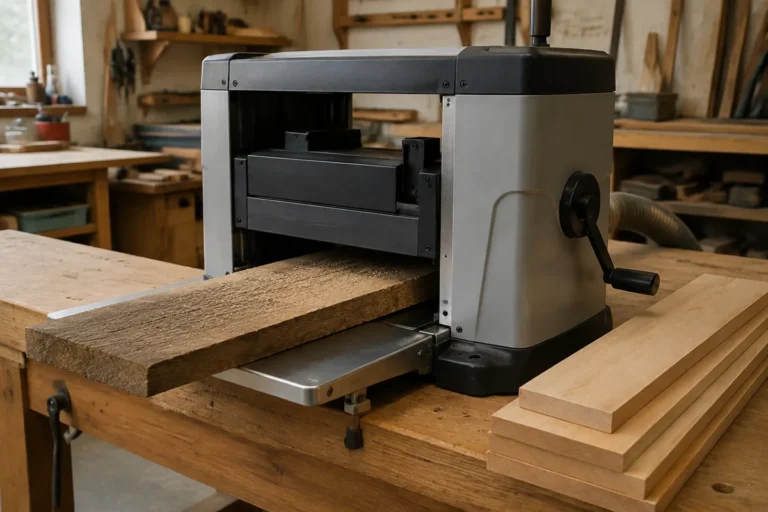
Planing a rough board that is nearly 12 inches wide is a sizing problem before it is a machine problem. Many portable thickness planers have a 12- to 13-inch capacity, but that rating leaves little room for a board that is bowed, cupped, or wider at one end. For repeat work near the full width, a 15-inch stationary planer is more comfortable. For occasional boards that fit cleanly, a benchtop machine can be a sensible, lower-cost choice.
As an Amazon Associate we earn from qualifying purchases at no extra cost to you.


Contents
What a planer can—and cannot—do
A thickness planer makes one face parallel to the opposite face. It does not reliably flatten a cupped or twisted board: if you feed a twisted board through, the rollers press it flat temporarily, and the knives reproduce the twist as the board springs back. Flatten one face first with a jointer, a router sled, or a planer sled; then plane the other face to thickness.
Check the machine’s maximum width and maximum depth of cut, and remember that the width rating is not a promise of clean results at every setting. A 12-inch board may fit a 12-inch planer, but there is no clearance for uneven edges, and a slight angle can cause a corner to catch. Measure both ends and the middle. If the board exceeds the machine’s stated capacity anywhere, don’t force it through.
Compare planer types
| Type | Typical width capacity | Best fit | Main trade-off |
|---|---|---|---|
| Portable benchtop | About 12–13 inches | Small shops and occasional wide stock | More snipe and noise; little width margin |
| 15-inch stationary | About 15 inches | Regular hardwood work and boards near 12 inches | Higher cost, weight, and space needs |
| 20-inch or wider | 20 inches and up | Wide panels and production work | Usually excessive for boards capped at 12 inches |
When a benchtop planer is enough
A benchtop planer is often the right buy if you process a few boards at a time, can keep stock within its capacity, and have a way to flatten one face. A 13-inch machine gives a little breathing room for boards up to 12 inches, but don’t treat the extra inch as permission to feed crooked or irregular stock. Portable planers commonly use two or three knives; models with a helical or segmented cutterhead cost more but can leave a better finish on difficult grain and make individual cutter replacement easier. Compare cutter replacement costs, not just the purchase price.
Take light cuts in hardwood. Start around 1/32 inch per pass, then reduce the cut if the motor labors or the surface tears. Deep cuts can overload a compact machine, leave ridges, or trip the breaker. Keep the board moving steadily, and support long stock level with the planer bed to reduce snipe—the deeper cut at the leading or trailing end. Sacrificial boards before and after the workpiece can help, but they do not fix poor infeed and outfeed support.
Look for a stable stand or a bench that will not move under load, accessible height adjustment, and a dust port that matches your extractor. Planers eject chips quickly; a shop vacuum can clog on continuous heavy cuts, so a dust collector is preferable if you plane much stock. For a compact setup, compare 13-inch benchtop thickness planers by capacity, cutterhead type, and available knives.
When to step up to 15 inches
If your usual boards are 10 to 12 inches wide, a 15-inch planer is the more forgiving choice. The added width gives room for uneven edges and future projects without jumping to a machine built for wide panel production. Stationary machines are heavier and generally more expensive, but their mass, longer beds, and larger cutterheads can make repeated hardwood work less fussy. Verify the machine’s actual maximum cut and the capacity of your electrical circuit before buying; larger motors may require a dedicated circuit or a different supply.
For a small professional shop or a serious hobbyist who regularly planes hardwood, this is the practical middle ground. Compare 15-inch stationary thickness planers with attention to cutterhead options, replacement knife availability, bed length, and whether a mobile base is included. A helical head can reduce tear-out and make maintenance less disruptive, but it is not a cure for poor grain direction or an overly deep cut.
Buying checklist
Before choosing, check the width of the widest board you actually expect to process, including any taper or rough edge. Allowing a few inches of spare capacity is useful; buying a 20-inch machine just to plane 12-inch boards usually is not. Check the machine’s maximum thickness as well, especially if you work with thick slabs, and confirm that its feed rate and bed arrangement suit your stock lengths.
Knife changes matter in daily use. Straight knives can be inexpensive to replace, but sharpening and setting them evenly takes care. Some portable machines use disposable or reversible knives, which simplify changes but can add up. Segmented cutterheads may cost more up front and use many small inserts, so price replacement inserts and confirm they are readily available. A damaged insert can leave a narrow line along the board.
Safer, cleaner results
Inspect rough stock for nails, staples, stones, and loose bark before it reaches the cutterhead. Metal can damage knives and become a projectile. Keep hands clear of the infeed opening, use the manufacturer’s chip collection setup, and wear hearing protection: portable planers are loud enough that extended use without protection is a poor trade.
Take two or more moderate passes rather than trying to remove a large amount at once. If the board chatters, stalls, or produces heavy tear-out, stop and check the cut depth, grain direction, support, and knife condition. For boards close to 12 inches wide, the buying decision is straightforward: choose a capable benchtop planer for occasional, well-prepared stock; choose a 15-inch stationary planer when that width is routine and you want margin rather than a machine operating at its limit.