Best Planers with Quiet Cutterheads for Residential Workshops
What's inside
As an Amazon Associate I earn from qualifying purchases. This post may contain affiliate links at no extra cost to you.
Contents
Why the cutterhead matters
A planer’s cutterhead affects noise, finish, and how well the machine handles figured or difficult grain. Traditional straight knives strike the wood across the full cutter width at once. That produces a sharp, high-pitched impact and can leave tear-out where grain reverses. Helical and segmented insert heads cut progressively with small carbide edges, usually reducing the harshness of the cut and making damaged edges easier to deal with.
“Quiet” is relative. A quieter cutterhead does not make a planer suitable for late-night use in a shared-wall home: the motor, dust collector, and the wood itself still make substantial noise. Wear hearing protection, and plan for dust collection. A sound meter app can help compare machines in your shop, but readings vary with distance, room acoustics, and feed rate.
What to buy for a home shop
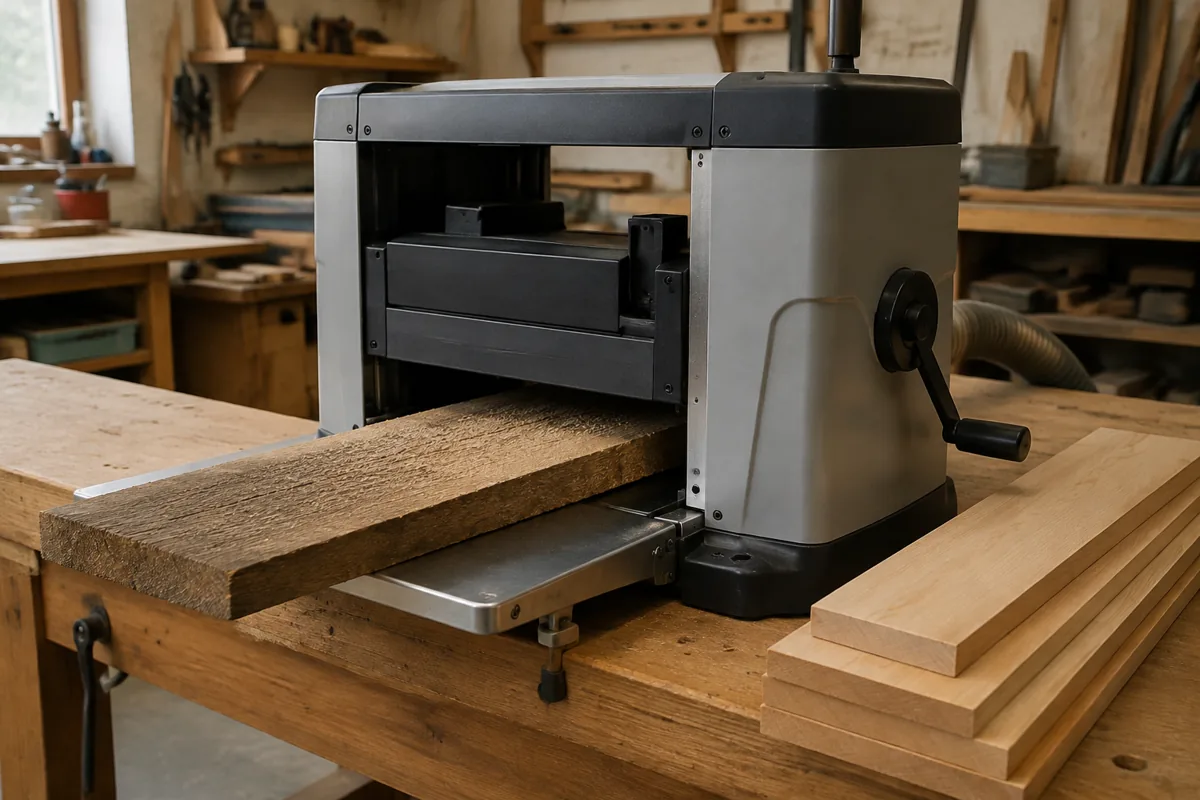
For most residential workshops, the practical choice is a 12- or 13-inch benchtop planer with a factory-installed helical-style head, or a standard straight-knife planer fitted with a compatible replacement head. Factory-equipped machines avoid the compatibility and installation questions that come with retrofits. A 13-inch benchtop planer with a helical cutterhead is a good search starting point if you need portability and commonly mill boards up to about 12 inches wide.
Choose a straight-knife planer if initial cost and easy knife replacement matter more than noise and tear-out resistance. Straight knives are not inherently a poor choice: sharp, correctly aligned knives can produce excellent results on ordinary straight-grained stock. The trade-off is more frequent sharpening or replacement, and a nick can leave a long, visible ridge down the board.
Cutterhead options compared
| Cutterhead | Typical advantage | Main trade-off | Best fit |
|---|---|---|---|
| Straight knives | Lower purchase price; knives can be sharpened or replaced | More impact noise and greater risk of tear-out | Budget shops milling mostly clear, straight-grained lumber |
| Segmented inserts | Small edges make angled cuts and can be rotated when nicked | Higher initial cost; insert changes take time | Regular use, figured grain, or a shop where harsh cutter noise is a concern |
| Replacement helical head | Can upgrade an existing planer without replacing the machine | Cost, fit, and installation depend on the exact planer | Owners of a sound machine with a compatible retrofit |
Insert heads are not maintenance-free. If one edge chips, rotate or replace the affected insert; do not keep feeding boards and accept a repeating defect. Keep a spare insert or two on hand, and confirm whether the head uses square, four-sided inserts or a different design before ordering replacements.
Match capacity to your stock and shop
A 12- or 13-inch benchtop planer suits furniture parts, shelves, and most rough lumber for home projects. Wider boards need a wider machine, glue-up strategy, or another method of flattening. Check the maximum thickness as well as width: many benchtop units handle stock several inches thick, but capacity differs by model.
These machines can draw substantial current, often around 15 amps at 120 volts. Check the nameplate and your circuit before buying; running a planer and dust collector on the same overloaded circuit can trip a breaker mid-cut. Planer weight also matters. A machine around 60–100 pounds is movable with help but awkward to lift repeatedly. If it will live on a bench, allow room for long infeed and outfeed support: a board several feet longer than the table can sag and produce snipe at the ends.
Control snipe and surface defects
Snipe is a deeper cut near the leading or trailing end of a board, often caused by the board lifting as it enters or leaves the rollers. Support long stock level with the planer bed, keep the board pressed down as it passes the cutterhead, and feed multiple pieces end to end when their thickness and length allow. If the planer has adjustable tables, set them according to its manual. Leave an extra inch or two at each end of rough stock if you can cut the ends off afterward.
Take light passes on difficult grain. A pass of about 1/32 inch is a sensible starting point for figured wood; heavier cuts can increase tear-out and strain a compact machine. Remove only enough material to reach the target thickness, and check thickness at several points with calipers. A helical head reduces the severity of some defects, but it cannot correct poor grain direction, dull inserts, excessive depth of cut, or a board that is cupped or twisted.
Retrofit or replace?
If you already own a reliable planer, first verify that a replacement head is made for its exact make and model. Bearing dimensions, drive gears, and mounting details matter; “fits 13-inch planer” is not enough. A replacement helical cutterhead for a planer can be worthwhile when the machine is otherwise in good condition, but compare the head’s installed cost with a new planer that includes one.
Retrofitting involves disassembly and careful reassembly. Unplug the machine, follow the manufacturer’s instructions, and verify that the cutterhead turns freely by hand before powering it up. If parts are seized, the instructions are unclear, or you cannot confirm compatibility, paying for installation—or buying a factory-equipped planer—is the safer choice.
A short buying checklist
Before ordering, check cutterhead type, working width, motor requirements, insert availability, warranty, and the cost of replacement knives or inserts. Also check the actual dimensions and weight: “benchtop” does not mean easy to move, and a planer needs sturdy support. For noise-sensitive homes, budget for hearing protection and a dust collector as well as the machine. If the planer will be used only occasionally on clean, straight-grained boards, an affordable straight-knife model remains a reasonable buy. If you plane regularly or work with reversing grain, a segmented head’s cleaner cuts and replaceable small edges can justify the extra cost.

